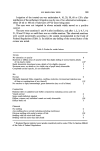
314 JOURNAL OF THE SOCIETY OF COSMETIC CHEMISTS Discard organic layers (if necessary after centrifuging). Acidify aqueous layer with hydrochloric acid 4M until pH 1. Shake with 10 ml chloroform. Discard aqueous fraction. Dry with anhydrous sodium sulphate. Evaporate chloroform. Dissolve residue in 0.25 ml chloroform. Extraction for low-level 'esterified' phenolic oestrogens (c) (4 g sample per ml extract). Mix 1 g of the sample with 20 ml ethanolic potassium hydroxide 0.5M. Boil mixture under reflux for « h. Cool, dilute mixture with 30 ml distilled water. Evaporate ethanol on a steambath. Adjust the volume to approximately 25 ml. Add 10 g of sodium chloride, shake vigorously to dissolve as much as possible of the salt. Cool to 10øC and add 0.5 g Hyflosupercel (filtering aid). Filter. Wash residue on filter with 2 x 10 ml sodium hydroxide 0.5M, which has been cooled to 10øC previously. Shake the clear combined tiltrates with 2 x 50 ml chloroform. Wait until the separation of the phases is completed (if necessary centrifuge) and discard the chloroform layers. Acidify aqueous layers with hydrochloric acid 4M to pH 1. Shake the phenolic oestrogens with 2 x 25 ml chloroform. Dry with anhydrous sodium sulphate. Evaporate the chloroform solution to 0'25 ml. Purification of extracts Two alternative column cleanup procedures were used. General column cleanup (D). Mix 2 ml of extract A (•, 1 g sample), 5 g anhydrous sodium sulphate and 3 g Hyflosupercel (filtering aid) to a homogeneous mass. Put this mixture on top of column (diameter 18 mm, glass), filled with 15 g alumina (neutral, activity II according to Brockmann). Elute successively with: fraction I: mixture of 85 ml n-hexane + 15 ml chloroform. Discard this fraction fraction II: mixture of 50 ml n-hexane + 50 ml chloroform. This fraction will contain: oestradiol-17-dibenzoate fraction III: 100 ml ethanol 96•o. This fraction will contain: oestradiol-17l•, oestrone and oestriol. Column cleanup for diethyl stilbestrol (E). Use 0.25 ml extract B (•-, 1 g sample). Put this on top of a glass column (6 cm x 7 mm), filled with 3.5 g of alumina (basic, activity IV according to Brockmann). Elute successively with: fraction I: 10 ml chloroform. Discard this fraction fraction II: 5 ml benzene. Discard this fraction fraction III: mixture of 13.5 ml acetone + 1.5 ml distilled water. This fraction contains DES. Thin layer chromatography One-dimensional thin layer chromatography (F). Ready made silica plates without fluorescent indicator, 200 x 200 mm. Solvent 1: n-hexane-ethylacetate (70: 30). Unlined tank. Solvent 2: n-hexane-benzene-ethylacetate (70: 20: 10). Unlined tank. Solvent 3: n-hexane-ethylacetate (60: 40). Unlined tank. Optimal amount of the hormonal substances: 1 [tg. Time: approximately 30 min for a 15 cm path. Visualization: mixture of anisaldehyde + sulphuric acid (98•o) + acetic acid

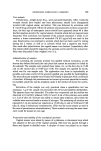
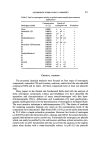
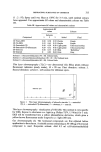
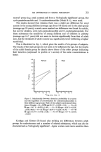
OESTROGENIC SUBSTANCES IN COSMETICS 315 (1 ' 2 - 97). Spray until wet. Heat at 130øC for 3-5 min, until optimal colours have appeared. For approximate Rf values and characteristic colours see Table III. Table III. Approximate Rf values and characteristic colours Approximate Rf values Colours Solvents Compound 1 2 3 Initial Final (1) Trans-DES 0.38 0.50 0.52 Purple Purple (2) Cis-DES 0.35 0.45 0.35 Purple Purple (3) Oestradiol-17[• 0.18 0.28 0.20 Light green Ultra-marine-blue (4) Oestradiol-17[•-dibenzoate 0.29 0.32 0.42 Light green Ultra-marine-blue (5) Oestrone 0.30 0.35 0.40 Blue 'Berlinblue' (6) Oestriol 0 0.02 0.04 Grey Grey Solvent 1: n-hexane-ethylacetate (70: 30). Unlined tank. Solvent 2: n-hexane-benzene-ethylacetate (70:20: 10). Unlined tank. Solvent 3: n-hexane-ethylacetate (60: 40). Unlined tank. Thin layer chromatography (TLC)--two dimensional (G). Silica plates without fluorescent indicator (ready made), 10 x 20 cm. First direction' solvent 3. Second direction: solvent 1. Left section for reference spots. Reference spots Rrsl --- Figure 1. Thin layer chromatography of phenolic steroids. 3 = oestradiol- 17[• 4 == oestradiol-17[•-dibenzoate 5 = oestrone 6 = oestriol. Thin layer chromatography: visualization of DES (H). This method is very specific for DES. Expose to shortwave u.v. light (e.g. Philips TUV, 15 Watt) for 3 min. DES will be transformed into a yellow phenanthrene derivative, which gives a yellow-brown fluorescence under longwave u.v. light (360 nm). Gas chromatography (I). The hormonal compounds are first silylated before application to the column. A suitable extract containing ca 50-100 Ixg of hormonal compound is used. Evaporate solvent. Add 0.2 ml N,O-bis(trimethylsilyl)
Purchased for the exclusive use of nofirst nolast (unknown)
From: SCC Media Library & Resource Center (library.scconline.org)