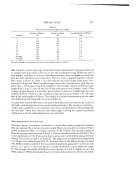
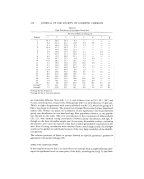
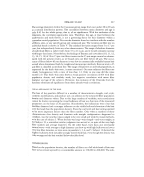
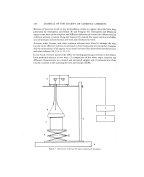
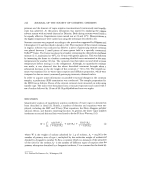
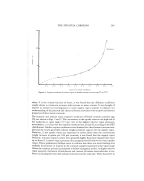
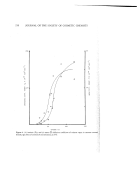
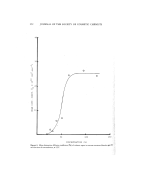
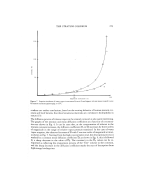
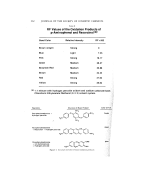
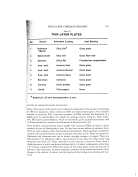
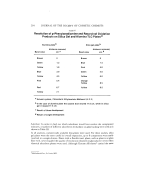
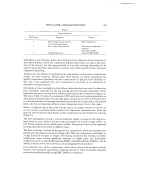
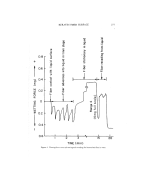
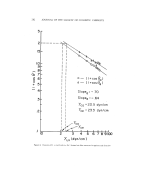
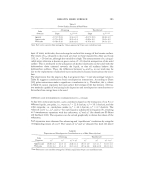
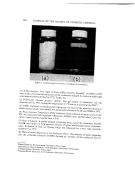
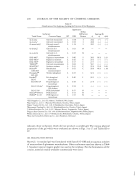
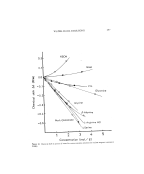
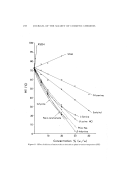
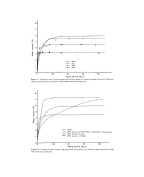
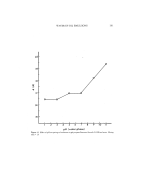
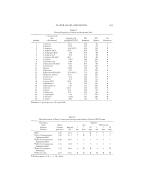
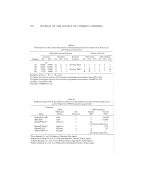
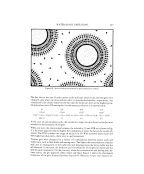
THE STRATUM CORNEUM 245 EXPERIMENTAL The gravimetric technique used to study benzene and toluene vapor sorption or de- sorption is shown in Fig. 1. The method employs a recording microbalance and stirred organic solutions to generate the required relative vapor pressure. The comeurn sample was hung on a very thin glass rod, which was suspended from the microbalance terminal (A) into a 500 ml flask containing the organic vapor system (B). The distance between the sample and the organic solution was maintained at about 1 in. To eliminate draughts, the glass rod was shielded by a glass tube, the upper end of which fitted tightly into the base of the microbalance, while the lower end was connected to a ground glass joint. The flask was placed on a small magnetic stirrer (C), which gently rotated a small magnetic bar placed in the solution. The magnetic stirrer was placed on a regular lab jack (D), which could be conveniently raised or lowered to allow quick change of flasks containing solutions of varying vapor pressures. The microbalance was placed on a specially constructed base which was secured to a stand (G). The whole set- up was placed on antivibration base (H) in a constant temperature and humidity room (23øC, 55 per cent RH). In Fig. 1, E and F depict the balance control of a Beckman*- microbalance L-600 and a chart recorder, respectively. This method was also used to examine the sotpriori, desorption, and diffusion of water vapor in keratins using satu- rated salt solutions. The salt solutions used to generate the required relative humidities at 23øC are as follows: Lithium chloride Potassium acetate Sodium iodide Sodium dichromate Copper chloride Ammonium chloride Potassium chromate Ammonium dihydrogen phosphate 11.5 per cent 21.5 per cent 38.0 per cent 54.0 per cent 68.0 per cent 78.0 per cent 87.0 per cent 93.0 per cent A flask containing drierite provided zero humidity. The partial pressure P of the or- ganic solvents was controlled by using solutions of benzene or toluene in hexadecane, the latter being essentially nonvolatile. According to Raoult's law, assuming ideality p = po X where p0 is the vapor pressure of pure benzene or toluene and X is the mole fraction of benzene or toluene in the hexadecane. The sorption experiments were carried out in the relative vapor pressure range from about 0.3 to 0.94. Lower relative vapor pressure conditions were employed in a number of cases. The stratum comeurn samples were initially dried over Drierite to obtain a base weight. The experimental approach was as follows: after drying out the comeurn, it was exposed to the organic vapor atmosphere of a given relative vapor *Beckman Instruments, Irvine, CA.

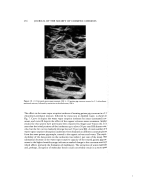
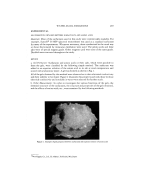
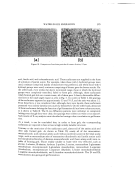
246 JOURNAL OF THE SOCIETY OF COSMETIC CHEMISTS pressure and the kinetics of vapor sorption was monitored continuously until equilib- rium was achieved. At this point, desorption was started by replacing the organic solvent system with activated charcoal or Drierite. Both drying systems were found to be equally effective. Experiments were carried out at 23 and 32øC. Measurements at the higher temperature were carried out using the technique described in (6). Stratum comeurn was prepared according to the procedure suggested by Kligman and Christopher (13) and described in detail in (14). The treatment of the stratum comeurn in organic solvents was conducted as follows: a piece of guinea pig stratum comeurn was placed between 2 small pieces of saran gauze held in a specially constructed Teflon ©* frame. The frame was placed in a beaker containing the chloroform-methanol mixture (2:1), maintained at 40øC, for 30 rain with gentle agitation. This was followed by immersing the frame in a beaker containing distilled water maintained at the same temperature for another 30 min. The comeurn was then taken out and dried at room temperature before storing it in the refrigerator. Although, no quantitative estimate was made, it was observed that the above described treatment brought about a substantial decrease in the dry weight of the comeurn (- 30 to 50). The treated cor- neum was examined for its water vapor sorption and diffusion properties, which were compared to data on intact (untreated) guinea pig corneum, obtained earlier. In order to acquire some information on possible structural changes in the comeurn samples, a preliminary SEM examination was conducted. The sample preparation for the SEM was as follows. Pieces of the stratum comeurn were mounted on stubs using transfer tape. The stubs were then placed into a vacuum evaporator and coated with 5 nm of carbon followed by 30 nm of 80:20 gold/palladium from two angles. DISCUSSION Quantitative analysis of equilibrium sorption isotherms of water vapor in keratin has been described in detail (6). Briefly, a number of theories and equations were em- ployed, including the BET and D'Arcy-Watt equations, the Flory-Huggins polymer solution theory, and Zimm's clustering function. In general, the water vapor sorption isotherms on excised skin and hair were found to fir the D'Arcy-Watt eq. (16). ' A,B,(P/P0) + C(P/P0) + DE(P/P0) (1) W = • 1 + B,(P/Po) ! E(V/Po) i O -- where W is the weight of sorbate adsorbed by 1 g of sorbent Ai = mni/N is the number of primary sites of type i, multiplied by the molecular weight of sorbate and divided by Avogadro's number N B• is a constant which is a measure of the attraction of the sites for the sorbate •v- is the number of different types of sorption sites for primary adsorption described by a Langmuir isotherm C is a constant for the linear ap- *E. I. DuPont De Nemours Co., Wilmington, DE.
Purchased for the exclusive use of nofirst nolast (unknown)
From: SCC Media Library & Resource Center (library.scconline.org)