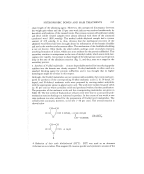
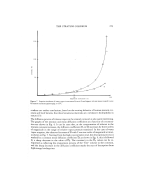
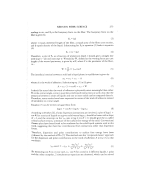
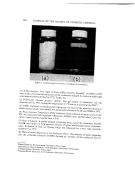
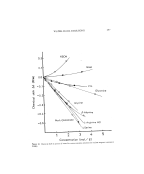
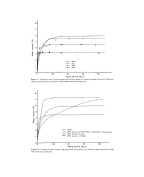
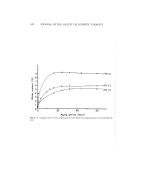
THE STRATUM CORNEUM 247 proximation to Langmuir adsorption on specific sites and D and E are constants describing secondary adsorption processes. P/P0 is the relative vapor pressure (relative humidity) of the sotbate. The results of the analysis indicate that in the low relative humidity range (0 to 30 per cent RH) sorption of water vapor occurs on reactive sites. Multilayer formation, ac- companied by extensive clustering, occurs at the high relative humidity end of the sorption isotherm. Clustering was evaluated according to Zimm's Eq. (17): 6^^ = _ ,B [0(a^/o^)] (2) v^ j PT where G^^ is the cluster integral for water molecules and V^ and a^ denote, respec- tively, the partial molar volume and the activity (relative humidity) of water. 0^ and 0B are the volume fractions of components water and keratin. Examination of the sorption/desorption isotherms showed that hysteresis is not a general phenomena in keratins, and was observed in a number of samples only. In general, the sotpriori isotherm was shown to exhibit the equilibrium properties re- quired for thermodynamic treatment. A background review of the mathematics of diffusion, and of the application of the principles developed by Crank and coworkers to the problem of water vapor diffusion in swelling keratins (for example, stratum corneum and human hair), has been given in (7). Determination of the diffusion coefficient is based on accurate measurements of the kinetics of vapor sorption or desorption in a small sheet of stratum-corneum ac- cording to the following equation: Mt M• .=0 (2n + 1) 2'•2 e -D(2n + l) 2•r2t/412 (3) where Mt denotes the total amount of diffusing substance which has entered the sheet at time t, and M• the corresponding quantity after infinite time. Equation (3) is the exact solution of Fick's basic diffusion equation, assuming a constant D, for the boundary conditions c=c0 0 (x (1 t=0 C = C• X = 0andX = 1 t ) 0 where Co is the initial concentration of water in the sheet when the surfaces (X = 0 and X = t0 are exposed to a constant concentration C• of vapor. The boundary conditions describe sorption or desorption depending on the values of Co and C•. -- A simple method based on eq. (3) for the determination of a mean value D (when D is not a constant) has been suggested by Crank (18). The value oft/12 for which Mt/M,:• =

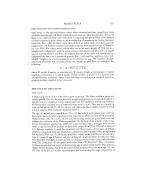
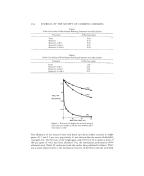
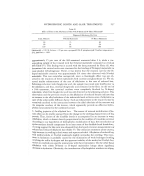
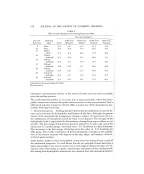
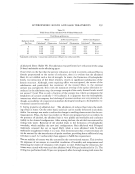
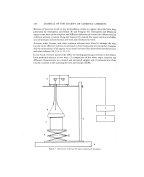
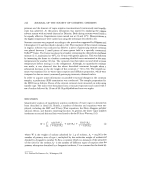
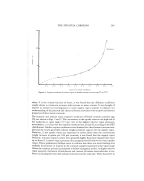
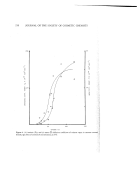
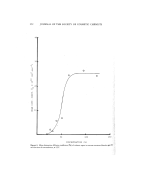
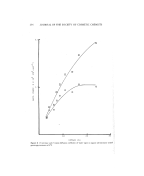
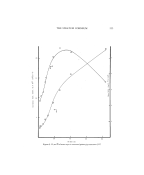
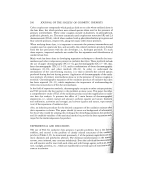
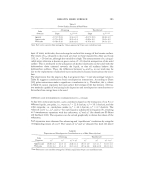
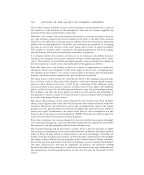
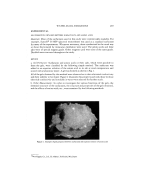
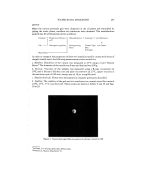
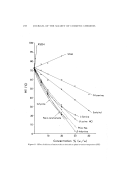
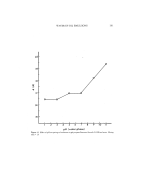
248 JOURNAL OF THE SOCIETY OF COSMETIC CHEMISTS 1/2 (designated as (t/lZ)•/2 or simply half-time) is de, termined experimentally according to the relationship • _ 0.04919 (4) (t/l 2) More accurate values for D are obtained when the average of sorption Ds and desorp- tion Dd is taken. Our findings indicate that the diffusion properties of the water vapor- stratum comeurn system can be characterized by a concentration-dependent diffusion coefficient. A detailed analysis of the behavior of the diffusion coefficient as a function of the water content in stratum comeurn shows that in highly swelling samples, a maximum is observed in the relationship between the mean diffusion coefficient (•) and water content. If the mean diffusion coefficient is corrected for swelling (intrinsic diffusion coefficient [Di]) D, - (5) (t -- V)' lOO BENZENE _ ATER 0.1 0.2 0.3 0.4 0.5 0.6 0.7 0.8 0.9 1.0 RELATIVE VAPOR PRESSURE Figure 2. Sotpriori isotherms of benzene and water vapor on female stratum corneum, age 20, at 23øC
Purchased for the exclusive use of nofirst nolast (unknown)
From: SCC Media Library & Resource Center (library.scconline.org)