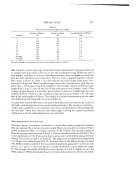
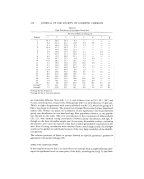
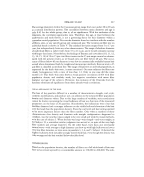
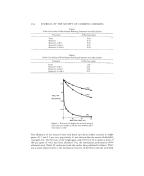
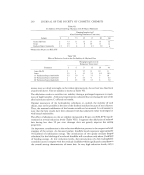
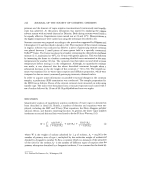
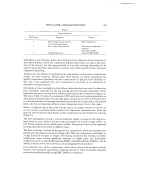
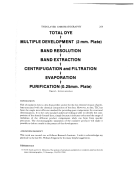
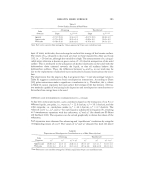
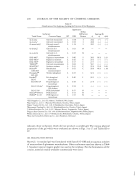
THIN-LAYER CHROMATOGRAPHY 269 TOTAL DYE MULTIPLE DEVELOPMENT (2 mm. Plate) BAND RESOLUTION BAND EXTRACTION CENTRIFUGATION and FILTRATION EVAPORATION PURIFICATION (0.25mm. Plate) Figure 3. Isolation procedure CONCLUSION TLC of oxidative dyes is a less than perfect answer for the dye chemist because of prob- lems associated with the chemical composition of the dyes. However, to date, TLC has been the single most effective method for providing pure components for structural determinations. It is the only standard analytical technique able to identify the com- position of the already-formed dyes, simply because it indicates colors and the range of mobilides of the different product components whch can form from specific precursors. The chromatographic separation of the oxidative products will make it possible to deduce trends in the pattern of dye developments. ACKNOWLEDGMENT This work was carried out at Gillette Research Institute. I wish to acknowledge my gratitude to the late Dr. William Tolgyesi for his many helpful suggestions. REFERENCES (1) R. B. Symth and G. G. Mckeown, The analysis of arylamines and phenols in oxidation-type hair dyes by paper chromatography, J. Chromatogr., 16, 454 (1964).

270 JOURNAL OF THE SOCIETY OF COSMETIC CHEMISTS (2) (3) (4) (5) (6) (7) (8) (9) (10) (11) (12) (13) (14) (15) (16) (17) (18) (19) (20) (21) (22) (23) (24) (25) (26) (27) (28) (29) I. Pinter, M. Kramer, and J. Kleeberg, Detection and determination of P-phenylenediamine in the presence of P-tolylenedmmme in hair dyes, Parfuem. Kosmet., 46, 61-4 (1965). C. J. Turi, Investigation and analysis of some cosmetics, Ann. Chim. (Rome), 49, 459 (1959) Chem. Abstr., 53, 19309. J. Desbusses and P Desbaumes, Idenufication of amines in hair dyes by paper chromatography, Mitt. Coabiete Lebensmitt. U. Hyg., 49, 335 (1958) Chem. Abstr., 1959, 53, 9580. J. H. Dannell and J. E. LuValle, Chromatographic separation and identification of photographic developers, Anal. Chem., 25 (1953). E. Sun&, Paper chromatography ofphenols,J. Chromatogr. 6, 475-80 (1961). W. H. Bryan, Gas chromatographic deterrfilnation of isomers of phenylenediamme, Anal. Chem., 36, 2025 (1964). L E. Brydia and F. Willebordse, Gas chromatographic analysis of isomeric diaminotoluenes, Anal. Chem. 40, 110 (1968). I. Prater and M. Kramer, Gas chromatographic detection and determination of some aromauc dinmines in hair dyes, Parfuem. Kosmet., 48, 126-8 (1967). I. Pinter and M Kramer, Gas chromatograph•c detection and determination of some aromatic dinmines in hair dyes, Parfuem. Kosmet., 48, 126-8 (1967). S. Goldstein, A. A. Kope, and R. Feinland, Analysis of oxidation dyes in hair colorants by thin-layer and gas chromatography, Proc. Joint Conf. on Cosmetic Sciences, Washington, D.C., 19-31 (1968). C. M. Kottemann, Two dimensional thin-layer chromatographic procedure for the identification of dye intermediates in arylamine oxidation hair dyes, J Ass Office. Agr. Chem., 49, 954 (1966). S. M. Bajo Petschen, Toxic action of some dyes which are found in hair tinctures. An. Fac. Quire. Farm. Univ. Chile, 15,192-97 (1963). Z. Krystyna and L. Bronislawa, Thin-layer chromatographic detection of basic dyes in hair dyes, Roozn. Panst. Zakl. Hig., 22,427-30 (1971). B. Uchytil, Thin-layer and high-speed liquid chromatography of the derivatives of 1,4-phenylene- dinmines, J. Chromatogr., 93,445-7 (1974). I. Pinter and M. Kramer, Simultaneous, thin-layer chromatographic detection of several dyes in cosme- tics, Parfuem. Kosmet., 50 129-34 (1969). ß I. Pinter and M. Kramer, Detection and quantitative determination of some aromatic dinmines present in hair-dyeing agents, by the use of thru-layer chromatography, Elelmiszerw'zgalati Kozlem. 12,193-200 (1966). Z. Krystyna and L. Bronislawa, Thin-layer chromatographic detection of basic dyes in hair dyes, Roozn. Panst. Zakl. Htg., 22,427-30 (1971) Chem. Abstr., 77, 1594 (1972). I. Prater and M. Kramer, The determination of some aromatic dinmines used in hair dyes by thin-layer chromatography, Parrum. Cosmet. Savons, 10, 257-60 (1967). M. Ortega, Electrophoretic study of p-phenylenediamine and its derivatives. Its employment in the analysis of hair tinctures, An. Real. Acad. Farm., 28, 99-109 (1962). .:. S. H. Newburger, A manual of cosmetic analysis, Association of Official Agricultural Chemists Inc., Washington, D.C., 1962, p. 76. T. Brouwer, Detection of p-phenylenediamine in hair dyes, C•em. Weekbl., 55,325 (1959). R. Heilingotor, Chromatographic study of the dyeing of human hair with P-phenylene&amine, Amer. Perrum. Cosmet., 83, 35 (1968). G. Sandberg, Polarograph•c investigation of fur dyes and their oxidation products, J. Soc. Dyers Colour., 72,235 (1956). M. Dolinsky, C. H. Wilson, H. M. Wisneski, and F. X. Demers, Oxidation products of P-phenylene- dinmine in hair dyes, J. Soc. Costlier. Chem., 19, 361-80 (1968). ". F. Brody and M. Burns, Studies concerning the reactions of oxidation dye intermediates, J. Soc. Cosmet. Chem. 19, 361-79 (1968). M. Airman and M. Rieger, The function of Bandrowski's base in hair dyeing, J. Soc. Cosmet. Chem., 19, 141-48 (1968). .. M. J. Shah, W. Tolgyesi, and A.D. Britt, Co-oxidation of P-phenylenediamine and resorcinol in hair dyes, J. Soc. Cosmet. Chem., 23,853 (]•972). M. J. Shah, Chromatographic and spectroscopic studies of the oxidation products of P-phenylene- diamine and resorcinol, Ph.D. Thesis, George Washington University (1•970).
Purchased for the exclusive use of nofirst nolast (unknown)
From: SCC Media Library & Resource Center (library.scconline.org)