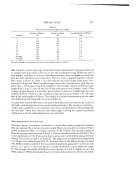
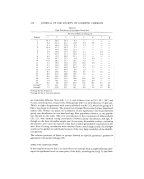
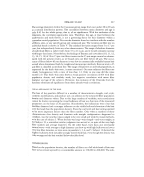
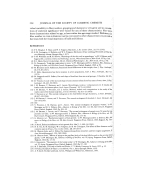
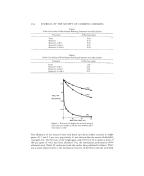
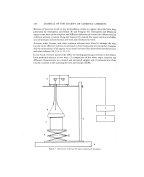
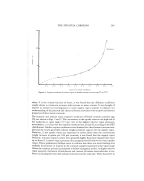
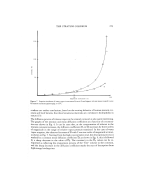
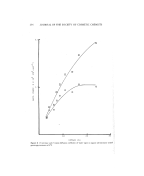
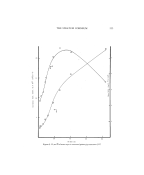
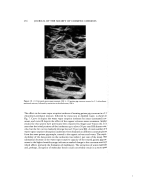
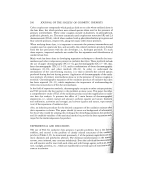
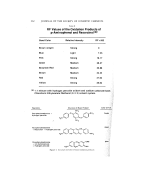
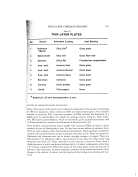
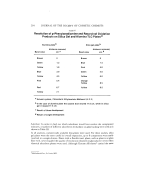
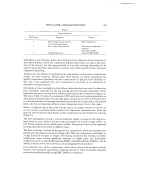
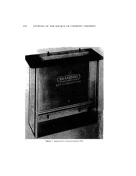
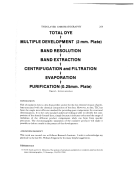
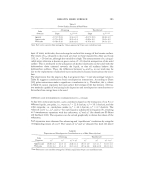
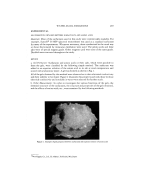
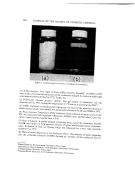
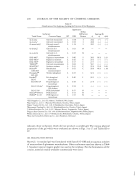
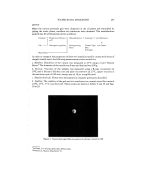
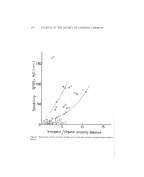
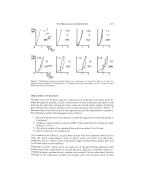
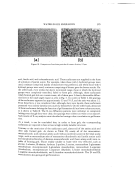
THIN-LAYER CHROMATOGRAPHY 267 Two dimensional,' Two-dimensional chromatography was most useful for compositions in which individual members differ qualitatively in their response to solvents, e.g., acidic and basic amino acids. This was not the case with oxidative dyes. Any increase in solvent activity increased the mobility of all the components. No solvent compositions was found which specifically favored slow-moving components. Continuous elution.' This method was used in order to obtain single components in sufficient amount for structural determination. Continuous elution was made in an ap- paratus* (Fig. 2). Oxidation product was applied as a band at the bottom of the plates. The lids on the developing tank were positioned to form slots 4 nm wide. Plates were allowed to stand in the solvent with the upper ends projecting into the free at- mosphere. The solvent moved and evaporated at slot levels as a continuous process, so that all components, except the undesirable polymeric uneluted product, were rede- posited at lid level as a narrow line. The plate was reversed so that the streak became the origin and developed again. Two separate functions can be achieved using this method. First, broad areas of sample can be converted into hairline streaks thus, sub- sequent runs provide better separation. Second, the running length of a plate is mul- tiplied many times, which enables even the most slow-moving fractions to be separated effectively. Continuous elution was found to be more advantageous than the repeated elution tech- nique. In addition to eliminating time-wasting multiple developments, it required no continuous attention. Furthermore, in repeated elution technique, the plate had to be dried after each step. During each exposure to air and humidity, some components un- dergo polymerization, which leaves a brown residue. ISOLATION PROCEDURE From the complex mixtures, a few components were isolated and purified for structural determination by spectroscopic methods. The procedure used is shown in Fig. 3. The total dye mixture, obtained as a solid material after filtration, was applied as a band on a 2-ram preparative plate and developed a number of times. After maximum resolu- tion was obtained, single component bands were scraped from the plate and were ex- tracted with methanol at room temperature. This extract was centrifuged to remove silica gel and then filtered to remove any remaining silica. The extracts were evaporated immediately to reduce the extent of "polymerization," and then were purified by spotting on analytical plates. This process was repeated several times. Despite all precautions, single components after 3 elution and recovery cycles consistently showed the same nonmoving residue at the origin, demonstrating the chemical sensitivity of the dyes. Although column chromatography can be used for the separation of the components in large amounts, trailing after the first few components was more severe than with thin- layer plates. For this reason, column chromatography was useful as a preliminary enrichment of components for subsequent thin-layer separation. *Shundon Southern Instrument Co., Inc., 515 Broad Str, Sewickley, PA 15143. Cat. #SAB-2852.

268 JOURNAL OF THE SOCIETY OF COSMETIC CHEMISTS Figure 2. Apparatus for continuous elution TLC
Purchased for the exclusive use of nofirst nolast (unknown)
From: SCC Media Library & Resource Center (library.scconline.org)