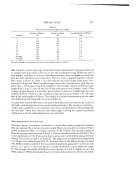
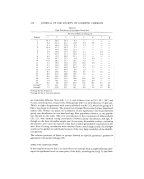
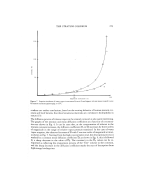
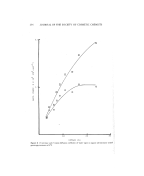
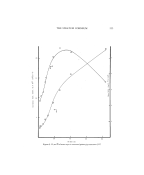
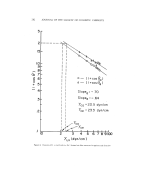
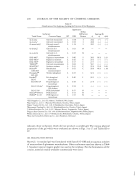
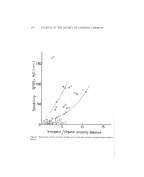
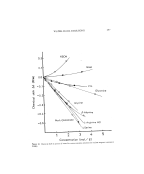
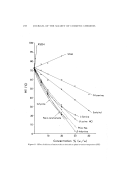
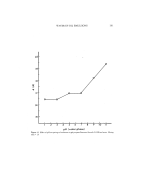
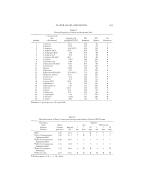
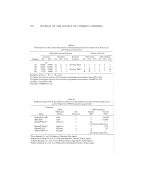
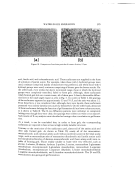
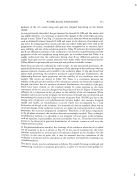
KERATIN FIBER SURFACE 275 reading in air, and Fb is the buoyancy force on the fiber. The buoyancy force on the fiber is given by Fb = lad (3) where 1 equals immersed length of the fiber, a equals area of the fiber cross section, and d equals density of the liquid. Substituting for Fb in equation (2) leads to equation (4): F,,. = w - lad (4) Therefore, a plot of Fw as a function of immersion depth 1 should give a straight line with slope (-ad) and intercept w. Wettability W, defined as the wetting force per unit length of the wetted perimeter, is given by w/P, where P is the perimeter of the fiber, i.e., W- w _7LvCOS0 (5) P ß The interfacial tension between a solid and a liquid phase in equilibrium is given by 3•s•. = 3•sv + Ylx - A (6) ß where A is the work of adhesion. Substituting eq. (1) in (6) gives A = 3'kv (1 + cos 0) = %.v + W (7) It should be noted that the work of adhesion is physically more meaningful than either W or the contact angle, since it quantifies solid-liquid interactions in such a way that the attraction between a series of liquids and one or more solids can be compared directly. ::i.. Therefore, some results have been expressed in terms of the work of adhesion instead ß ofwettability or contact angle. Equation (7) can be written in logarithmic form , • log (1 + cos 0) = log A - logg'•.v (8) According to Fowkes [6], if only dispersion interactions are involved, a plot of log (1 + cos •9) for a series of liquids on a given solid versus log 9q.v should be linear with a slope ß of -1, and the intercept on the 9'i.v axis at log 2 (cos 0 = 1) should give the so-called ß .. critical surface tension, a measure of the surface free energy of the solid. Conventional Zisman plots have been found to be nonlinear for the solid-liquid systems used in this work, suggesting that there'are contributions from interactions other than dispersion ::: for ce s, • Therefore, dispersion and polar contributions to surface free energy have been evaluated by the method of Wu [7]. This method uses the "reciprocal means" approach for the dispersion and polar contributions to the work of adhesion A in eq. (7), so that we obtain 'YLv COS •9 --'¾LV -t- 4'Ysa'YLa 4'ysP'YLP = 1- (9) 7s a + .yLd .ys P + .y•p By measuring cos •9 (or, in our case, 9'•.v cos •9) for a solid in 2 different liquids, 1 polar and the other nonpolar, 2 simultaneous equations are obtained, which can be solved

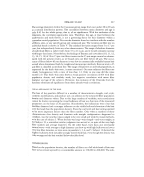
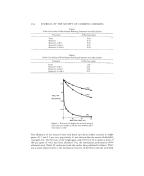
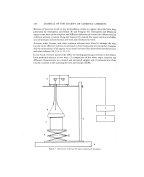
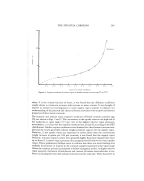
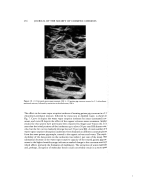
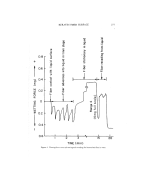
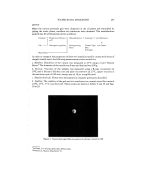
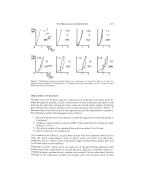
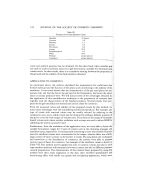
276 JOURNAL OF THE SOCIETY OF COSMETIC CHEMISTS for 'ys d and 'ys p. Values of'yL d and 'yL p for the 2 liquids must be known (for details see the original reference). Symbols "d" and "p" stand for dispersion and polar contribu- tions, respectively. EXPERIMENTAL MATERIALS European dark brown hair * has been used throughout this work. The hair was cleaned by extraction with methylene chloride followed by exhaustive rinsing with distilled water. All specimens were conditioned at 65 per cent RH and 70øF. Water used in this work was distilled twice in an all-glass apparatus. For preparing water-butanol soluti9ns analytical reagent grade n-butanol was used. These solutions were prepared according to the method of Shuyten et al. [8], and their surface tensions were measured by the standard capillary rise method. Fischer purified reagent grade methylene iodide was redistilled under vacuum (38øC, -2 mm Hg). Hydrogen peroxide-I- for oxidation was electronic grade. Dithiothreitol used in reduction was ob- tained from Calbiochem.• WETrINO FORCE ME^SUKE•ENTS The apparatus for the wetting force measurements has been described elsewhere [5]. It consists of an electrobalance and a microscope stage for raising and lowering the liquid level. The fiber is glued to a small wire hook mounted on the beam of the balance and counterbalanced in air. The liquid level is raised to immerse the fiber !mm at a time up to an immersed length of 5 min. The fiber is then allowed to remain immersed in the liquid for •15 rain during which time the force on the electrobalance reaches a constant level. Advancing wetting forces at immersion depths of 1-5 mm and the force after it has reached a constant level are read from the chart. All measurements were made in an environment of 65 per cent RI-I and 70øF. Perimeters of the fibers were determined microscopically. Values of the perimeters calculated from the major and minor axes of the elliptical cross section have been found to agree with the actual measured values within -3 per cent. Electron micrographs were made with a scanning electron microscope. *•' Fiber specimens were coated with gold prior to microscopic examination. RESULTS AND DISCUSSION WETTING BEHAVIOR OF HAIR-WATER SYSTEM The recorder trace obtained in a typical measurement of wetting force is shown in Fig. 1. At the first contact with the water surface, an upward (negative) force is experienced *De Meo Brothers, New York, N.Y. 'l'Lehigh Chemical Co., Eastern, PA 18042. g. Calbiochem, LaJolla, CA 92037. **JEOL, Japan.
Purchased for the exclusive use of nofirst nolast (unknown)
From: SCC Media Library & Resource Center (library.scconline.org)