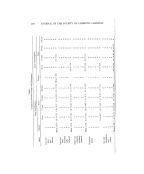
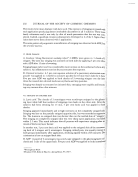
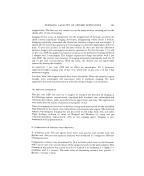
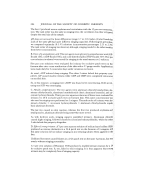
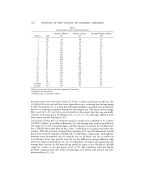
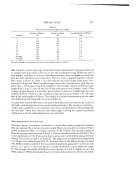
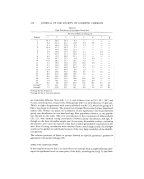
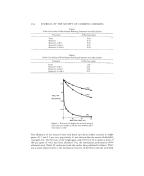
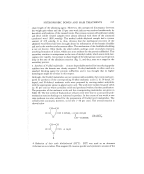
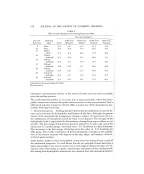
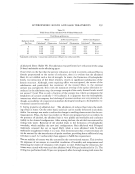
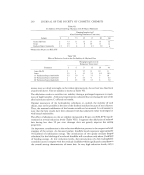
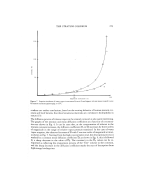
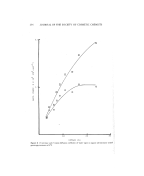
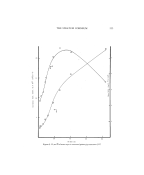
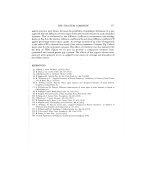
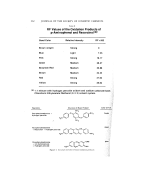
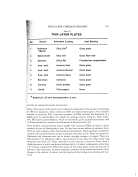
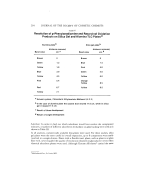
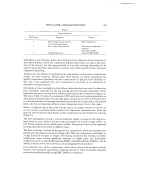
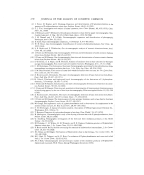
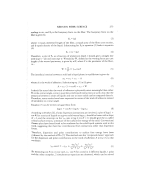
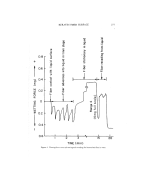
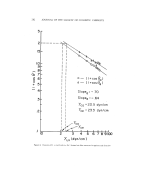
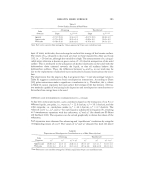
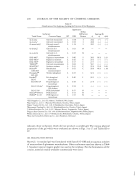
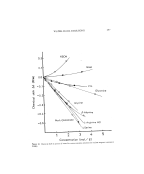
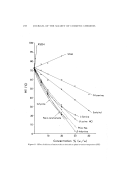
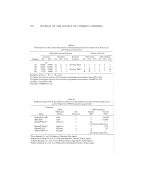
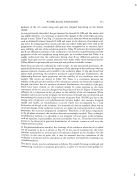
KERATIN FIBER SURFACE 283 Table II Critical Surface Tension of Hair Fibers Scale Advancing "Equilibrium" direction Slope %,,• ., •.,m Slope Ignored -0.72 +- 0.03 19 4 _-+ 1.0 -0.67 + 0.16 24.8 _+ 3.9 Against scale -0.75 -+ 0.09 20 9 --- 2.4 -0.68 - 0.11 26.0 -+ 6.9 With scale -0.78 -+ 0.10 20.0 --+ 2.0 -0.70 --+ 0.11 24.9 _+ 3.0 Note: Each entry is an interfiber average for 5 fibers reported at 95 per cent confidence level. layer of water molecules, thus reducing the surface free energy of the keratin surface. The values of 3'c• obtained in this work are close to those reported by Alter and Cook [15], i.e., -26 dyn/cm, although the variability is high. The measurement of% using al- cohol-water solutions is known to give a value of -26 dyn/cm irrespective of the solid surface. This is attributed to the adsorption of alcohol molecules on the solid with the hydrocarbon chain oriented towards the liquid, so that all surfaces behave like hydrocarbon surfaces. Thus, the difference between %'a and 3'c• in our work may be due to the replacement of adsorbed water molecules by butanol molecules at the inter- face. The observation that the slopes in Fig. 4 are greater than - 1 (see also average values in Table II) suggests contributions from nondispersion interactions. According to Dann [16], polar interactions make a significant contribution to %,. Therefore, the %. values in Table II cannot represent the total surface free energy of the hair keratin. Alterna- tive methods capable of evaluating both dispersion and nondispersion contributions to the surface free energy have to be used. DISPERSION AND NONDISPERSION CONTRIBUTIONS TO 3',. or HAIR As has been mentioned earlier, such a method is based on the evaluation of cos 0 in 2 different liquids, one polar, i.e., water (%) = 22.0 dyn/cm, %)' = 50.5 dyn/cm), and the other nonpolar, i.e., methylene iodide (%) = 44.1 dyn/cm, 3q. •' = 6.7 dyn/cm). The values of cos 0, %.v, %), and %)' for each liquid is substituted in equation (9), resulting in 2 simultaneous equations with the unknowns, 3,.• • and 3'•"(for details see E1-Shimi and Goddard [13]). The equations can be solved graphically to obtain the values of the unknowns. Such equations were obtained for advancing and "•quilibrium" conditions by using the corresponding values of cos 0. The values of'y•t and 3,• •' obtained for both the above Table III Dispersion and Nondispersion Contributions to 7,. of Hair Fibers (dyn/cm) Scale Advancing "Equilibrium" Direction 7.• '• 3's" 7s '• + 7s" 3's '• 7s" 3's s + 7s •' Against scale 24.8 --+ 2.2 2.6 -+ 1 3 26.8 + 1.4 19.5 --+ 1.9 11.5 -+ 1.7 31.0 --+ 1.6 With scale 23.9 +- 2.2 2.5 -+- 1.5 26.5 -+ 1.0 19.5 --+ 2.4 10.0 +- 2.0 29.6 + 2_2 Note: Each entry is an interfiber average for 10 fibers reported at 95 per cent confidence hmit.

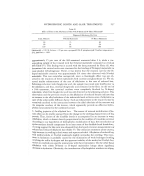
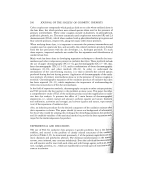
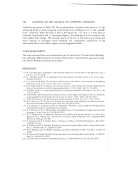
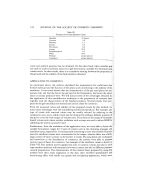
284 JOURNAL OF THE SOCIETY OF COSMETIC CHEMISTS conditions are given in Table III. The nondispersion or polar contribution '),.•t' in the advancing mode is small compared to the dispersion contribution 'y.•. In the "equilib- rium" condition, when the fiber is left in the liquid for -15 rain, it is seen that 3,.• t' increases considerably and 'ys • decreases slightly, thus leading to a net increase in the total surface free energy. The increase seems to be due to the interaction of hair and water leading to hydrogen bond breaking and consequent orientation of the macromolecules in the surface regions, as was suggested earlier. ACKNOWLEDGMENT The work reported here was conducted as part of a project on "Studies of the Modifica- tion of Human Hair Properties by Surface Treatments" sponsored by a group of corpo- rate Textile Research Institute participants. REFERENCES (1) N. L. R. King and J. H. Bradbury, The chemical composition of wool. Part V, The Epicut•cle, Aust. J B/o/. Sci., 21,375 (1968). (2) L J. Wolfram and M. K. O. Lindemann, Some observations on the hair cuticle, J. Sot', Cosmet. Chem., 22,839-50 (•971). (3) J. A. Swift and B Bews, The chemistry of human hair cuticle. Part I: A new method for the physical isolation of cuticle, J. Sot'. Cosmet. Chem, 25, 13-22 (1.974). (4) E.G. Shafrin and W. A. Zisman, Constitunve relations in the wetting of low energy surfaces and the theory of the retraction method of preparing monolayers, J. Phys. Chem., 64, 519-24 (1.960). (5) B. Miller and R. A. Young, Methodology for studying the wettability of filaments, Text. Re•. J.. 45, 359-65(1.975). (6) F. M. Fowkes, Determination of interfacial tensions, contact angles, and dispersmn forces in surfaces by assuming ad&tivity of intermolecular interactions in surfaces, J. Phys. Chem., 66• 382 (1962). (7) S. Wu, Calculatmn of interfacial tension in polymer systems, J. PoIym. Sci., Part C, 34, 19 (1.971). (8) H. A. Shuyten, J. W. Weaver, andJ. D. Reid, An index of the water-repellancy of textiles from the sur- face tension of aqueous solutions,Amer Dye.•t. Rep.. 38,364-8 (1949). (9) Y. K. Kamath, C. J. Dansizer, and H.-D., We•gmann, Wettabihty, contact angle and wetting hysteresis ofkeratin fiber surfaces, unpublished communication. (1.0) E G. Shafrin and W. A. Zisman, Effect of adsorbed water on the spreading of organic liquids on soda- lime glass, J. Amer. Chem. Sot', 50,478-84 (1967). (1.1) W. E. Savige and J. A MacLaren, Oxidanon of disulfides with special reference to cystine, in N. Kharasch and C. Meyers, Eds., The Chemistry of Organic Sulfur Compounds. vol. 2, Pergamon Press, New York, 1.966, pp. 367-402. (1.2) P. Alexander and R. F. Hudson, Wool, •ts Chemistry a•d Physics, Franklin Publishing Co., New Jersey, 1.963, Pp. 262-64. (13) A. E1-Shimi and E. D. Goddard, Wettability of some low energy surfaces. Part I. Air/liquid/solid inter- face, J. Colloid Interfat. Sci., 48,242-8 (1974). (14) H. D. Feldtman and J. R. McPhee, Spreadi•tg and Adhesion of Polymers on Wool. Text. Res. J,, 34,634-42 (1.964). (15) H• Alter and H. Cook, The effect of adsorbed water on the critical surface tension of hair, J. Colloid In- terfac, Sc•., 29,439-43 (1.969). (16) J. R. Dann, Forces involved in the adhesive process, J. Colloid Interfat. Sci., 32,302-20 (1970).
Purchased for the exclusive use of nofirst nolast (unknown)
From: SCC Media Library & Resource Center (library.scconline.org)