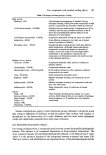
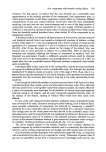
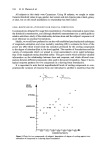
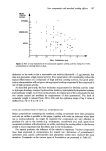
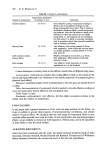
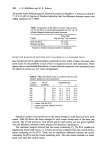
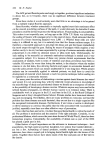
New compounds with menthol cooling effects 197 MEAN TOPICAL RATING STRONG MODERATE WEAK x x x x x x x x x ß x , x x I I I I I I • 0.2 0'5 I 2 5 10 "'- ORAL THRESHOLD (•Jg) Figure 4. Plot of oral threshold of 64 compounds against cooling activity rating for 0'15% concentration in shaving foam on face. deduction to be made is that a reasonable oral activity (threshold 2 gg) permits, but does not guarantee, a high topical activity. Poor penetration will considerably reduce the topical effectiveness of a compound of high intrinsic cooling activity, but good pene- tration characteristics will not give a strong topical cooling compound if the compound is not of high intrinsic activity. As described previously, the four molecular requirements for intrinsic activity relate to hydrogen bonding, compact hydrocarbon skeleton, hydrophilic/hydrophobic balance, and molecular weight. As evolves in this section, for topical use of the compounds the last two criteria named are modified by requirements of skin penetration. The limit of molecular weight is reduced from 350 to 250, and the optimum range of log P value is shifted from 3.0 + 1.0 to 2.0 + 1 '0. COOLING COMPOUNDS IN TOPICAL COMPOSITIONS Many compositions containing the synthetic cooling compounds have been prepared, and only an outline is possible in this paper, together with notes on instances where their use is contra-indicated. As might be expected the compounds are very effective in products for use in the mouth (e.g. toothpastes, mouthwash etc.) and, apart from occasional problems with absorption on solids, matching the cooling effect to the flavour profile is more important that the effects due to the formulation. For topical products, the influence of the vehicle is important. Various compounds have been examined in compositions for topical use derivatives of p-menthane-3- carboxylic acid, acyclic carboxamides and phosphine oxides have received the most attention. Comments on the various types of formulation are presented in Table III.

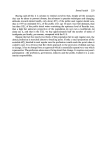
198 H.R. Watson et al. Table 1211. Coolants in compositions Approximate proportion Nature of composition of coolant, % w/w Comments Alcohol solution (0.3-0' 5) Shaving foam (0.1-0' 2) O/W emulsion creams, (0.2-0.5) lotions, balms. Solid cologne (0.3-0.7) Gives effective cooling. Compounds residing on the face can be transferred via finger to lips, giving cooling effect hours later. This is viewed as undesirable, therefore slightly volatile compounds are preferred. Note that the effective vehicle of an aftershave is often the mixture of non-volatile components, i.e. the fragrance oil and emollients. For this reason it is better to use polar emollients such as propylene glycol than non-polar emollients such as isopropyl myristate. Very effective, with cooling noticed 10-30 sec after application. Little residue left on face, hence no transfer problems. Cooling remains 5-15 min after removal. Effective. Perception may be slow, e.g. 60 sex: after application. With suitable compounds, duration is long. Very effective. Much recurrence of cooling experienced on, e.g. the forehead. Contra-indications normally relate to the different sensitivities of different body areas' Aerosol sprays: if aerosols are inhaled, the cooling effect is likely to be noticed in the throat and lungs (although in air fresheners a very small proportion of compound gives a pleasant fresh effect). Shampoos: accidental ingress of the resulting foam to the eyes gives an intense level of cooling. Talcs: the concentration of compound which is needed to provide effective cooling on most skin areas gives intense effects in the ano-genital area. Toilet Soaps: as talcs. Deodorants, antiperspirants: very effective, but the subject associates coolness in the axillae with the wetness of perspiration. CONCLUSION In this paper only a general description of the work has been possible. In the future, we hope to publish in greater detail aspects of structure/activity correlations, and certain aspects of topical effects. We recognise that the wide range of compounds which is now available offers possible new tools for study of skin penetration and neurophysiological effects we are unlikely to extend our brief inspection of these areas, and invite specialists in these fields to take the study further. ACKNOWLEDGMENTS Many have been concerned with the work, but special mention should be made of John Gascoyne, Dorothy Mitchell, Michael Russell and Roderick Thomson (all of Wilkinson Match Research Division) who carried out most of the skin test experiments.
Purchased for the exclusive use of nofirst nolast (unknown)
From: SCC Media Library & Resource Center (library.scconline.org)