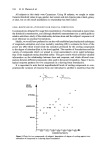
New compounds with menthol cooling effects 191 receptors. For this reason, we believe that the oral activities are a reasonably close approximation to the intrinsic activities of the compounds. Oral equipotency tests, in which trained panelists would derive equivalent cooling effects by balancing different concentrations of test and control solutions would have been the most scientifically satisfying, but such tests are very time-consuming and in view of the large number of compounds involved, were not considered for our own studies. (Trained panelists at Arthur D. Little, Boston, derived the same order of ranking of effectiveness which results from the threshold method described below when testing 20 of the compounds by an equipotency method.) A threshold method was used for all determination of oral activity, and the values of oral threshold derived from it are treated as (reciprocal) measures of intrinsic cooling activity. Filter paper (1 x 1 cm) was impregnated with a known amount of compound by application of a measured volume (1-5 pl) of a solution in redistilled petroleum ether (40-60ø). After 30 sec, the paper was placed on the tongue of the subject, who was required only to report presence or absence of a cooling effect. After an interval, the procedure was repeated, adjusting the amount of compound as required, until the threshold was ascertained. Usually, a sufficiently accurate estimate could be obtained with as few as five to ten measurements, and although there was a variation of + 30•o on repeat tests, this was acceptable because differences between compounds were usually quite considerable. Individuals differ in their sensitivity to the cooling effect, and the personal thresholds of a group of subjects are likely to cover a considerable range. For example, the menthol thresholds of 23 subjects, chosen at random, were in the range of 0.02-10 lsg. Also it is a general feature that the distribution is not simple Gaussian. Most panelists had thresholds reasonably near the minimum, there being a long tail to the value representing lowest sensitivity. Even though the individual members of a panel may have had a wide variation in their menthol threshold, they ranked a series of compounds in the same order. Thus, although the basic sensitivity to a cooling effect varied from subject to subject, the relative effects of a series of compounds were equivalent for all panelists. All strong compounds appeared relatively strong to all subjects, and all weak compounds appeared relatively weak. In the absence of this feature, ranking of intrinsic effect would have been much more difficult. In view of the wide variation between panelists, arithmetic means of threshold results were obviously of no value. Geometric means gave useful ranking, but it is believed that a more accurate comparison of compounds was achieved by comparing a panelist's threshold for a test compound with his personal threshold for a standard compound. The average ratio for the whole panel was then derived as the arithmetic mean of the individual ratios, and the mean threshold was calculated by reference to the known mean threshold (geometric mean of 23 subjects) of the standard substance. Menthol was not chosen as the standard substance because it gives occasional inaccurate values owing to its volatility N-ethyl-p-menthane-3-carboxamide (II, Fig. 2) is our standard. The above method appears to be reliable. Panelists were routinely checked for standard response by normal cross-check methods, and it is noteworthy that their thres- hold for a given cooling compound does not change even after several years of practice. Oral thresholds recorded during the work spanned the range 0-08-50 pg. A compound with a threshold of less than 0.5 [tg is regarded as 'strong'. Thresholds of greater than 50 [tg were not quantified at that level a compound shows exceedingly weak activity, and

192 H.R. Watson et al. undesirable side effects such as an unpleasant taste, tingling and burning usually pre- dominate. Large numbers of compounds were examined in our study. When the method described above had become well established, a small panel of four to six subjects, chosen from the larger panel for their near average sensitivity was used for rapid initial screening of compounds. Topical Testing Like oral threshold determination, measurement of topical thresholds is complicated by the fact that individual sensitivities to cooling compounds differ considerably. Skin thresholds were measured as follows: 0.2 ml of a solution in petroleum ether (40-60 ø) was measured on to a circular area el0 cm •) of skin surface on the inside of the forearm, midway between the wrist and elbow. After 30 min, the subject was required to respond whether or not a cooling effect had been noticed during the period. CSome compounds were slow to act, but the main reason for the delay between dose and question was to allow the panelist to differentiate the chemical cooling effect from the inevitable but transient physical effect of the solvent evaporation.) Since degreasing the skin with solvent before application of the cooling compound did not change the threshold, and washing may have caused hydration, the skin was not treated before a threshold test. A panel of 50 subjects, tested by the above method, had thresholds for menthol of between 0.5 and 100 mg. As an example of the non-Gaussian grouping towards the sensitive end, the thresholds of 32 of the subjects lay between 2.0 and 10 mg, and only six subjects had thresholds of greater than 25 mg. It should be recalled that the oral threshold method was used extensively because it appeared to give the best measure of intrinsic cooling activity. Skin threshold levels were not of value for that purpose, and in addition they were confounded by the manner in which the compound deposited on the skin following evaporation of the solvent. Some compounds even crystallised, and therefore clearly gave spuriously high 'threshold' results. For these reasons, our topical testing did not rely on threshold methods. The aim of the topical testing was C a) to find, in general terms, those compounds which were most suitable for application in topical products and Cb) to match compounds with product types so that the overall effect of the addition of a particular cooling com- pound to a product could be judged. In view of the difficulties implicit in skin threshold testing, and the inevitable relationship between compound effectiveness and the medium in which it is applied, we concentrated on tests based on application in the product type. Thereby (b) above, for a particular composition, was satisfied directly, and Ca), the relative general characteristics of the compounds, gradually emerged as the number of tests in different media increased. This part of the study is on-going. The pattern of product oriented tests is exemplified by the following, which was used for aerosol shaving foams. The panel consisted of five men who were experienced in the effects of cooling compounds. The subjects applied approximately 0.5 g* of the shaving foam across the trigeminal/cheek area, wiped the area after 5 rain, and a trained observer recorded their comments during (normally) the first 10 min following application. The observer took * Unlike threshold testing, direct effectiveness testing is less influenced by the quantity of material applied. The concentration of the cooling compound in the medium is important, but compositions such as shave foams, which are applied in excess, are best tested in excess, it being implicit that they do not dry out during the period of observation.
Purchased for the exclusive use of nofirst nolast (unknown)
From: SCC Media Library & Resource Center (library.scconline.org)