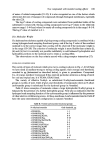
Effect of pyrollidone carboxylic acid 203 (7, 8). It consisted of a trained technician using a simple numerical scoring system to assess six areas of each hand according to the following scheme: 0=no relevant visible damage, 1 =slight dryness, 2=marked dryness and/or slight flaking, 3-----severe dryness and/or marked flaking, 4=severe flaking and/or slight cracking, 6=severe cracking. The areas of the hand assessed were: back of hand, thumb web, other webs, back of fingers, palm, front of fingers. The 12 areas on each panellist were summed to give a total hand score. For convenience, the panel was divided into two halves and each half saw a different assessor. Each panellist saw the same assessor throughout the trial. Panellists were allocated to one of the six possible sequences of hand cream usage according to their initial total hand score. The allocation was carried out so that there were equal numbers of women in each of the six sequences and so that the mean and range of hand scores in each sequence was approximately the same. The allocation was carried out separately for each assessors' half of the total panel. After allocation to one of the six sequences, each panellist was given the appropriate cream and asked to use it at home after wet operations and before going to bed. They were asked to return for assessment after 2 weeks and collect the next cream. They were instructed not to use any cream on the assessment days. Residues of cream obscure dryness and flaking and absence of cream from the hands during assessment means that any effect of cream is on the skin itself and is reasonably long-lasting and does not reflect the ability of the fatty components of the creams to stick down any'- scales and obscure dryness by optical effects. The assessors were not aware which panellist had been using which product. The panellists themselves received coded products and did not know which creams contained humectant. After the end of the trial, results were examined for statistically significant differences between creams by analysis of variance. Because the trial was balanced for initial hand scores and because all possible sequences of cream usage were employed, it is reasonable to calculate mean changes from previous hand scores at each assessment and for each cream. These changes were calculated and used as the data for the analysis of variance. The results for each assessor were calculated separately and then combined to give an overall mean. RESULTS WATER-HOLDING CAPACITY OF ISOLATED CORNEUM Table I shows the mean water-holding capacity at 81•o r.h. of guinea pig corneum treated with the cream with and without Na PeA. The cream with Na PeA resulted in

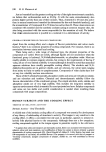
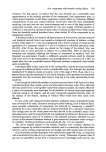
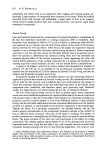
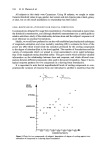
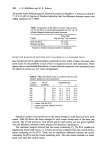
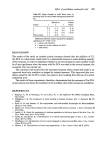
204 J. D. Middleton and M. E. Roberts the greater water-holding capacity. Statistical analysis by Student's 't' test gave a value for 't' of 4.14 with 14 degrees of freedom indicating that the difference between creams was highly significant (P 0.001). Table I. Comparison of the effects of cream with and with- out 5•o Na PCA on water-holding capacity at 81% r.h. of solvent-damaged guinea pig footpad corneum Water held Cream (mg 100 mg -x dry corneum) With Na PCA 19 '4 (15) Without Na PCA 17.2 (15) Figures in brackets indicate number of replicates EFFECT ON HAND SKIN DRYNESS AND FLAKINESS IN A CONSUMER TRIAL One hundred and forty eight panellists completed the trial. Table H shows the mean total hand scores for all panellists in each of the six sequences and at each assessment. These figures show a considerable fluctuation of scores between sequences and assessments and the effects of creams are not easily distinguished. Table 1I. Mean total hand scores in consumer test for each product sequence at each assessment Cream No. of Assessment No. sequence panellists 1 2 3 4 abc 24 11.4 11.1 11-8 11.5 acb 24 12.7 14.1 10.6 15.3 bac 24 11.5 12.8 11.7 13.8 bca 23 11.2 13.4 12.2 13.5 cab 27 12.3 13.2 11.9 16.7 cba 26 12.5 13.8 14.9 15.6 a = cream with Na PCA. b = cream as (a) but without Na PCA. c = urea cream. Statistical analysis was carried out on the mean changes in total hand score for each cream. Table III shows the mean changes for each cream during each of the three use periods. The overall means for each period and for each cream are also given together with the difference between creams required for statistical significance. The statistical analysis showed that the cream containing 5•o Na PCA resulted in significantly lower hand scores, i.e. in better hand skin condition, than the control formu- lation containing no Na PCA There was no significant difference between the cream containing Na PCA and the cream containing urea. The urea cream resulted in a lower hand score than the control cream.
Purchased for the exclusive use of nofirst nolast (unknown)
From: SCC Media Library & Resource Center (library.scconline.org)