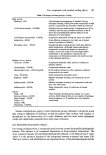
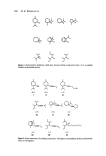
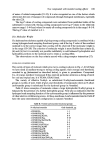
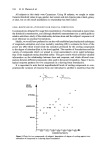
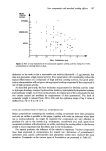
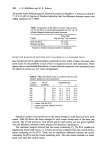
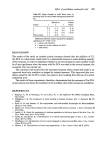
New compounds with menthol cooling effects 189 of series of related compounds (19-22). It is also recognised as one of the factors which determines the rate of transport of compounds through biological membranes, especially the skin (23). The log P values of cooling compounds were calculated from published tables of the substituent x-values (24). Strong cooling compounds have log P values in the relatively narrow range 1.5-4.0 and values for nearly all cooling compounds lie in the range 1.0-5.0. The log P value of menthol is 3' 1. (iv) Molecular Weight If a hydrocarbon skeleton capable of giving strong cooling compounds is combined with a strong hydrogen-bond accepting functional group, and if the log P value of the resultant molecule is in the correct range, then cooling will be observed if the molecular weight is in the range 150-350. The criterion of molecular weight is more flexible than criteria (i), (ii) and (iii) but it is certainly not possible indefinitely to add balanced hydrophobic and hydrophilic portions to the molecule and to retain a cooling effect. The observations on the four criteria accord with a drug-receptor interaction (17). COOLING COMPOUNDS The variety of types of molecule which give rise to cooling is shown in Fig. 2. All of these we have rated as medium-strong to strong cooling agents their average oral threshold, recorded in [tg (determined as described below), is given in parentheses. Compound I is, of course, menthol. Compound II has received particular attention as being of merit for oral and topical use it is FEMA GRAS listed. The variety of effective N-alkyl- or substituted N-alkyl-carboxamide functional groups is worthy of note. Table H gives oral thresholds of compounds where an N-alkyl- carboxamide group is substituted for the hydroxyl group in/-menthol. Table H shows examples of molecules where a large hydrophobic N-alkyl group is balanced by the presence of a further hydrophilic group. Note also an indication that the hydrogen bond accepting function of the carboxamide group is influenced by the presence of other electron withdrawing atoms. All thep-menthane-3-carboxamides listed in Table II have the same stereochemical configuration as natural/-menthol. Table II. N-alkyl carboxamide functional groups N-Alkylcarboxamide Oral threshold, gg -CONHCH, 1.1 -CONHCH•CH, 0.2 -CONI-ICH:CH•CH, 0' 8 -CONHCH(CH,): 0.45 -CONHCH•CH•CH:CH, 1.4 -CONHC(CHa)a 0' 4 -CONHC6H4OCHa(p) 0' 2 -CONHCH:CH•OH 5' 0 -CONH(CH•)aOH 2' 7 -CONH(CHO6OH 1' 1 -CONHCH:CH•OCH, 2' 7 -CONHCH:COOC•H, 0' 13 -CONHCH(CHa)COOC:H, 0' 4

190 H.R. Watson et al. Just as bmenthol has the greatest cooling activity of the eight stereoisomeric menthols, we believe that carboxamides such as II (Fig. 2) with the same stereochemistry also possess higher activity than any of their isomers. Thus, d-menthol is 45 times less active than its natural enantiomer/-menthol (as determined by the oral threshold method), and the d-enantiomer of Compound II is 70 times less active than II. These observations are consistent with menthol and the synthetic coolants acting at common receptor sites, the sites being associated with the nerves responsible for the sensation of cold. We believe that whare stereoisomerism is possible in a molecule it is a determinant of activity. GENERAL PROPERTIES OF COOLING COMPOUNDS Apart from the cooling effect, and a degree of flavour potentiation and odour modi- fication,* there is no common property of cooling compounds. For instance, there is no association between minty smell and cooling. There being such a wide range of chemical type, the physical properties of the compounds are varied. Most are solids, although liquids are not uncommon when the functional group is hydroxyl, N,N-dialkylcarboxamide, or phosphine oxide. Most are readily soluble in common organic solvents, but owing to the requirements of the log P value, all are of very limited solubility in water (although it should be noted that saturated aqueous solutions have readily perceptible cooling effects). The alcohols and N,N- dialkylcarboxamides are in general volatile, and are odorous, the odour types ranging from minty to fruity to earthy to camphoraceous. Compounds of other classes have low or very low volatility and are non-odorous. Many of the N-alkylcarboxamides, phosphine oxides and ureas are virtually involatile, and are odoudess and tasteless. Chemical and thermodynamic stability follow the known characteristics of the constituent groups. The simple alcohols, acids, amides and phosphine oxides are of very high stability. This includes the long-term stability in aqueous environments which is essential for most projected end uses. Sulphur compounds and ureas are less stable and careful consideration is needed when matching these compounds with usage compositions. HUMAN SUBJECTS AND THE COOLING EFFECT TESTING OF RELATIVE ACTIVITY Intrinsic Activity- Oral Thresholds A reliable test of the intrinsic cooling effect of a compound was essential for development of any theory of relationship of structure to activity. The tongue is very sensitive to the cooling effect, it offers a convenient test site and, in particular, appears to present re- latively little physical barrier to the compounds. Although there are a few exceptions, cooling compounds applied to the tongue appear to penetrate rapidly to the cold nerve * It appears that when cold receptors are chemically excited, there is an associated mild response from adjacent odour and taste receptors, and modification of these two senses is almost certainly a general characteristic of cooling compounds (25). (David Kendall of Arthur D. Little, Boston, has tested over 100 compounds of our series all modified flavour.) The property is in accord with that of pungent or 'warming' compounds pungent components of peppers, chillies etc. are well established as flavour modifiers.
Purchased for the exclusive use of nofirst nolast (unknown)
From: SCC Media Library & Resource Center (library.scconline.org)