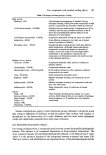
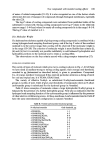
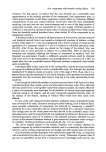
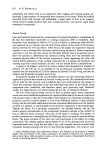
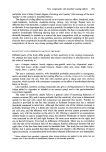
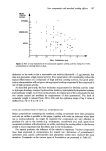
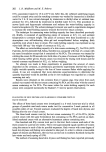
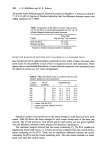
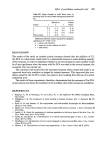
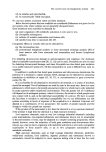
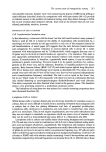
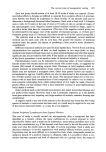
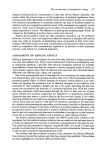
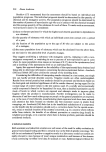
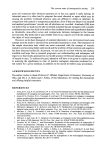
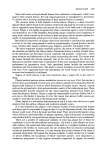
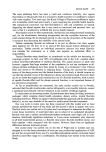
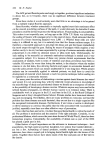
New compounds with menthol cooling effects Table I. Hydrogen bonding groups: cooling 187 High Activity Hydroxyl, -OH N-Alkylcarboxamide, -CONHR N,N-Dialkyl carboxamide, -CONRa Sulphoxido, -S(O) R Phosphine oxide, =P(O)R Medium or Low •lctivity Carboxyl, -COOH Carboxamide, -CONHa Hydroxyalkyl ester, -COOCnH2n0H Urea, -NCONRa Sulphone, -SOAR Sulphonamide, -SOaNRa Sulphinamide, -SONR2 Inactive Ether, -OR Ketone carbonyl, -C(O)R Ester (simple), -COOR Chloro, -C1 Amine, -NHa Thioamide, --C(S)NRa The hydrogen bonding group of menthol. Strong hydrogen bonding, which gives some compounds of high activity. Compounds are normally volatile and odorous. Probably the most useful group. Compounds are of low volatility, and the many possible variations of the R allow the hydrophilic/hydrol•hobic balance of the molecule to be tuned finely. Compounds reasonably strong but many are volatile. Gives effective compounds, but their use is limited owing to problems of stability. Strong hydrogen bonding groups which give effective, useful compounds. (Although organo-phosphoms compounds in general are suspect on ground• of toxicity, we are not aware of a toxicological effect attributable to the phosphine oxide group the compounds are thermodynamically very stable and are of low chemical reactivity.) Compounds relatively weak activity is reduced in alkaline vehicles. Compounds relatively weak. If the hydroxyl group is in the 2-position, moderate- strong activity can result. Some compounds reasonably active. Medium hydrogen bonding, but compounds of low activity. Medium hydrogen bonding, but compounds weak and have very bitter taste. Weak compounds, many of which are of limited stability. These hydrogen bonding groups appear not to give activity, either because they are not capable of hydrogen bond acceptance, or, if capable, give only relatively weak bonds. Similar considerations apply to other functional groups, although it should be noted that owing to difficulties of synthesis, we did not explore fully systems with sulphur or phosphorus as the hetero-atom of a cyclic skeleton, and the most active phosphine oxides and sulphoxides prepared have open chain structures. (iii) Hydrophilic/Hydrophobic Balance For strong cooling activity, a compound must have the correct hydrophilic/hydrophobic balance. This balance is of recognised importance in drug-receptor interactions. The most common measure of hydrophilic/hydrophobic balance is the Hansch log P value, where P is the partition function of the compound between n-octanol and water (18). The log P value is well established as an important factor of the pharmacological activity

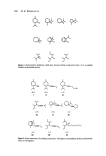
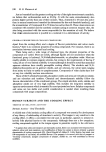
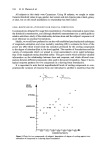
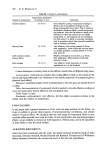
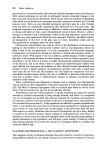
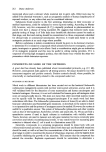
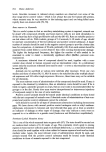
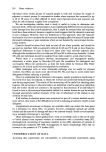
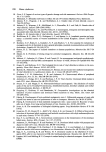
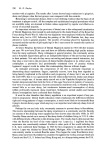
188 H.R. Watson et al. Figure 1. Hydrocarbon skeletons which give strong cooling compounds when -X is a suitable N-alkyl carboxamide group. Io.3) 1o.2• •oo..-• L,• •N•coNH •-• Figure 2. Some structures of cooling compounds. The figure in parentheses is the oral threshold value in micrograms.
Purchased for the exclusive use of nofirst nolast (unknown)
From: SCC Media Library & Resource Center (library.scconline.org)