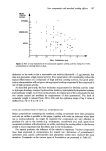
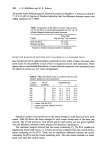
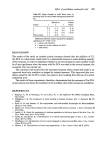
Effect of pyrollidone carboxylic acid 205 Table lII. Mean changes in total hand score in consumer trial for each cream during each period of use Period no. Cream Cream 1 2 3 mean a 0.5 -1.2 1.0 0.11 b 1.7 0.9 4.8 2.47 c 1.1 -2.3 0.9 -0.07 Period mean 1.1 - 0' 9 2.3 Difference between creams required for statistical significance (P=0.05)=1.56 a = cream with Na PCA b = cream as (a) but without Na PCA c = urea cream. DISCUSSION The results of the study on isolated animal corneum showed that the addition of 5•o Na PCA to a skin cream could result in a measurable increase in water-holding capacity of the corneum. In order to determine whether or not this increase in water content would be of any significance when the cream with Na PCA was used in the normal manner, the consumer trial was carried out. The consumer trial showed that the increased corneum water content did result in an improved hand skin condition as judged by trained assessors This improved skin con- dition caused by the Na PCA cream was equal to that resulting from the use of a cream coilraining urea. The results of these experiments, therefore, demonstrate that the presence of Na PCA in skin creams can reduce the incidence of dry and flaky skin under normal use conditions. REFERENCES 1 Kligman, A.M. In Montagna, W. and Lobitz, W. C. The Epidermis 410 (1964) (Academic Press, New York). 2 Middleton, J. D. The mechanism of water binding in stratum corneum. Brit. J. Dermatol. 80 437 (1968). 3 Speir, H. W. and Pascher, G. Zur analytischen und funktionellen Physiologie der Hautoberfl•iche. Hautarzt 7 55 (1956). 4 Blank, I. H. Factors which influence the water content of the stratum corneum. J. Invest. Derrnatol. 18 433 (1952). 5 Jacobi, O. K. About the mechanism of moisture regulation in the horny layer of the skin. Proc. Sci. Sect. Toilet Good Assoc. 31 22 (1959). 6 Laden, K. and Spitzer, R. J. Identification of a natural moisturising agent in skin. J. Soc. Cosmet. Chem. 18 351 (1967). 7 Middleton, J. D. Development of a skin cream designed to reduce dry and flaky skin. J. Soc. Cosmet. Chem. 25 519 (1974). 8 Gibson, I. M. The evaluation of hand-care preparations. J. Soc. Cosmet. Chem. 24 31 (1973).

J. $oc. Cosmet. Chem. 29 207-223 (1978) An appraisal of the current state of mutagenicity testing DIANA ANDERSON Imperial Chemical Industries Limited, Central Toxicology Laboratory, Alderley Park, Macclesfield, Cheshire Presented at the Symposium on Cosmetics and Toiletries - Safety Assessment, 8 November 1977 Birmingham Synopsis Every year many new chemical substances are introduced into our environment. Some of these chemicals may possibly induce genetic damage in populations exposed to them. There is a risk that such damage may accumulate in the gene pool and affect future generations, or even cause cancer in the present gener- ation since a link has now been established between mutagenicity and carcinogenicity. At present the most appropriate way to determine which chemicals may cause genetic damage is to test them in various in vitro or in vivo laboratory test systems capable of detecting damage to DNA, chromosomes or the genome. Some of these methods are discussed, as are the factors which determine a mutagenic response, problems encountered when using the test systems, together with data interpretation and assessment of genetic effects. INTRODUCTION The problem of the possible induction of genetic damage after chemical exposure is worrying both to the scientific community and to the population at large The increase in number of different chemical substances and biological synthesis products in man's environment is due to the rapid strides made by scientific and technical progress. Each year new chemical substances are introduced in the form of medical preparations, pesticides, food additives and industrial compounds and some of these could induce mutations. There is a risk that such mutations may accumulate in the population and affect future generations. In recent years many substances shown to be mutagens have also been shown to be carcinogenic, with 80-90•o correlations between mutagenicity and carcinogenicity with certain organic chemicals 0-8). These data are in conflict with similar studies made in the early 1950s on the mutagenicity of chemical carcinogens which showed little correlation between carcinogenic and mutagenic activity. These early experiments led to the premature demise of the somatic mutation theory of cancer metabolic activation systems were not used and it was not realised that certain strains of bacteria might detect only specific types of genetic alterations (9). Nowadays, with the new-found interest in the somatic mutation theory of cancer, a study of the genetic effect of chemical substances may be useful not only for protecting future generations but also for preventing cancer in present generations. Little is known of the practical use of results obtained from mutagenic studies, how these results might apply in the field of toxicology in general, or how relevant they are to man. Whilst cancer in man has a definitive end-point in the production of a malignant 0037-9832/78/0400-0000 $02.00 ¸ 1978 Society of Cosmetic Chemists of Great Britain 207
Purchased for the exclusive use of nofirst nolast (unknown)
From: SCC Media Library & Resource Center (library.scconline.org)