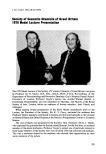
J. Soc. Cosmet. Chem. :•9 227-233 (1978) Dental health- a community responsibility M. N. NAYLOR Department of Periodontology and Preventive Dentistry, Guy's Hospital Dental School, London Bridge SE1 9RT The 1978 Medal Lecture by Professor M. N. Naylor, R.D., B. Sc., B.D.S., Ph.D., F.D.S., R.C.S.(Eng), delivered before the Society of Cosmetic Chemists of Great Britain on the 2nd March 1978 with K. V. Curry Esq., President of the Society in the Chair. It is perhaps almost as difficult to define what is meant by the term 'dental health' as it is to measure the level of dental health in any community. In 1965 the World Health Organisation defined dental health as 'a state of complete normality and functional efficiency of the teeth and supporting structures, and also the surrounding parts of the oral cavity and of the various structures related to mastication and maxillo-facial com- plex'. This is not a very helpful definition for there is no attempt to specify 'normality' or 'functional efficiency'. A much easier situation to describe is 'dental ill-health' due to the two major oral diseases, decay or caries, and periodontal disease. Both of these conditions have such an extremely high prevalence that for practical purposes they must be regarded as universal in civilised man. It has been estimated that by the age of 15 years, 97•o of British children have decay in Norway this proportion is 995/0 whereas at age 21 years, only one in a thousand is free of disease. In 1973 a survey of 13,000 children in England and Wales showed that approximately 75•o of 5-year-old children had decay and that, on average, every child had four affected deciduous teeth. In spite of previous care, 20•o of children aged 5-8 years and 10•o aged 9-15 years had five or more teeth needing treatment. By age 15 years on average, 10 of the 28 teeth were either decayed, filled or extracted. These data are confirmed by our own studies in London, the Isle of Wight and Hampshire. It is interesting to note that in the year prior to this survey, i.e. 1972, 7-8 million courses of treatment were provided under the NHS for children of school age. The situation in adults is no less depressing. In 1963, 375/0 of a carefully generated random sample of adults over the age of 16 years, in England and Wales was found to have had a complete clearance of all teeth. In Scotland the figure was 445/0. A recent survey reported by Dowell and Beal has shown that by 1977 the situation had improved in England and Wales, the percentage of toothless adults having fallen to 315/0 . Periodontal disease is no less prevalent. Some years ago, we examined 120 11-year-old children in a smallish London comprehensive school. Only one child was entirely clear of overt gingivitis. At this stage the condition is entirely reversible but the evidence supports the view that steps are not taken, generally speaking, to achieve this. In adults, periodontal destruction becomes the major reason for extraction in people over the age of about 30 years. 0037-9832/78/0400-0000 $02.00 ¸ 1978 Society of Cosmetic Chemists of Great Britain 227

228 M. N. Naylor It is an unfortunate fact that the public generally does not place good dental health high on the list of priorities. This is not surprising since most people remain entirely unconcerned about their general state of health - until of course, they become seriously ill. Testimony of this are peoples' smoking habits, the prevalence of obesity and the scant regard paid to even the simplest forms of exercise. Small wonder that dental health is ignored when people are prepared to set themselves onto a head-on collision course towards coronary heart disease, malignant neoplasia and other equally devastating conditions resulting from personal abuse. At all levels of society dental diseases are accepted as inevitable. Dental treatment, whether it be based upon regular routine visits to a practitioner or when driven to seek extractions because of pain, is likewise regarded as an unpleasant inevitability. There are still people who regard a full clearance of all natural teeth and the provision of full upper and lower dentures as the sole criterion for good dental health. Not so long ago a girl's marriage prospects were regarded as being greatly enhanced when she became the proud possessor of full dentures! Despite the fact that both decay and periodontal disease can be prevented, most people accept as normal, bleeding and inflamed gums, and the inevitable bad breath, decaying teeth and the various types of pain which accompany the different phases of the disease. Compared with some of the 'killer' diseases with which our medical colleagues have to deal, dental diseases may seem but minor considerations. Nevertheless, dental diseases have such a high prevalence that the cost of NHS treatment is running at over t 140,000,000 per annum a conservative estimate of the working days lost due to dental disease has been put at 0'6 million. Finally, despite its relatively minor nature, dental diseases do have a mortality rate and it has been estimated that about 12 people per year die either from dental disease, the consequences of the disease or treatment. Some of these are anaesthetic deaths and others are associated with sub acute bacterial endocar- ditis of dental origin. It is quite impossible of course, to quantify the pain and distress which people suffer from dental diseases. Periodontal disease, when it has reached a certain stage in its natural history, and dental decay., are both irreversible conditions. When the periodontal disease is confined to the gingival margins and not involving the deeper periodontal structures, the situation can be reversed and normal health restored. However, when the deeper structures are involved, namely the periodontal membrane and the alveolar bone, the condition cannot be reversed and the best that treatment can do is bring the inflammation under control and prevent further destruction of tissue. If the destructive processes proceed inexorably, eventually the teeth become loose and finally are exfoliated. The onset of destruction and indeed the rate of destruc- tion varies considerably from patient to patient. Unfortunately, the reasons for this variance are not clear. Caries, certainly when an established lesion is present, is irreversible and the only treatment available is surgery which takes either the form of extraction of the tooth or excision of the diseased tooth substance and its replacement by means of one of several filling materials. There is evidence that very early lesions which have not involved a breach of the surface continuity of the tooth can be reversed or arrested. Examples of this are, reversal by sodium fluoride rinses of experimentally induced very early lesions, and the common clinical experience of an early lesion becoming arrested when stagnation is eliminated by extraction of the neighbouring tooth.
Purchased for the exclusive use of nofirst nolast (unknown)
From: SCC Media Library & Resource Center (library.scconline.org)