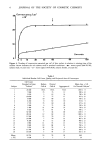
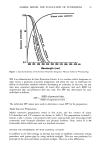
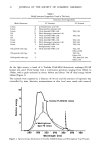
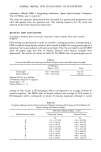
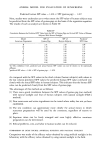
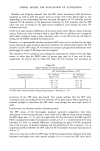
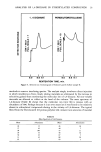
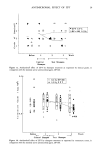
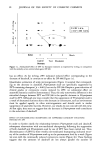
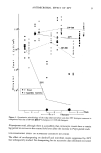
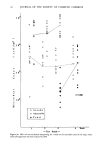
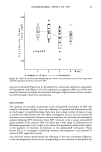
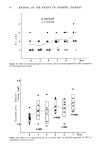
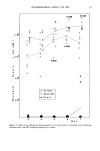
ANIMAL MODEL FOR EVALUATION OF SUNSCREENS 13 radiometer (Model RMi-1 Integrating radiometer, Japan Spectroscopic Company). The UV-B flux was 1.1 mw/cm 2. The series of exposures administered was increased in a geometrical progression, and each 30% greater than the previous one. The starting exposure for the series was selected on the basis of previous experience. RESULTS AND DISCUSSION SUNSCREEN TESTING WITH NATURAL SUNLIGHT USING GUINEA PIGS AND HUMAN SUBJECTS Field testing was performed in order to establish a testing procedure corresponding to FDA's method (using human subjects with natural sunlight) by using guinea pigs as a substitute for human subjects with natural sunlight. First, the untreated (control) MED value of guinea pigs and that of human subjects with natural sunlight were determined. The results are shown in Table II. The MED value of guinea pigs was an Table II Untreated Site MED of Guinea Pigs and Human Subjects Determined With Natural Sunlight • UV-Monitor 2 (Mean _+ S.D.) Time Guinea pigs 3 1921 _+ 520 counts 47.2 rain Human subjects 4 1076 __ 340 counts 25.8 min 'Okinawa (26 ø N.L. July, Midday). 2UV-Monitor: Sunburn UV integrator. 3Guinea pigs n = 50. 4Human subjects n = 73. average of 1921 counts in SU-Integrator, which corresponds to an average of about 47 minutes exposure. The MED value of human subjects was average of 1076 counts in SU-Integrator which corresponds to' about 26 minutes exposure, although it varied Table III Comparison Between the Sun Protection Factors Obtained by Guinea Pig Testing and That Obtained by Human Testing with Natural Sunlight Model Sunscreen Tested SPF Values Obtained (Mean _+ S.D.) Guinea Pig Testing Human Testing (n) (n) B 2.21 + 0.73 (14) 2.10 + 0.53 (38) D 1.76 _+ 0.30 (5) 1.40 _+ 0.70 (13) F 2.10 _+ 0.70 (7) 1.83 +_ 0.46 (31) G 2.68 _+ 0.41 (10) 2.40 + 1.00 (13) H 3.19 + 0.87 (16) 3.15 + 0.72 (15) I 5.24 + 1.34 (5) 5.56 + 2.80 (21) J 2.79 +- 0.40 (5) 2.50 + 0.80 (5) K 7.68 _+ 0.69 (7) 9.99 -+ 2.37 (26) L 4.14 _+ 0.94 (7) 5.00 +_ 1.80 (13)

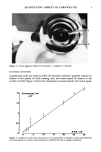
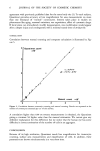
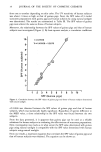
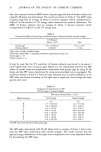
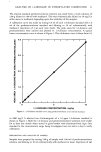
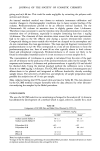
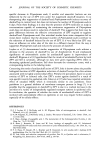
14 JOURNAL OF THE SOCIETY OF COSMETIC CHEMISTS from one to another depending on skin color. The UV sensitivity of human subjects was about 2 times as high as that of guinea pigs. Next, the SPF value of 9 model sunscreen preparations with guinea pigs and human subjects by using natural sunlight was determined. The results are summarized in Table III. The SPF values of guinea pigs were almost the same as those of human subjects. Moreover, the relationship between the SPF values of guinea pigs and that of human subjects was investigated (Figure 3). By least-squares analysis, a correlation coefficient 10- _ _ _ _ _ r=0.9936 Y----1.4260X--1.267 , SPF (Guinea pigs) Figure 3. Correlation between the SPF values of guinea pigs and those of human subjects determined with natural sunlight. of 0.9936 was obtained between the SPF values of guinea pigs and that of human subjects, which was statistically highly significant. Regardless of species difference in the MED value, a close relationship in the SPF value was found between the two subjects. From the data presented, it is apparent that guinea pigs can be used as a reliable substitute for human subjects in evaluating the effectiveness of sunscreen preparations. Next, investigation was made as to what extent the SPF value determined with guinea pigs using natural sunlight is compatible with the SPF value determined with human subjects using natural sunlight. From our results, a regression equation that correlates the SPF value of guinea pigs and that of human subjects was obtained. The equation can be shown as:
Purchased for the exclusive use of nofirst nolast (unknown)
From: SCC Media Library & Resource Center (library.scconline.org)