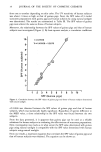
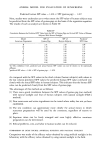
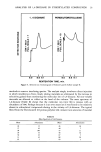
ANIMAL MODEL FOR EVALUATION OF SUNSCREENS 15 Predicted human SPF value = 1.426 x SPF (guinea pig) -- 1.267 Next, studies were undertaken as to what extent the SFP value of human subjects may be predicted from the SPF value of guinea pigs on the basis of the regression equation. The results of such an analysis are shown in Table IV. Table IV Correlation Between the Predicted SPF Value from the SPF of Guinea Pigs and Actual SPF Value of Human Subjects With Natural Sunlight x Model SPF of SPF of Predicted 2 Sunscreen Preparation Guinea Pigs Human Subjects SPF Value B 2.21 2.10 L.88 D 1.76 1.40 1.24 F 2.10 1.83 1.73 G 2.68 2.40 2.55 H 3.19 3.15 3.28 I 5.24 5.56 6.21 J 2.79 2.50 2.71 K 7.68 9.99 9.68 L 4.14 5.00 4.64 1At 95% confidence level, predicted and actual human SPF values can not be shown to be statistically different. 2predicted SPF value = 1.426 x SPF of guinea pigs - 1.2670 As compared with the SPF values in the third column (human subjects) with values in the last column (predicted SPF value), the predicted human SPF value correlated very closely with the actual SPF value in human subjects. This indicates that the human SPF value can be predicted closely from the SPF value of guinea pigs. The advantages of this method are as follows: (1) There was a good correlation between the SPF values of guinea pig (our method) with natural sunlight and that of human subjects with natural sunlight (FDA's method). (2) New sunscreens and active ingredients can be tested where safety has not yet been established. (3) The test condition can approximate more closely the actual means in which sunscreen preparations will be used by the consumer, regardless of season or place. (4) Exposure times can be freely arranged and even highly effective sunscreen preparations can be determined. (5) Ethical problems, cost, and labor in human studies can be reduced. COMPARISON OF LIGHT SOURCE: ARTIFICIAL SUNLIGHT AND NATURAL SUNLIGHT Comparison was made of the efficacy value obtained by using artificial sunlight in the laboratory with the efficacy value obtained by using natural sunlight in the field.

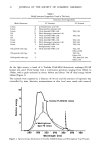
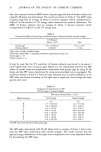
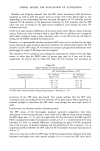
16 JOURNAL OF THE SOCIETY OF COSMETIC CHEMISTS First, the untreated (control) MED value of guinea pigs and that of human subjects by using FL-SE lamps was determined. The results are shown in Table V. The MED value of guinea pigs had an average of about 6 minutes exposure which corresponded to 0.6J/cm 2 as the amount of UV energy when measured by research radiometer. The MED of human subjects had an average of about 4 minutes exposure which corresponded to 0.4J/cm 2 as the UV energy dose. Table V Untreated Site MED of Guinea Pigs and Human Subjects Determined With Artificial Sunlight' UV-Monitor 2 (Mean _+ S.D.) Time Guinea pigs 3 0.63 _+ 0.13J/cm 2 6.0 _ 1.2 min Human subjects 4 0.38J/cm 2 3.7 min 'Light source: Toshiba FL40SE30 lamps. 2Thermopile. Model RM 1-1 integrating radiometer (Japan Spectroscopic Co.). 3Guinea pigs n = 50. 4Human subjects n = 3. It may be seen that the UV sensitivity of human subjects was found to be about 2 times higher than that of guinea pigs. Moreover, the relationship between the SPF values of model sunscreen preparations determined with guinea pigs by using FL-SE lamps and the SPF values determined by using natural sunlight were investigated. The results are shown in Table VI. From the data obtained here, a marked difference in the SPF value was found according to the light source employed, even though the same species were used. Table VI Comparison of Light Sources on SPF (FL-SE Lamps vs. Natural Sunlight) SPF values obtained (Mean _+ S.D.) • Model Sunscreen FL-SE Lamps Natural Sunlight (n) (n) B 2.77 _+ 0.67 (10) 2.21 + 0.73 (14) D 2.50 + 0.80 (14) 1.76 + 0.30 (5) F 3.14 + 0.47 (5) 2.10 + 0.70 (7) G 4.60 + 1.34 (5) 2.68 _+ 0.41 (10) H 15.01 _+ 4.36 (15) 3.19 -+ 0.87 (16) J 8.00 + 1.90 (5) 2.70 + 0.40 (5) K 27.93 - 3.40 (8) 7.68 + 0.69 (7) L 4.07 + 0.93 (15) 4.14 _+ 0.94 (7) 'The SPF values were determined with guinea pigs. The SPF value determined with FL-SE lamps had an average of about 3 times more than the SPF value determined with natural sunlight. The results indicate that the spectral energy distribution of the light source employed is the most important factor for determining the SPF value.
Purchased for the exclusive use of nofirst nolast (unknown)
From: SCC Media Library & Resource Center (library.scconline.org)