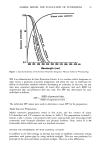
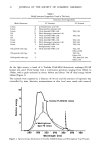
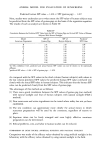
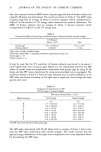
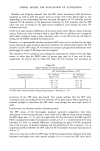
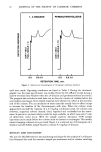
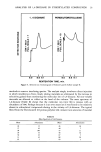
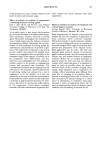
ANALYSIS OF 1,4-DIOXANE IN ETHOXYLATED COMPOUNDS 23 1,4 DIOXANE I I I 8.0 8.6 9.1 PERDEUTOROTOLUENE , I I I 8.0 8.6 9.1 RENTENTION TIME, min. Figure 3. Selected ion chromatogram of Sodium Laureth Sulfate sample B. methods to remove interfering species. The analysis simply involves a direct injection in which interferences from closely eluting materials are eliminated by the increase in selectivity gained from monitoring the molecular ion of 1,4-dioxane. All non-volatile materials are allowed to collect at the head of the column. The mass spectrum of 1,4-dioxane (Table II) shows that the molecular ion (m/e 88) is intense with an abundance of 59%. Perhaps because it is an even mass ion it was found to be relatively absent in ethoxylated compounds eluting in the vicinity of 1,4-dioxane. The typical bleed from the Chromosorb 103 porous polymer did contain trace amounts of material Table II Mass Spectrum of 1,4-Dioxane. Mass Abundance Mass Abundance 26 15 43 20 27 26 44 7 28 100 57 11 29 53 58 36 30 18 87 5 31 16 88 59 42 5 89 3

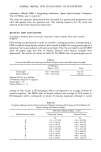
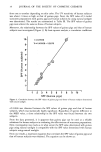
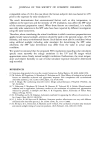
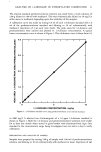
24 JOURNAL OF THE SOCIETY OF COSMETIC CHEMISTS giving and m/e 88 ion. This could be made negligible by extracting the polymer with acetone and toluene. An internal standard method was chosen to maintain instrument calibration and monitor changes in chromatographic conditions due to heavy sample loading of the column. Perdeuterotoluene proved to be an effective internal standard. On the Chromosorb 103 column its retention time is slightly greater than 1,4-dioxane. Therefore it was convenient to use the retention time of perdeuterotoluene to mark the retention time of 1,4-dioxane, expecially in samples containing less than 1 mg/kg 1,4-dioxane. The closeness of their retention times meant that the mass spectrometer had to be open to the GC effluent only during a narrow retention-time window. Compounds eluting at times outside this window are dumped to the atmosphere and do not contaminate the mass spectrometer. The mass spectral fragment monitored for perdeutertoluene is m/e 98. This corresponds to a loss of one deuterium to form the perdeuterotropylium ion. Ions of mass 98 are also typically absent in both column bleed and ethoxylated compounds. Perdeuterotoluene is of course not likely to be found in ethoxylated materials and so it is not necessary to screen samples for it. The concentration of 1,4-dioxane in a sample is calculated from the ratio of the peak area of 1,4-dioxane to the peak area of the perdeuterotoluene added to the sample. The response ratio between 1,4-dioxane and perdeuterotoluene is typically 0.26 and should be checked daily. Using the internal standard method the calibration curve is linear from 0.5 to 1000 mg/kg 1,4-dioxane. The GC/MS software stores chromatograms and allows them to be plotted and integrated at different thresholds, thereby avoiding sample reruns. The selectivity of detection and simplicity of sample preparation make possible the analysis time of 15 min per sample. Data collected during the CTFA round robin are listed in Table III. The data obtained by the GC/MS method compare favorably with the data obtained by other laborato- ries analyzing the samples by the Birkel procedure. CONCLUSION The use of a GC/MS selective ion monitoring technique for the analysis of 1,4-dioxane has allowed the development of a method which is rapid, selective, useable for a wide Table III Comparison of GC/MS Data and Birkel Data Obtained by CTFA (1). 1,4-Dioxane, mg/kg Sample GC/MS • Birkel 2 Sodium Laureth Sulfate A Sodium Laureth Sulfate B Polysorbate 60 A Polysorbate 60 B 87 _+ 2 92 _+ 4 9.2 -+ 0.3 9.3 -+ 1.5 0.5 0.5 6.5 _+ 0.2 8.0 _+ 0.4 PEG-8 A 12 + 0.1 14 + 0.7 PEG-8 B 1.0 + 0.1 1.0 + 0.1 aBased on triplicate analysis. 2Average of the five laboratories performing the unmodified Birkel procedure. Standard deviations are based on triplicate analysis by each laboratory then averaged for all five.
Purchased for the exclusive use of nofirst nolast (unknown)
From: SCC Media Library & Resource Center (library.scconline.org)