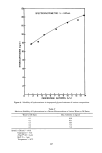
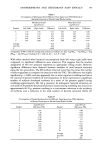
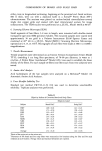
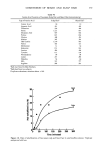
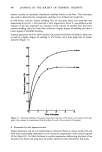
COMPARISON OF BEARD AND SCALP HAIR 369 11. Permanent Set The percent set imparted to scalp and facial hair fibers of similar diameters, when treated at 30% extension in boiling 5% sodium bisulfite for 30 minutes, followed by 30 minute relaxation in boiling distilled water, was determined. At least four fibers per sample were analyzed and the values averaged. 12. Supercontraction The contraction of hair fibers, when treated in the relaxed state, at the boil, for 30 minutes with 5% sodium bisulfite, followed by 30 minute relaxation in distilled water at room temperature and air drying, was calculated. Four fibers per sample were analyzed.

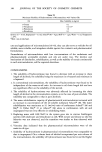
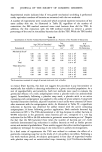
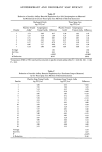
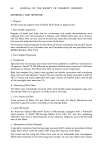
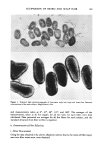
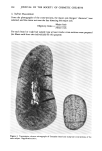
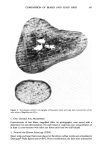
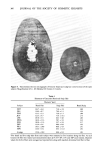
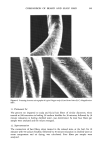
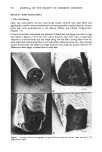
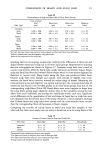
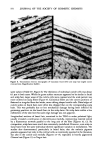
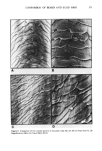
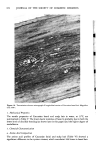
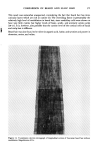
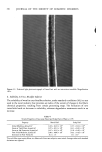
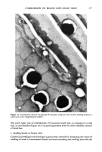
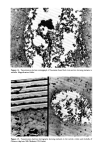
370 JOURNAL OF THE SOCIETY OF COSMETIC CHEMISTS RESULTS AND DISCUSSION 1. Fiber Morphology Light and transmission electron microscopy studies showed that scalp fibers had significantly smaller cross-sectional areas and were generally circular-elliptical, whereas facial hairs were asymmetrical, in the oblong, kidney, and trilobal configurations (Figures 1-4). In the ten Caucasian individuals, the diameter of beard hair was larger than that of scalp hair (Table I, Figures 2-4). It has to be noted, however, that there was a considerable variation in cross-sectional size and shape along the hair fiber, among fibers from the same individual, and among fibers from individuals within the same race. The variation can be illustrated by the range of average diameters and ellipticity indices (Tables I-II). Differences were larger in beard then in scalp hair. C.- D Figure 7. Scanning electron micrographs of typical Chinese scalp hair (A) and beard hairs (B, C, D). Magnification 400 x.
Purchased for the exclusive use of nofirst nolast (unknown)
From: SCC Media Library & Resource Center (library.scconline.org)