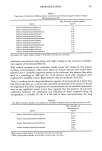
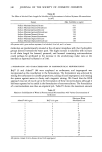
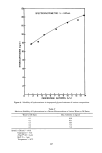
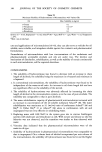
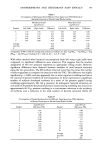
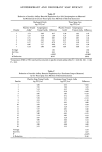
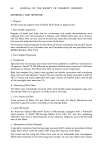
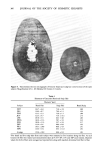
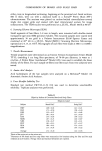
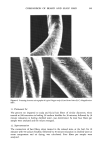
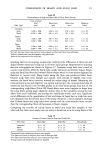
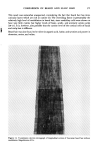
COMPARISON OF BEARD AND SCALP HAIR 371 Table III Characterization of Scalp and Beard Hair of Three Racial Groups Fiber Type a Cross-sectional Area b Major Axis Minor Axis (/am 2) (/am) (/am) Ellipticity Index c Caucasian Scalp 6,300 _+ 1000 110.8 _+ 11.0 67.8 _+ 23.8 1.6 _+ 0.3 Beard 10,700 _+ 1400 164.4 +_ 14.1 79.7 -+ 16.8 2.1 _+ 0.5 Chinese Scalp 7,600 _+ 2300 106.4 _+ 18.3 82.8 _+ 10.2 1.3 _+ 0.2 Beard 14,100 _+ 3900 171.3 -+ 29.3 94.4 _+ 24.1 1.9 -+ 0.5 Negro Scalp 6,200 +_ 1200 118.8 _+ 15.2 66.1 _+ 15.1 1.9 -+ 0.4 Beard 12,900 _+ 4400 172.7 _+ 31.1 84.6 _+ 20.2 2.1 +_ 0.4 aFor each hair type twelve cross-sections were prepared, six fibers each from two individuals. bindirect measurement from photographs using planimeter. CRatio of the major axis to the minor axis. Scanning electron microscopy studies also confirmed the differences in fiber size and shape between beard and scalp hair in all three racial groups. Representative scanning electron micrographs are shown in Figures 5-7. Caucasian scalp hairs were round or oval in cross-section, while the beard hairs usually had more asymmetric shapes. Negro scalp and facial hair fibers had twisted ribbon shapes which in cross-section appeared as flattened or curved ovals. Sharp twists along the fiber axis produced kinky hairs. Chinese scalp hairs were straight and regular, with circular or slightly oval cross- sections the beard hairs, however, showed the widest range of shapes. Measuring the cross-sectional areas and ellipticity via optical microscopy, the cross-sectional area of beard hair was found to be 70-1009'3 greater in all three racial groups than that of the corresponding scalp fibers (Table III). Beard fibers were more irregular in shape than the scalp fibers, giving larger ellipticity indices. Due to the variability among the hair fibers from each individual and among the individuals within each race, significant racial differences in the quantitation of size and shape of beard hair or scalp hair were not obtained from the limited data of this study. However, a trend emerged, showing that Chinese beard and scalp hairs were coarser and the cross-sections more circular than the corresponding fibers of Caucasian or Negro origins. Comparing the number of cuticle layers in beard and scalp hair samples, it was observed that there were nearly twice as many in facial hair as in the scalp fibers of the Table IV Number of Cuticle Layers in Beard and Scalp Hair a Fiber Type Beard Hair Scalp Hair Beard/Scalp Caucasian b 10.3 +_ 1.6 6.4 _+ 1.4 1.7 _+ 0.4 Black c 8.3 -+ 2.1 5.3 _+ 1.5 1.7 _+ 0.8 Chinese • 11.5 +_ 1.9 6.3 -+ 1.2 1.8 _+ 0.2 aDetermined from transmission electron micrographs. bFive fibers each from six subjects four cross-sections per fiber. CFive fibers each from four subjects four cross-sections per fiber. Average values and standard deviations are reported.

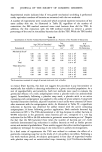
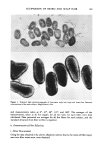
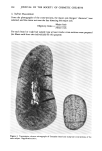
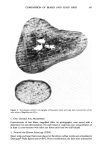
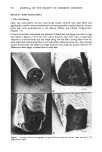
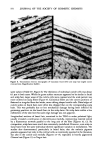
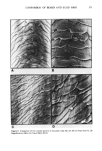
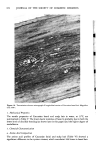
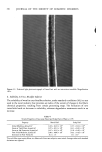
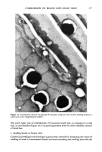
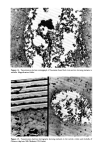
372 JOURNAL OF THE SOCIETY OF COSMETIC CHEMISTS - . • ß . • ---- - . , •..•.•- . •.• ...... •.. . • ß -- . --,• • •. - • ..- -. • •.,* , • '• ., • ,•..•-. • ' •-. . • ....• . : • •' .... : • • . .. . • . , -- . -•-• Figure 8. Transmission electron micrographs of Caucasian beard (left) and scalp hair (right) cuticle cross-sections. Magnification 36,•x. same subject (Table IV, Figure 8). The thickness of individual cuticle cells was about 0.5/xm in both cases. While the gross surface structure appeared to be similar in facial and scalp hair, larger areas of the cuticle cells were exposed and the scale pattern was more ordered on scalp fibers (Figure 9). Cylindrical fibers and the convex portions of flattened or irregular fibers had wider, more oblong shaped cuticle cells. Distal edges of cuticle scales on beard hairs were often less chipped than on the corresponding scalp hairs. This was probably due to less mechanical damage having been inflicted by grooming practices on the beard than on the scalp hairs. On scalp hairs within a few millimeters of the skin line this scale edge damage was not apparent. Longitudinal sections of beard hair, examined in the TEM or under polarized light, usually revealed a continuous or discontinuous medulla, representing material joined by a filamentous network parallel to the long axis of the fiber (Figures 10, 12). By comparison, scalp hairs were much less extensively medullated. However, even scalp or facial hairs from the same individual showed significant variation in medullation. The studies also demonstrated, particularly in beard hairs, that the melanin pigment granules appeared not only in the cortical cells, as commonly reported in the literature, but also in the cuticle and medulla (Figures 13-14), especially in heavily pigmented Chinese hair (Figure 15) or Negro hair.
Purchased for the exclusive use of nofirst nolast (unknown)
From: SCC Media Library & Resource Center (library.scconline.org)