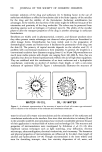
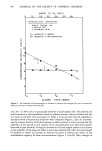
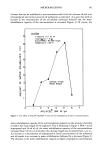
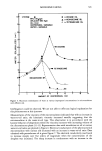
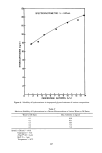
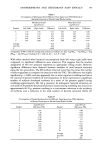
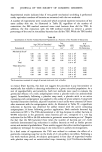
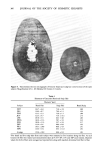
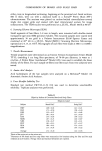
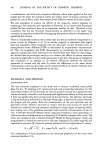
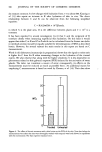
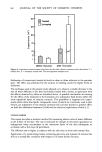
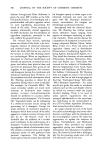
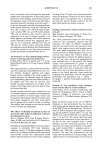
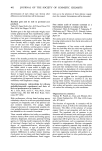
338 JOURNAL OF THE SOCIETY OF COSMETIC CHEMISTS E WATER TO OIL RATIO 0 O, I O. 2 0.3 0.4 O. 5 0.6 MICROE MULSION COMPOSITION Sodium Steorote Igm n-Pentonol 8 ml n-Tetrodecone I0 ml A= Solubility in Alcohol B= Solubility in Microemulsions o i I I C 4 C 5 C 6 C 7 ALCOHOL CHAIN LENGTH Figure 2. The solubility of hydrocortisone in alcohols of various chain lengths (A), and in microemul- sions as a function of water-to-oil ratio (B). mol. dm -3 at 20øC (27). It is practically insoluble in hydrocarbon oils. The solubility of hydrocortisone in microemulsions based on sodium stearate, various alcohols and oils at a water-to-oil ratio of 0.10 are given in Table I. It can be seen that the solubility is maximum with n-butanol and minimum with n-heptanol (Figure 2, Line A). Consider- ing the volume fraction of alcohols present in these systems, it may be noted that the solubility of the steroid in unit volume of the microemulsion is at least twice greater than that in pure alcohols. Though an increase in oil chain length results in an increase in the solubility of the drug, the effect is much less marked than when the chain length of alcohols is varied. An increase in water-to-oil ratios is without any effect on the solubilization capacity of these microemulsions (Figure 2, Line B). Also, changes in

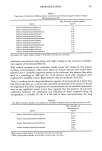
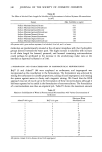
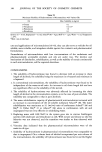
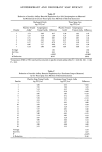
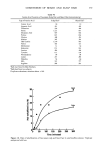
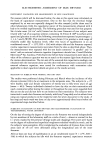
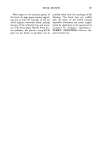
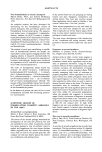
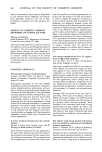
MICROEMULSIONS 339 Table I Dependence of Solubility of Hydrocortisone on Alcohol and Oil Chain Length in Sodium Stearate Microemulsions at 20øC Max. Solubility of Hydrocortisone System mg/ml Sodium Sodium Sodium Sodium Sodium Sodium Stearate/butanol/hexane Stearate/butanol/decane Stearate/butanol/tetradecane Stearate/pentanol/hexane Stearate/pentanol/decane Stearate/pentanol/tetradecane Sodium Stearate/hexanol/hexane Sodium Stearate/hexanol/decane Sodium Stearate/hexanol/tetradecane Sodium Stearate/heptanol/hexane Sodium Stearate/heptanol/decane Sodium Stearate/heptanol/tetradecane 7.32 7.70 8.70 5.05 6.06 6.3O 4.3O 4.92 5.05 3.53 3.78 3.65 All systems with 1 gram sodium stearate, 8 ml alcohol, 10 ml oil, and 1 ml water. surfactant concentration bring about only slight changes in the maximum solubiliza- tion capacity of the steroid (Table II). With sodium myristate as the surfactant, similar trends were observed. The sodium myristate microemulsions unlike those based on sodium stearate were turbid when prepared due to insoluble impurities present in the surfactant, but became clear when spun in a centrifuge at 5000 rpm for 15-20 minutes. Such clear emulsions were employed for solubility studies. Representative data are tabulated (Table III). Thus, it is evident that the drug solubilization capacity of microemulsions is better than that of pure alcohols on a volume basis of alcohol incorporated in the system. It should be emphasized that other components of microemulsions do not solubilize hydrocorti- sone to any significant extent. It has been reported that the presence of non-ionic surfactants facilitates the dissolution and solubility of water insoluble drugs by incorporation in micelies (27-28). It is felt that in these microemulsions, the drug Table II The Effect of Sodium Stearate Concentration On Solubility of Hydrocortisone in Microemulsions at 20øC System Max. Solubility of Hydrocortisone. mg/ml Sodium Stearate/butanol/tetradecane Sodium Stearate/pentanol/tetradecane Sodium Stearate/hexanol/tetradecane Sodium Stearate/heptanol/tetradecane 8.7* 9.34** 6.30* 7.58** 5.05* 5.68** 3.66' 4.67** *With 1 gram sodium stearate, 8 ml alcohol, 10 ml oil, and 2 ml water. **With 2 gram sodium stearate, 8 ml alcohol, 10 ml oil, and 2 ml water.
Purchased for the exclusive use of nofirst nolast (unknown)
From: SCC Media Library & Resource Center (library.scconline.org)