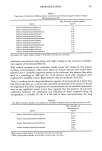
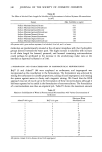
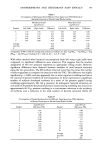
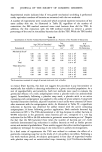
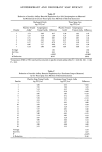
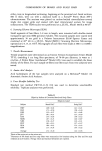
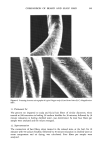
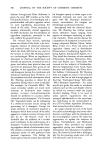
340 .JOURNAL OF THE SOCIETY OF COSMETIC CHEMISTS Table III The Effect of Alcohol Chain Length On Solubility of Hydrocortisone in Sodium Myristate Microemulsions at 20øC System Max. Solubility in mg/ml Sodium Myristate/butanol/decane 8.21 Sodium Myristate/butanol/tetradecane 8.83 Sodium Myristate/pentanol/decane 6.56 Sodium Myristate/pentanol/tetradecane 5.80 Sodium Myristate/hexanol/decane 5.30 Sodium Myristate/hexanol/tetradecane 4.97 Sodium Myristate/heptanol/decane 3.80 Sodium Myristate/heptanol/tetradecane 3.66 All systems with 1 gram sodium myristate, 8 ml alcohol, 10 ml oil, and 1 ml water. molecules are predominantly situated at the oil-water interphase with their hydrophilic groups directed towards the water pool. The slight increase in solubility with increase in oil chain length for butanol, pentanol, and hexanol containing microemulsions could perhaps be attributed to the increase in the alcohol/soap molar ratio at the interface as reported by Bansal et al. (30). 2. PREPARATION AND CHARACTERIZATION OF PHARMACEUTICAL MICROEMULSIONS Brij © 35 and Arlacel © 186 were employed as surfactants, and isopropanol was incorporated as the cosurfac'tant in the formulation. The formulation was achieved by mixing the surfactants in suitable proportions, adding oil and isopropanol, and titrating the system against water to clarity with magnetic stirring. We found that the HLB approach was not of much use in the formulation of these microemulsions although it has been reported to be useful in the formulation of macroemulsions. The formulation of a microemulsion was thus an empirical job. Table IV shows the maximum amount Table IV Maximum Solubilization of Water in Pharmaceutical Microemulsions with Various Concentrations of Surfactants Maximum Water Arlacel © 186 in gms Brij © 35 in gms Solubilized in ml 1 5 0 1 4 0 1 3 0 1 2 0 2 4 3.1 2 3 2.0 2 2 1.3 2 1 0.5 3 3 2.5 3 2 2.6 3 1 2.1 4 2 7.0 4 1 4.0 5 1 8.2 6 0 1.4 All systems contain 10 ml n-decane oil and 4 ml isopropanol.

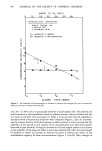
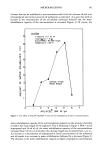
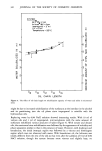
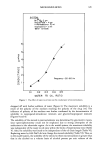
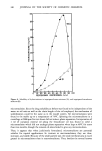
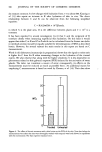
MICROEMULSIONS 341 of water that can be solubilized in microemulsions with 10 ml of n-decane oil and 4 ml of isopropanol and various amounts of surfactants as indicated. It is seen that with an increase in the concentration of the oil soluble surfactant Arlacel © 186, the water solubilization capacity of the microemulsion is increased (Figure 3). Of course, the 9 4 SYSTEM: n-Decone oil" I0 ml Isoprop,•ono I = •r ir• Arlace 1ø186 + 5= 6gm Temperature = 20 øC Isotropic Sing le Phase Region i i i i 0 I 2 3 4 5 6 7 ARLACE• 186 IN gm. Figure 3. The effect of Arlacel © 186/Brij © 35 ratio on the solubilization of water in microemulsions. water solubilization capacity of the microemulsions depends on the amount of alcohol as well as the chain length of oil employed. This is illustrated in Figure 4. With 3 ml of isopropanol and 10 ml of oil, the water solubilization capacity of the microemulsions increased from 5.0 ml to 5.9 ml when the oil chain length was increased from C8 to C•6. An increase in concentration of isopropanol at fixed concentrations of the surfactant and oil results in an increase in water solubilization followed by a decrease (Figure 5). The decrease in the water solubilization capacity at higher isopropanol concentrations
Purchased for the exclusive use of nofirst nolast (unknown)
From: SCC Media Library & Resource Center (library.scconline.org)