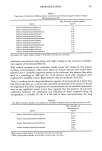
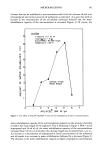
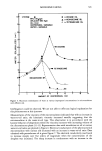
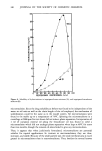
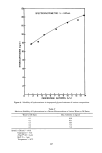
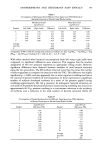
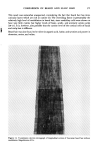
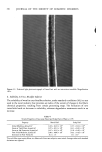
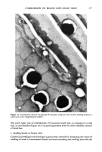
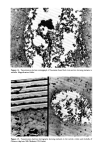
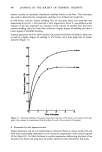
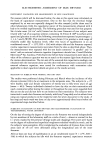
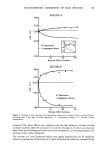
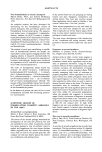
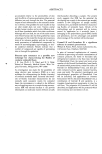
ELECTROMETRIC ASSESSMENT OF SKIN DRYNESS 389 SECTION A 0.80[ 0.32[ .'_ --•ø• ø'•ø'•'"'"'ø'--'--o o o •0 -0.64 I .10 I- ß I ß Capacitance I I• '•" •:'• ' .•:e I I I i i i io 2o 3o Minutes After Occlusion SECT/ON 0.80 - 0.52 y 0.00 -0.64 -o • ß Capacitance o•. o Impedance (100 Hz) -i .60 I i i i0 20 30 Minutes After Occlusion Figure 4. Changes in skin capacitance and impedance measured in normal (A) and dry skin (B) after occlusion with a thin film of white petrolatum. T = petrolatum treated, U = pre-test control measurement. measured. The latter effects are consistent with the low dielectric constant of this occlusive material. Both the increase in C and the decrease in Z which are observed after a brief time following occlusion have been interpreted (1,2,3) as being related to an increase in skin surface hydration. The increase in C with hydration (which may appear paradoxical) can be explained based on experiments of Clar [cited in (7)] who found that the dielectric constant (K) of

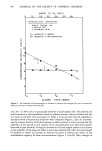
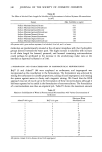
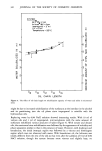
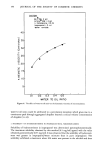
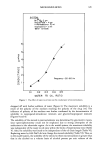
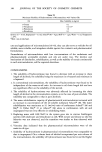
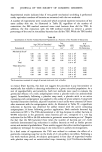
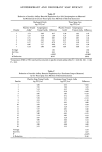
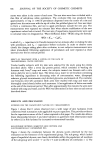
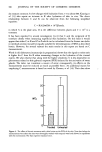
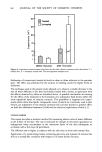
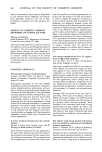
390 JOURNAL OF THE SOCIETY OF COSMETIC CHEMISTS dry stratum corneum in vitro changes with hydration from 2-3 to about 600. Kraning et al. (13) also report an increase in K after hydration of skin in vivo. The direct relationship between C and K can be observed from the following simplified equation: C = KA/[47rD(9 x 10n)]Farads, in which A is the plate area, D is the difference between plates and 9 x i0 n is a constant. It has been reported by several investigators (1,2,3) that C and the reciprocal of R correlate closely when measuring superficial skin hydration. On this basis it would appear that either C or R and Z or 0 which can be calculated from the former two (refer to methods section) would be equally suitable for determinations of WDi as described herein. However, for several reasons the main results in this report are based on C measurements. Work in this laboratory (manuscript in preparation) shows that the signal to noise ratio is higher for C than for R when measuring changes in the hydration of the corneal matrix. We also observe that along with the higher sensitivity, C is less dependent on phenomena related to skin galvanic response (SGR) induced by the activation of sweat glands. The latter can constitute a source of error consequently, its effects on the measurements must be reduced as much as possible (9,11). An additional reason for employing C measurements is based on work by Clausen, et aL (14). Their data show WDi 20 IS 10 0 Treated Untreated Figure 5. The effect of chronic treatment with a skin lotion on the WDi of dry skin. Note that before the measurements were taken the sites were thoroughly washed with soap and water and allowed to equilibrate with the environment. The bars represent standard error.
Purchased for the exclusive use of nofirst nolast (unknown)
From: SCC Media Library & Resource Center (library.scconline.org)