252 JOURNAL OF THE SOCIETY OF COSMETIC CHEMISTS Many therapeutic and cosmetic agents are nonpolar in nature with limited aqueous solubility. They readily dissolve in various organic solvents, but use of many of these vehicles is restricted in skin permeation experiments because of their membrane- damaging potential. The objective of the present study was to investigate the interaction of a series of donor solvents with full-thickness hairless mouse skin, using caffeine as a reference compound for skin permeation measurements. The octanol-water partition coefficient of this compound is 1 and it has adequate solubility in various polar and nonpolar solvents, thus making it a suitable candidate for this study. MATERIALS AND METHODS MATERIALS Radiolabeled caffeine was utilized to facilitate skin permeation quantitation. [•4C] caffeine (specific activity, 55.7 mCi/mmol) was obtained from ICN Biomedicals, Costa Mesa, CA, and its radiochemical purity was determined by the manufacturer to be greater than 97%. The radioactivity of experimental samples was measured in a 1217 Rackbeta scintillation counter (LKB Instruments, Gaithersburg, MD) using Liquiscint © (Diagnostic Products Corp., Manville, NJ) as the scintillation fluid. Nonradiolabeled caffeine, chlorobutanol, light mineral oil, n-pentadecane, n-dodecane, n-nonane, n-hep- tane, propylene glycol, n-propanol, and isopropanol were obtained from either Sigma Chemical Co., St. Louis, MO, or Fisher Scientific, Springfield, N J, and used as re- ceived. METHODS Preparation of skin samples. Female hairless mice (Skh 1, Charles River Labs, Wilming- ton, MA), 8-14 weeks old, were used as the source for all skin samples. Animals were sacrificed by cervical dislocation and skin was immediately excised. Subcutaneous fat and underlying tissues were carefully removed from the dermal surface. The skin sam- ples were inspected visually for defects such as tears or holes and used within one half hour after animal sacrifice. Full-thickness skin, from both dorsal and ventral side, was used in initial experiments. The dorsal skin was selected for subsequent use for its ease of handling. Preparation of donor solutions. Nine donor solvents were selected for investigating vehicle- skin interactions. These included: water, propylene glycol, isopropanol, n-propanol, n-heptane, n-nonane, n-dodecane, n-pentadecane, and light mineral oil. Radiolabeled caffeine was mixed with unlabeled compound in an alcoholic solution to obtain a final specific activity of 3.63 mCi/mmol. Different volumes of this solution were placed in glass vials, and following evaporation of alcohol, the residues were dissolved in selected volumes of various solvents to prepare donor solutions. In vitro diffusion studies. A modified flow-through diffusion cell system, similar to that described by Bronaugh et al. (4) was utilized in skin permeation studies. The diffusional area in each cell was 0.64 cm 2. The receptor fluid continuously washed the dermal surface of the skin and was collected into vials placed in the fraction collector. Freshly degassed receptor solution was used in each experiment. The skin surface temperature was maintained at 32øC by adjusting the water bath temperature to 34.5øC. After an

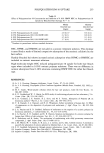
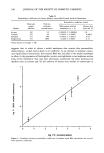
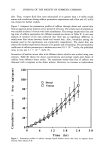
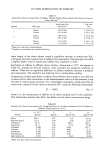
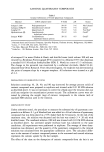
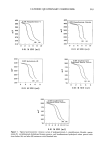
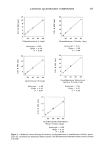
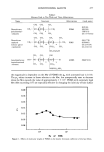
IN VITRO INTERACTION OF VEHICLES 253 initial equilibration period (one half hour), the donor was added to the skin sample mounted in the cell. The fraction collector was set to collect effluent for a desired time interval. Each cell was inspected at different time intervals for the presence of air bubbles under the skin surface. Any bubbles formed during the experiment were removed by tilting the cell. Depletion of the donor was avoided by total replacement with fresh donor solution periodically, as necessary, to maintain the concentration as essentially invariant. The experiment was continued until a sufficient number of samples were collected to allow estimation of the steady-state flux (J). At the end of the experiment, receptor samples, unpenetrated donor (plus cell washings), and skin samples were analyzed for caffeine content by liquid scintillation counting. Data analyses. Raw radioactivity counts were converted to quantities of permeant using counting efficiencies and specific activities. Cumulative amounts of permeant penetrated per unit area were plotted against time and the linear portion of each plot was subjected to linear least square regression to determine steady-state flux and lag time (t L) for that penetration experiment. The permeability coefficient (Kp) was calculated by dividing steady-state flux by the donor concentration of penetrant. Caffeine solubility studies. The solubility of caffeine in various solvents was determined by adding an excess amount of nonradiolabeled caffeine to 10 ml of solvent in test tubes. The tubes were kept for one week in a water bath maintained at 32øC and shaken at regular intervals. The solutions were then filtered through 0.45 ptm disposable filters and analyzed spectrophotometrically. Caffeine content was determined using calibration curves of caffeine constructed with the solvents. Statistical analyses. All data were evaluated using analysis of variance (ANOVA). Dif- ferences between means were considered significant if p was less than 0.05. RESULTS AND DISCUSSION Experiments were carried out to determine the effects of receptor fluid flow rate on the permeation of caffeine through hairless mouse skin. The use of a low flow rate may give rise to a large stagnant layer and reduced dermal permeation. Two flow rates, 1.0 and 3.0 ml/hr, were selected, and permeation experiments were carried out using full- thickness dorsal skin and an aqueous caffeine solution as donor. As shown in Table I, steady-state caffeine fluxes obtained at both flow rates were statistically indistinguish- Table I Steady-State Fluxes of Caffeine Through Female Hairless Mouse Skin at Different Receptor Fluid Flow Rates From an Aqueous Donor Solution a'b Flow rate Steady-state flux Animal (ml/hr) (ng/cm2/hr) ! !.0 3.83 (0.35) 3.0 3.83 (0.12) 2 !.0 3.97 (0.25) 3.0 4.10 (0.26) Mean of at least three determinations. Numbers in parentheses are standard deviations.
Purchased for the exclusive use of nofirst nolast (unknown)
From: SCC Media Library & Resource Center (library.scconline.org)