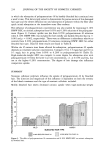
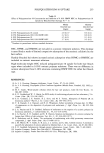
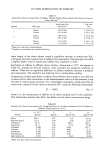
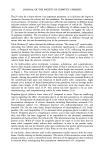
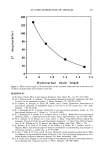
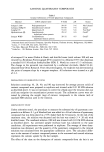
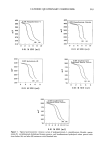
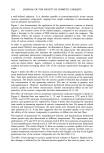
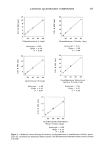
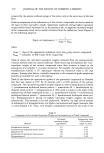
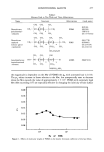
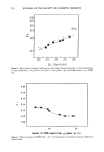
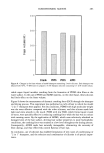
256 JOURNAL OF THE SOCIETY OF COSMETIC CHEMISTS The J* value for a donor solvent is an important parameter, as it indicates the degree of interaction between the solvent and the membrane. For saturated solutions containing excess permeant, the product of the partition coefficient and solubility in different donor solutions remains constant and does not change irrespective of vehicle (6). Therefore, differences in the values of J* reflect differences in diffusivity of caffeine caused by the interactions of various solvents with the membrane. Generally, the higher the value of J*, the more the interaction between the donor solvent and the membrane, independent of permeant solubility. The viscosities of various donor solutions were assumed not to significantly affect the steady-state permeation of caffeine, as diffusion through the mouse skin was the rate-determining step in the permeation process. Table III shows J* values obtained for different solvents. The values of J* varied widely, indicating that vehicle-skin interactions contributed significantly to caffeine perme- ation. n-Propanol was found to have the highest value of J*, indicating the greatest interaction between this solvent and the mouse skin among the various solvents inves- tigated. Isopropanol provided a much lower value of J* compared to n-propanol. The higher values of J* associated with these alcohols may be related to their ability to remove lipids from the stratum corneum (7,8). In the hydrocarbon series (n-heptane, n-nonane, n-dodecane, and n-pentadecane), shorter chain length compounds had higher values of flux at saturation and, in fact, the value of J* decreased exponentially as the carbon chain length was increased, as shown in Figure 2. This indicated that shorter carbon chain length hydrocarbons exhibited greater interactions with the hairless mouse skin than the longer chain length com- pounds. Among the possible effects of short-chain hydrocarbons are increased fluidity of the intercellular lipid layer and extraction of lipids and/or other components. Light mineral oil (a mixture of liquid hydrocarbons from petroleum with an average hydro- carbon chain length of 30) provided the least interaction with the mouse skin, as indicated by the lowest value of J*. This solvent has been reported to be an inert, noninteracting, and nonpenetrating vehicle by other workers (2,9). Propylene glycol yielded a lower value of J* compared to water. There are conflicting reports regarding the effect of propylene glycol on the skin penetration of compounds (10-17). Incorporation of propylene glycol in the vehicle has been found to enhance the percutaneous absorption of various chemicals including fluocinolone acetonide (10), betamethasone valerate (! 1), diflorasone diacetate (12), trifluorothymidine (13), and estradiol (14). On the other hand, dermal absorption of chloramphenicol (15), butyl- paraben (16), and theophylline (17) is decreased when propylene glycol is added to the vehicle. Propylene glycol is a hygroscopic solvent, and it may cause dehydration of the skin this effect has been suggested to be responsible for the decreased transdermal permeation of chemical from this vehicle (18). This phenomenon may be operative in the present study. While J* values for propylene glycol are equal to or less than that for water when compared under infinite dose conditions, as seen in the present study, similar results may not be obtained under open conditions that permit rapid evaporation of volatile solvents and formation of thin films on the skin surface (19). In conclusion, donor solvents used in skin permeation studies interact with the mem- brane, thereby altering its barrier properties. The extent of this interaction varies widely among solvents, as seen in the present study. Selection of the appropriate donor medium is essential when investigating skin penetration characteristics of a compound.

IN VITRO INTERACTION OF VEHICLES 257 140 120 - 100 - 81)- 20- I I I I 6 8 10 12 14 16 Hydrocarbon chain length Figure 2. Effect of chain length of the hydrocarbons on the calculated steady-state flux at saturation (J*) of caffeine through female dorsal hairless mouse skin. REFERENCES (1) B. Idson, Vehicle effects in percutaneous absorption, Drug. Metab. Rev., 14, 207-222 (1983). (2) M. S. Roberts and R. A. Anderson, The percutaneous absorption ofphenolic compounds: The effect of vehicle on the penetration of phenol, J. Pharm. Pharmacol., 27, 599-605 (1975). (3) H. Schaefer, G. Stuttgen, A. Zesch, W. Schalla, and J. Gazith, Quantitative determination of percutaneous absorption of radiolabeled drugs in vitro and in vivo by human skin, Curr. Probl. Dermatol., 7, 80-94 (1978). (4) R. L. Bronaugh and R. F. Stewart, Method for in vitro percutaneous absorption studies. IV. The flow-through diffusion cell, J. Pharm. Sci., 74, 64-67 (1985). (5) R. L. Bronaugh, R. F. Stewart, E. R. Congdon, and A. L. Giles Jr., Method for in vitro percutaneous absorption studies. I. comparison with in vivo results, Toxicol. Appl. Pharmacol., 62, 474-480 (1982). (6) W. J. Addicks, N. D. Weiner, R. L. Curl, and G. L. Flynn, "Drug Delivery From Topical For- mulations: Theoretical Prediction and Experimental Assessment," in Topical Drug Delivery Formula- tions, D. W. Osborne and A. H. Amann, Eds. (Marcel Dekker, New York, 1990), p. 239. (7) K. Knutson, R. O. Potts, D. B. Guzek, G. M. Golden, J. E. McKie, W. J. Lambert, and W. I. Higuchi, Macro- and molecular physical-chemical considerations in understanding drug transport in the stratum corneum, J. Control. Rel., 2, 67-87 (1985). (8) T. Kai, V. Mak, R. O. Potts, and R. H. Guy, Mechanism of skin penetration enhancement: Effect of n-alkanols on the permeability barrier. Presented at the 15th International Symposium on Con- trolled Release of Bioactive Materials, Abstract 124, Basel, Switzerland, 1988. (9) J. R. Evans and C. Hughes, In vitro methodology for investigating quantitative relationships between skin permeation and compound structure, J. Pharm. Pharmacol., 38, 68P (1986).
Purchased for the exclusive use of nofirst nolast (unknown)
From: SCC Media Library & Resource Center (library.scconline.org)