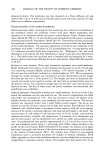
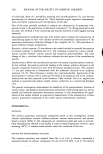
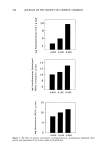
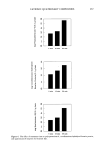
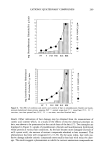
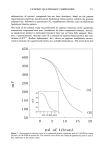
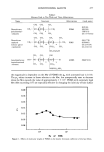
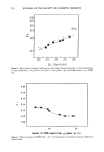
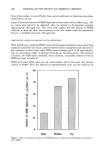
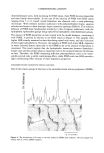
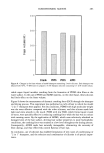
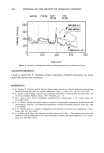
CONDITIONING AGENTS 283 400 3OO 200 o lOO o B 1 ank PDMS POES ADMS Figure 8. Changes in the foam volume of model shampoos containing 2 wt% silicones. Each shampoo was diluted with 40øC, 4 ø DH water to prepare a 0.5% shampoo solution containing 0.3 wt% model sebum. stable vapor-liquid interface resulting from the formation of PDMS thin films at the water surface. In the case of POES and ADMS systems, on the other hand, these silicones had little effect on the foam volume. Figure 9 shows the measurement of dynamic combing force (DCF) through the shampoo and drying process. This experiment was performed on tufts of hair to which the model "2 in 1" shampoos were applied. For dry conditions, PDMS with high molecular weight was the most effective compared with the other silicones, and this silicone made hair light and extra smooth to the touch. POES with low HLB, which forms liquid crystal in water, were specially effective in reducing combing force while the hair was in contact with running water. By the application of ADMS, which were selectively adsorbed on damaged sites of the hair surface, altering hair surface properties to more hydrophobic conditions, the combing force was retained at a low level throughout the drying process. Consequently, ADMS make hair naturally manageable, eliminating the necessity of blow drying, and they effectively control flyaway of hair tips. In conclusion, use of silicones has enabled formulation of new types of conditioning or "2 in 1" shampoos, and the selection and combination of silicones is of special impor- tance.

284 JOURNAL OF THE SOCIETY OF COSMETIC CHEMISTS •ashing rinsing to•el blo• deying deying 8øø f 600 400 2OO 0 o ' POES(HLB=4.6) b., • AI•IS (S•702C) h 2' ','' •'•.. : •&^ _ ,. ] :! '-•' v '\ :. _ '"'%/- ,-,,-•--,,./,. v•,,v : VVXd • _/••22x10 ß I ' I I 200 400 800 800 Time(see) Figure 9. Dynamic combing force during shampooing process as a function of time. ACKNOWLEDGMENTS I wish to thank Mr. S. Onitsuka of Kao Corporation Research Laboratory for many useful discussions and comments. REFERENCES (1) K. Yahagi, N. Hoshino, and H. Hirota, Solution behaviour of new cationic surfactants derived from Guerbet alcohols and their use in hair conditioners. Intern. J. Cosmet. Sci., 13, 221-234 (1991). (2) Y. Suzuki and K. Yahagi, Dynamic and qualitative evaluation of combing force on human hair, The 31th SCCJ Sdentific Meeting, Tokyo, 1991, Preprints, pp. 1-6. (3) M. L. Garcia and J. Diaz, Combability measurements on human hair, J. Soc. Cosmet. Chem. 27, 379-398 (1976). (4) P. A. Winsor, Binary and multicomponent solutions of amphiphilic compounds. Solubilization and the formation, structure, and theoretical significance of liquid crystalline solutions. Chem. Rev., 68, 1-40 (1968). (5) S. R. Wendel and A. J. Disapio, Organofunctional silicones for personal care applications. Cosmet. Toiletr. 98, 103-106 (1983). (6) J. A. Swift and B. Bews, The chemistry of human hair cuticle. Part 3. The isolation and amino acid analysis of various subfractions of the cuticle obtained by pronase and trypsin digestion, J. Soc. Cosmet. Chem. 27, 289-300 (1976).
Purchased for the exclusive use of nofirst nolast (unknown)
From: SCC Media Library & Resource Center (library.scconline.org)