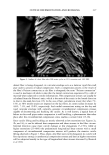
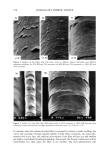
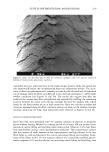
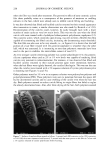
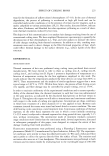
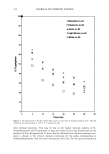
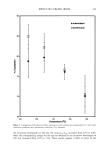
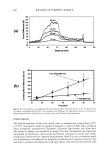
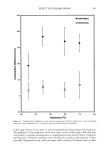
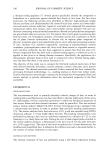
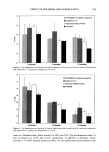
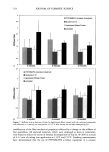
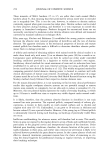
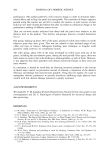
232 JOURNAL OF COSMETIC SCIENCE lOO 7o 6o 4o 3o 2o lO o 0 Bleached, k=.04 [] Piedmont, k=.05 • Asian, k=.03 X Light Brown, k=.04 O White, k=.03 0 5 10 15 20 25 30 35 Time (min) Figure 4. Decomposition of Trp for various fiber types as a function of thermal exposure time. Thermal treatment was administered at 164øC. k is reported in min 1. after thermal treatment. This may be due to the higher thermal stability of N- formylkynurenine and l-kynurenine, or may arise from the fact that kynurenines are the products of Trp decomposition. It must also be addressed that thermal treatment pro- duces a change in the relative emission intensities for the peaks corresponding to N-formylkynurenine (420 nm) and 1-kynurenine (465 nm). For the spectra obtained at

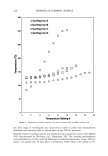
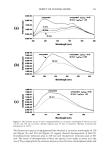
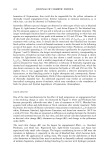
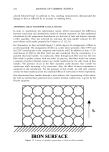
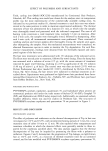
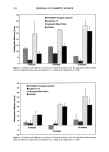
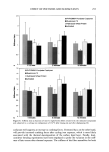
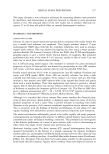
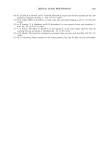
EFFECT OF CURLING IRONS 233 90 85 80 75 70 65 125 • Intermittent [] Continuous 135 145 155 165 Temperature (øC) Figure 5. Comparison of Trp decay for fibers exposed to several curling iron temperatures for 3-min under continuous conditions and intermittent conditions (15-s intervals). the excitation wavelength of 320 nm, the ratio I465/I42 o increased from 0.79 to 0.95, while the corresponding change for the spectra obtained at an excitation wavelength of 450 nm increased from 0.95 to 1.04. These results suggest a shift, in favor of the
Purchased for the exclusive use of nofirst nolast (unknown)
From: SCC Media Library & Resource Center (library.scconline.org)