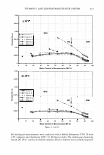
276 JOURNAL OF COSMETIC SCIENCE CONCLUSION From the investigations carried out it can be stated that: 1. The W/O and O/W microemulsion region of the SDS/pentanol/water system behaves as a typical Newtonian fluid: viscosity remains constant for all the shear rates. 2. The ascorbic acid addition to the system causes the viscosity of the microemulsion to increase. The largest Tl increases were observed in the bicontinuous region and at the lowest investigated temperature. The ascorbic acid presence in the system changes its microstructure, which causes changes in the colloidal system's viscosity. REFERENCES (1) T. Beitz, J. Kotz, G. Wolf, E. Kleinpeter, and S. E. Friberg, Poly(N-vinyl-2-pyrrolidone) and 1-octyl- 2-pyrrolidinone modified ionic microemulsions,j. Colloid Interface Sci., 240, 581-589 (2001). (2) P. C. Hiemenz and R. Rajagopalan, "Principles of Colloid and Surface Chemistry, Colloidal Struc tures," in Surfactant Solutions: Association Colloids, 3rd ed. (Marcel Dekker, New York, Basel, Hong Kong, 1997), p. 355. (3) R. Oda, J. Narayanan, P.A. Hassan, C. Monohar, R. A. Salkar, F. Kern, and S. J. Candau, Effect of lipophilicity of the counterion on the viscoelasticity of micellar solutions of cationic surfactants, Langmuir, 14, 4364-4372 (1998). (4) F. Kern, R. Zana, and S. J. Candau, Rheological properties of semidilute and concentrated aqueous solutions of cetyltrimethylammonium chloride in the presence of sodium salicylate and sodium chlo ride, Langmuir, 7, 1344-1351 (1991). (5) R. Makhoufi and R. Cressey, Temperature dependence of the non-Newtonian viscosity of elongated micellar solutions, Colloid Polym. Sci., 270, 1035-1041 (1992). (6) F. Kern, P. Lemarechal, S. J. Candau, and M. E. Cates, Rheological properties of semidilute and concentrated aqueous solutions of cetylttimethylammonium bromide in the presence of potassium bromide, Langmuir, 8, 43 7--440 (1992). (7) J. F. A. Soltero and J.E.Puig, Rheology of the cetyltrimethylammonium tosilate-water system: Linear viscoelastic regime, Langmuir, 12, 2654-2662 (1996). (8) W. J. Kim, S. M. Yang, and M. Kim, Additive effects on the microstructure evolution in hexadec yltrimethylammonium bromide solution and its rheological properties,]. Colloid Interface Sci., 194, 108-119 (1997). (9) P.A. Hassan, S. J. Candau, F. Kern, and C. Monahar, Rheology of wormlike micelles with varying hydrophobicity of the counterion, Langmuir, 14, 6025-6029, (1998). (10) W. J. Kim and S. M. Yang, Effect of sodium salicylate on the microstructure of an aqueous micellar solution and its rheological responses,]. Colloid Interface Sci., 232, 225-234 (2000). (11) S. J. Candau and R. Oda, Linear viscoelasticity of salt-free wormlike micellar solutions, Colloids Surf A Physicochem. Eng. Aspects, 183, 5-14 (2001). (12) A. Knaebel, R. Skouri, J.P. Munch, and S. J. Candau, Structural and rheological properties of hy drophobically modified alkali-soluble emulsion solutions, ]. Polym. Sci. B Polym. Phys., 40, 1985- 1994 (2002). (13) Israelachvili, The science and applications of emulsions-An overview, Colloids Surf A Physicochem. Eng. Aspects, 91, 1-8 (1994). (14) F. Lequeux, Emulsion rheology, Curr. Opin. Colloid Interface Sci., 3, 408--411 (1998). (15) T. G. Mason, New fundamental concepts in emulsion rheology, Curr. Opin. Colloid Interface Sci., 4, 231-238 (1999). (16) S. Peker, K. Bora, and Y. Over, Effect of interfacial properties on drop size distribution of high internal phase ratio emulsions, Colloids Surf A Physicochem. Eng. Aspects, 182, 43-56 (2001). (17) H. A. Barnes, Rheology of emulsions, Colloids Surf A Physicochem. Eng. Aspects, 91, 89-95 (1994). (18) M. Szymula, J. Szczypa, and S. E. Friberg, A comparison between atmospheric and electrochemical oxidation of vitamin C in surfactant system,]. Dispers. Sci. Technol., 23, 1-9 (2002). (19) M. Szymula, Atmospheric oxidation of vitamin C and E in surfactant system,]. Dispers, Sci. Technol., 21, 983-998 (2000).

VITAMIN C AND SDS/PENTANOL/WATER SYSTEM 277 (20) M. Szymula, Atmospheric oxidation of [3-carotene in aqueous, pentanol, SDS microemulsion systems in the presence and absence of vitamin C,j. Dispers. Sci. Technol., 25, 129-137 (2004). (21) M. Szymula, "Antioxidant Activity in Oil-in-Water Microemulsion Stabilized by Anionic Surfac tant," in Annales Universitatis Maria Curie-Sklodowska, Sectio AA Chemia (Lublin, Poland, 2002), vol. LVII, pp. 271-280. (22) M. Szymula and J. Narkiewicz-Michalek, Atmospheric and electrochemical oxidation of ascorbic acid in anionic, nonionic and cationic surfactant system, Colloid Polym. Sci., 281, 1142-1148 (2003). (23) M. Szymula and S. Radzki, A study of molecular complex formation between propyl gallate and ascorbic acid in the microemulsion phase of sodium dodecyl sulphate, pentanol and water system, Colloids Surf B Biointerfaces, 35, 249-257 (2004). (24) M. B. Davies, J. Austtin, and D. A. Partridge, in Vitamin C: Its Chemistry and Biochemistry (Royal Society of Chemistry, Thomas Graham House, Science Park, Cambridge, 1991). (25) Y. K. Han, S. G. Oh, S. I. Shin, W. D. Joung, S. C. Yi, and C. G. Cho, Stability of alkanoyl-6-O ascorbates in various surfactant aggregates systems, Colloids Surf B Biointerfaces, 24, 3 3--44 (2002). (26) L. Zhang, S. Lerner, W. V. Rustrum, and G. A. Hofmann, Electroporation-mediated topical delivery of vitamin C for cosmetic applications, Bioelectrochem. Bioenerg., 48, 453-461 (1999). (27) D. Gopinath, D. Ravi, B. R. Rao, S.S. Apte, D. Renuka, and D. Rambhau, Ascorbyl palmitate vesicles (aseasomes): Formation, characterization and application, Int. j. Pharm., 271, 95-113 (2004). (28) P. Spiclin, M. Hamar, A. Zupancic, and M. Gasperlin, Sodium ascorbyl phosphate in topical micro emulsions, Int. J. Pharm., 256, 65-73 (2003). (29) P. Spiclin, M. Gasperlin, and V. Kmetec, Stability of ascorbyl palmitate in topical microemulsions, Int. J. Pharm., 222, 271-279 (2001). (30) G. M. Silva and PM. B. G. Maia Campos, Histopatological, morphometric and stereological studies of ascorbic acid and magnesium ascorbyl phosphate in a skin care formulation, Int. J. CoSJnet. Sci., 22, 169-179 (2000). (31) M. Gallarate, M. E. Carlotti, M. Trotta, and S. Bovo, On the stability of ascorbic acid in emulsified systems for topical and cosmetic use, Int. J. Pharm., 188, 233-241 (1999). (32) G. Ceve, Lipid vesicles and other colloids as drug carriers on the skin, Adv. Drug Deliv. Rev., 56, 675-711 (2004). (33) S. Magdassi, Delivery systems in cosmetics, Colloids Surf, 123-124, 671-679 (1997). (34) C. C. Miiller-Goymann, Physicochemical characterization of colloidal drug delivery systems such as reverse micelles, vesicles, liquid crystals and nanoparticals for topic administration, Eur. J. Pharmaceut. Biopharrnaceut., 58, 343-356 (2004). (35) L. L. Schramm, The Language of Colloid and Interface Science: A Dictionary of Terms (American Chemical Society, Washington, DC, 1993 ). (36) G. Guerin and A. M Bellocq, Effect of salt on the phase behaviour of ternary system water-pentanol sodium dodecyl sulfate, J. Phys. Chem., 92, 2550-2557 (1988). (37) S. E. Friberg, Ch. Brancewicz, and D.S.Morrison, O/W microemulsion and hydrotropes: The coupling action of a hydrotrope, Langmuir, 10, 2945-2949 (1994). (38) Y. C. Chiu and W. L. Yang, Partition of vitamin E in microemulsion possessing high resistance to oxidation in air, Colloids Surf A Physicochem. Eng. Aspects., 63, 311-322 (1992). (39) Y. C. Chiu and F. C. Jiang, Determination of long-term stability of vitamin E emulsion and formation of microemulsion by using laser light scattering and UV absorption measurements, J. Dispers. Sci. Technol., 20, 449--465 (1999). (40) Poradnik fizykochemiczny (PWN Wyd. Nauk. Tech, Warszawa, 1974) in Polish. (41) K. P. Miszczenko and A. A. Rawdiel, Zbior wielkofci fizykochemicznych (PWN, Warszawa, 1974) rn Polish. ( 42) I. Putilowa, rn Cwiczenia laboratoryjne z chemii koloid6w, wyd (PWN, Warszawa, 195 5) p. 81, rn Polish. (43) E. Cappelaere, R. Cressely, and J.P.Decruppe, Linear and non-linear rheological behaviour of salt-free aqueous CTAB solutions, Colloids Surf A Physicochem. Eng. Aspects, 104, 353-374 0995). (44) G. G. Warr, Shear and elongational rheology of ternary microemulsions, Colloids Surf A Physicochem. Eng. Aspects, 103, 273-279 (1995). (45) M. Fanun, E. Wachtel, B. Antalek, A. Aserin, and N. Gatti, A study of the microstructure of four-component sucrose microemulsions by SAXS, Colloids Surf A Physicochem. Eng. Aspects, 180, 173-186 (2001).
Purchased for the exclusive use of nofirst nolast (unknown)
From: SCC Media Library & Resource Center (library.scconline.org)