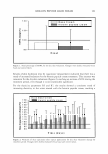
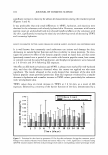
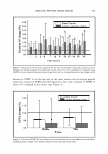
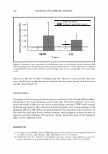
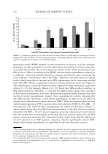
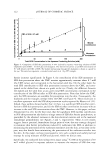
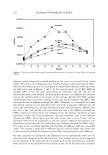
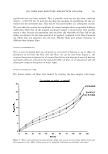
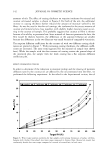
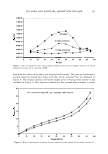
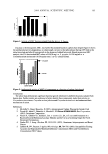
SDS MICELLES IN SKIN BARRIER PERTURBATION 123 penetrate into the skin barrier in the presence of glycerol (corresponding to the triangles in Figure 4). It is interesting to observe that the triangles and the diamonds overlap below the CMC in Figure 4. At an SDS concentration below the CMC of SDS (8.7 mM), the SDS aqueous contacting solution essentially consists of SDS monomers contacting the skin. Therefore, upon adding 10 wt% glycerol to the SDS aqueous contacting solution, one can observe that the SDS monomers are not hindered from penetrating into the skin. However, the addition of 10 wt% glycerol to the SDS aqueous contacting solution at concentrations above the CMC significantly impacts SDS skin penetration. Indeed, as can be seen, the presence of 10 wt% glycerol in the SDS contacting solution eliminates almost completely the amount of SDS that can penetrate into the skin barrier from the high SDS concentration contacting solutions. The significant difference be tween the diamonds (or the dashed line) and the triangles (which lie very close to the SDS monomer contribution corresponding to the solid line) clearly shows that SDS micelles, which would have contributed to skin penetration in the absence of 10 w% glycerol, cannot do so in the presence of 10 wt% glycerol in the contacting solution. These in vitro results suggest that the addition of 10 wt% glycerol to the SDS contacting solutions may also represent a simple, yet very useful, practical strategy to mitigate SDS-induced skin barrier perturbation in vivo by preventing the SDS micelles from penetrating into the skin barrier. In the following section, we put forward several hypotheses to explain, from a mecha nistic viewpoint, why glycerol, without affecting the skin penetration ability of the SDS monomers, is able to significantly reduce the ability of the SDS micelles to contribute to SDS skin penetration in vitro. POSSIBLE HYPOTHESES TO EXPLAIN THE EFFECT OF GLYCEROL ON THE OBSERVED IN VITRO DOSE INDEPENDENCE OF SDS SKIN PENETRATION Using micelle stability arguments put forward by Patist et al. (43), Moore et al. (11) have shown that the kinetics of micelle dissolution cannot be invoked to explain the observed dose dependence of SDS skin penetration. Moore et al. have also compared the time constant for the breakup of SDS micelles to replenish the decreased SDS monomer supply to the SC as the SDS molecules penetrate into the skin with the time constant for SDS diffusion across the skin. This comparison has unambiguously shown that the rate-determining step for SDS skin penetration is governed by the diffusion, or the penetration, through the SC and not by the micelle kinetics (11). Furthermore, Moore et al. have shown that micelle disintegration upon impinging on the SC and subsequent absorption by the skin barrier also does not seem to be a plausible mechanism to explain the observed dose dependence of SDS skin penetration (11,44,45). With all of the above in mind, according to Moore et al. J a consistent hypothesis to explain the observed dose dependence of SDS skin penetration considers the ability of SDS micelles to penetrate into the SC, based on a size limitation (11). Without directly measuring the skin aqueous pore radius, r pore • and the pore number density, e/rr, Moore et al. hypothesized6 6 Note that Moore et al. (11), to their credit, compared micelle sizes for free SDS micelles and PEO-bound SDS micelles, using DLS measurements similar to those reported here, and found that the PEO-bound SDS mirPlli h:1d R larger hydrodynamic radius than the free SDS micelle. This observation, along with the observation that the PEO-bound SDS micelle, unlike the free SDS micelle, did not contribute to SDS skin (continued on p. 124)

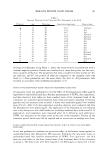
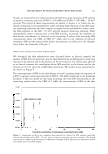
124 JOURNAL OF COSMETIC SCIENCE that a free SDS micelle, being smaller than the aqueous pore, is able to penetrate into the SC, while a PEO-bound SDS micelle, being larger then the aqueous pore, is not able to do so. Our hypothesis to explain the observed dose-dependence of SDS skin penetra tion in the absence of glycerol is similar to that of Moore et al. (11), the difference being that we have further substantiated this hypothesis by directly determining the average skin aqueous pore radius, r pore ' and the pore number density, e!T, of the skin aqueous pores induced by SDS. Considering the skin penetration of both the SDS monomers and the SDS micelles, we have investigated in vitro the following three hypotheses to explain the ability of glycerol to minimize the contribution of SDS micelles to SDS skin penetration: (i) the addition of 10 wt% glycerol to the SDS aqueous contacting solution reduces the concentration of the SDS monomers contacting the skin, and/or (ii) the addition of 10 wt% glycerol to the SDS aqueous contacting solution increases the SDS micelle size relative to that of the skin aqueous pores, such that the larger SDS micelles can no longer penetrate through these aqueous pores into the SC, and/or (iii) the addition of 10 wt% glycerol to the SDS aqueous contacting solution reduces the radius, r p o r e • and the number density, e/'T, of the skin aqueous pores, such that the SDS micelles, which are on average larger than the skin aqueous pores, can no longer penetrate into the SC and contribute to SDS skin pen etration. According to hypothesis (iii), in addition to the decrease in the radius of the aqueous pores, the decrease in the number density of the aqueous pores should further limit the ability of the SDS micelles to penetrate into the SC through these aqueous pores. We have investigated hypothesis (i) by conducting surface tension measurements to deduce the CMC of SDS in aqueous solution in the absence and in the presence of 10 wt% glycerol. Hypothesis (ii) was investigated through DLS measurements to determine the SDS micelle hydrodynamic radius in aqueous solution in the absence and in the presence of 10 wt% glycerol. Finally, we investigated hypothesis (iii), by determining the radius and the number density of the skin aqueous pores induced by aqueous SDS contacting solutions in the absence and in the presence of 10 wt% glycerol through our average skin electrical resistivity and mannitol transdermal permeability measurements, in the context of the hindered-transport porous aqueous pathway model. We discuss the results of studies (i-iii) above in the following three sections. (i) Results from the surface tension measurements to determine the CMC. Recall that the CMC of a SDS aqueous contacting solution is the threshold total SDS concentration above which the concentration of the SDS monomers remains approximately constant, while that of the SDS micelles continues to increase upon increasing the total SDS concen tration. Therefore, if the addition of 10 wt% glycerol to the SDS aqueous contacting solution results in a lowering of the CMC, one may conclude that the number of SDS monomers contacting the skin decreases in the presence of glycerol, which may explain why glycerol reduces SDS skin penetration. However, our surface tension results indicate that the CMC of SDS in the presence of 10 wt% glycerol is 9.2 mM, which is slightly larger than the CMC of SDS in the absence of glycerol (8.7 mM). Our CMC value in (continued) penetration, formed the basis for their hypothesis that SDS micelles can penetrate into the SC, based on a size limitation. However, Moore et al. did not measure the effect of SDS on the radius and on the number density of the skin aqueous pores directly, as is done here.
Purchased for the exclusive use of nofirst nolast (unknown)
From: SCC Media Library & Resource Center (library.scconline.org)