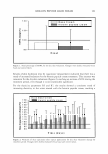
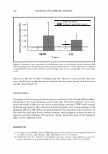
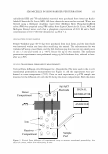
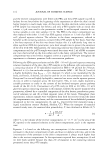
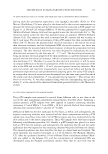
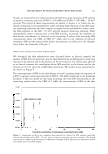
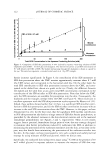
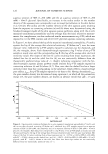
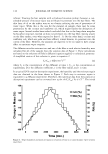
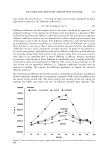
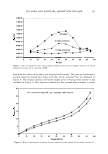
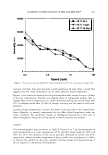
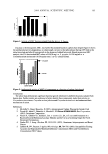
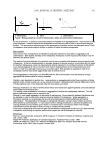
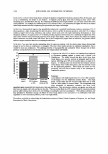
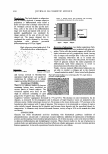
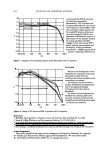
138 JOURNAL OF COSMETIC SCIENCE nificant. Treating the hair samples with oil reduced moisture pickup however, a con siderable amount of moisture vapor was still found to penetrate into the hair fibers. The thin layer of oil on the surface may act as a barrier reducing the rate of penetration of water vapor. While this is the case for the mineral oil sample, there may be some penetration by the coconut and sunflower oil, which might hinder the absorption of water vapor. Several studies have indeed concluded that due to the long-chain nonpolar hydrocarbon structure, mineral oil does not penetrate into the hair fiber, leaving a layer on the fiber surface, even when exposed to heat (1-3). On the other hand, coconut and sunflower oils, which are polar and have affinity toward keratin, do penetrate into the cortex of the fiber. However, the amounts are expected to be too small to have a large effect on moisture vapor sorption. The diffusion rates for moisture into and out of the fiber at each relative humidity were calculated for all of the samples from the sorption data of Figure 1. These calculations are based on the solutions of Ficks's diffusion equation applied to cylindrical geometry. A simplified version of this solution is given in equation 2: C/C e9 = 4(D thr r2) 112 (2) where Cr is the concentration of the diffusant at time t, Ce 9 is the concentration at equilibrium, D is the diffusion coefficient, r is the fiber radius, and t is time. In a typical DVS sorption-desorption experiment, the humidity and the moisture regain data are obtained in the form shown in Figure 2. Each step in moisture regain is equivalent to a diffusion experiment. Therefore, the numerical data from the sorption (or desorption) experiment can be converted into a plot of (C/Ce 9 ) Vs (t/r2 ) 112 • The initial - � en en :i: C: ·- CL C, C: cu 0 130 125 120 115 110 105 100 0 1000 2000 3000 Time (min.) 100 90 -Am(%) -RH(%) 80 70 60 .-. 50 ::c 40 0:: 30 20 10 0 4000 5000 6000 Figure 2. Target humidities and moisture regains as a function of time in a typical dynamic vapor sorption experiment.

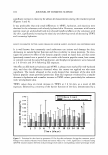
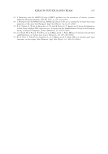
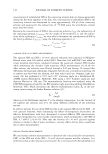
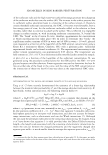
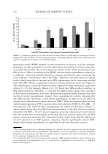
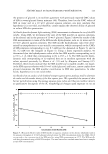
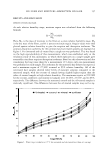
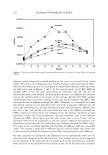
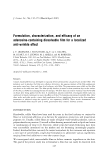
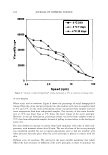
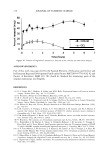
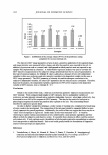
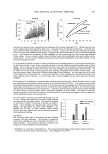
OIL FILMS AND MOISTURE ABSORPTION ON HAIR 139 part of this plot (for (C/C eq ) -0.5) will be linear and its slope (calculated by linear regression) is related to the diffusion coefficient as D = (1r/l6) (slope)2 cm2/s (3) Diffusion coefficients for hair samples used in this work, calculated by equation 3, are displayed in Figure 3 for sorption and in Figure 4 for desorption as a function of RH. It should be noted that the diffusion coefficients obtained by this procedure are apparent diffusion coefficients because they are determined for a fiber sample and an average value of the radius is used in the calculation. True diffusion coefficients can be determined only by establishing concentration profiles as a function of time for diffusion into a single fiber. In Figure 3, we can see that as relative humidity increases from 0%, the diffusion coefficients increase, reach a maximum, and then decrease. In Figure 4, for desorption, we see the same pattern, although the values of the diffusion coefficients at all humidities are somewhat higher than those found in the sorption mode. This is because sorption takes place in an unswollen fiber in which diffusion is difficult, whereas desorption occurs from a swollen fiber in which diffusion is considerably easier. Swelling of the fiber is believed to open several pathways for diffusion. This is true of most materials. In the case of hair we see anomalous behavior, i.e., diffusion coefficients decrease with an increase in swelling. We propose the following hypothesis to explain the observed diffusion behavior. The overall rate of diffusion into the hair cortex is controlled by two factors: (a) diffusion of water molecules through the cell membrane complexes (CMCs) and (b) diffusion into the matrix of the cortical cells. The latter involves the swelling of the cell, which can constrict the CMCs and reduce the rate of diffusion through these channels. This 1.60E-09 1.40E-09 1.20E-09 1.00E-09 8.00E-10 C 6.00E-10 4.00E-10 2.00E-10 0.00E+00 0 -a- control --+-coconut -..- mineral -+--sunflower 10 20 30 40 50 RH(%) 60 70 80 90 100 Figure 3. Plot of calculated water vapor sorption diffusion rates for various oil-treated hair as a function of RH.
Purchased for the exclusive use of nofirst nolast (unknown)
From: SCC Media Library & Resource Center (library.scconline.org)