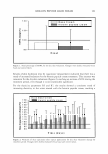
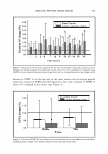
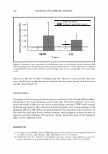
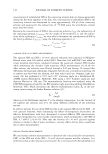
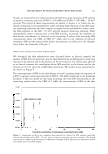
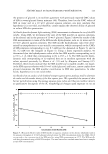
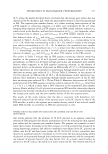
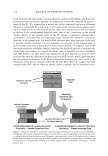
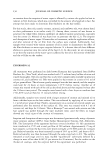
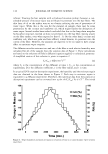
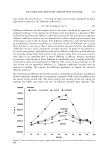
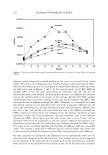
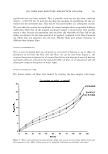
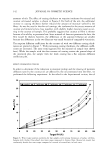
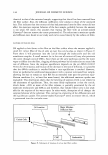
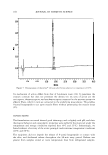
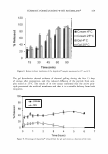
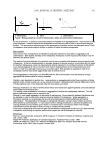
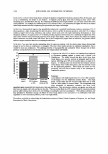
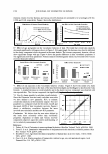
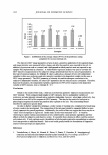
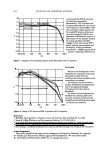
140 JOURNAL OF COSMETIC SCIENCE N.$_ 2.50E-09 ....... ---------------------------------. Untreated 2.00E-09 1.50E-09 1.00E-09 5.00E-10 0.00E+00 +---"T'""-----r-------r------.---.----..-----r-----r------r-----1 0 10 20 30 40 50 RH(%) 60 70 80 90 100 Figure 4. Plot of calculated water vapor desorption diffusion rates for various oil-treated hair as a function of RH. happens mainly because the outward swelling of the cortex is restricted by the cuticle sheath. This directs the swelling pressure inwards, leading to the constriction of CMCs. Based on this realistic picture, we can explain the shape of the diffusion coefficient versus the RH curves seen in Figures 3 and 4. In the sorption mode, at low RH, diffusion through CMCs is fast, but slows down when the molecules cross over into the cell because the matrix is not swollen. As the humidity increases, the diffusion rate increases because the swelling leads to an increase in free volume. Beyond 70% RH, capillary condensation leads to excessive swelling of the cells, which constricts the CMCs, thus reducing the rate of diffusion through the CMCs. Therefore, it is reasonable to assume that during sorption, at low humidities (left side of the maximum), diffusion into the cells is the controlling step. At high humidities (right of the maximum), diffusion into the cells is fast, and therefore the rate-controlling step is the diffusion through the CMCs, which are constricted by the swelling of the cell. During desorption at high humidities (right side of the maximum), the rate-controlling step is the diffusion through the CMCs, which open up as the cells contract due to loss of water. At low humidities (left side of the maximum), as the cells contract, diffusion through these cells slows down and becomes the rate-controlling step. Diffusion through the CMCs is fast. This seems to be a reasonable hypothesis for the shape of diffusion coefficient versus RH curves. This concept is applicable to diffusion into the cuticular sheath also, except that in the cuticle the endocuticle adjacent to the CMC may participate in the diffusion. For both sorption and desorption, the diffusion rates are substantially lower for the oil-treated hair compared to the untreated hair. Two possible reasons can be suggested for the lowering of the regain for the oil-treated hair: (a) the penetrated oil molecules block the sites for the sorption of water and (b) in the case of oil-treated hair, sorption

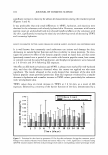
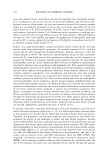
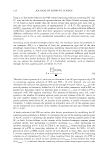
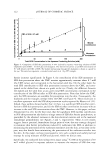
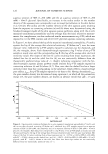
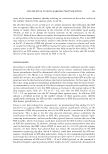
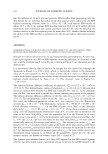
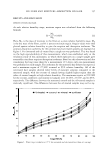
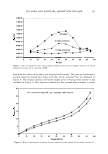
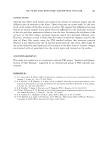
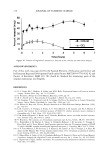
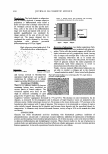
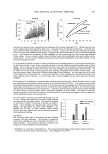
OIL FILMS AND MOISTURE ABSORPTION ON HAIR 141 equilibrium has not been reached. This is possible since we use the same condition (dm/dt = 0.00015 % for 20 min) for deciding the reaching of equilibrium for the un treated and the oil-treated hair. This will be discussed further in a subsequent section. We note that the coconut and sunflower oil-treated samples show comparable diffusion coefficients while that of the mineral oil-treated sample is much lower. The possible reason is that, because of penetration into the fiber, the vegetable oil films left on the surface are thinner, for the same amount of oil applied, compared to the film of mineral oil, which does not penetrate into the hair. Thicker films give greater resistance to diffusion than thinner films. EFFECT OF TEMPERATURE The coconut oil-treated hair was subjected to a low level of heating to see its effect on absorption of oil from the film into the fiber. As can be seen from Figure 5, the sorption-desorption isotherms for oil-treated hair before and after application of heat are essentially identical, indicating the negligible effect of heat on oil absorption and the subsequent sorption-desorption of water vapor. EFFECT OF THICK OIL FILMS The thicker-surface oil films were formed by treating the hair samples with larger 30 25 20 .5 15 C'G 10 5 I-+-- coc-heat -+- control -+-- coconut I untreated coconut coc & heat 0 �--....... --....... --"""T"""--"""T""--......------"""'T"----r----------. 0 10 20 30 40 50 RH(%) 60 70 80 90 100 Figure 5. Water vapor isotherms for untreated hair sample and coconut oil-treated hair samples before and after exposure to heat. Effect of heat seems to be negligible (isotherms are essentially coincident).
Purchased for the exclusive use of nofirst nolast (unknown)
From: SCC Media Library & Resource Center (library.scconline.org)