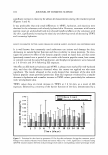
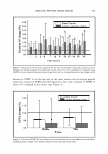
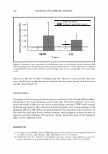
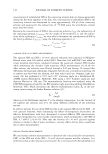
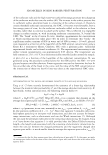
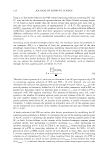
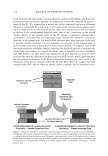
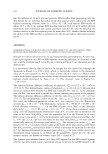
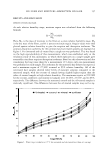
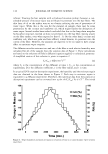
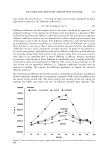
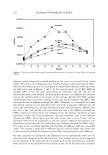
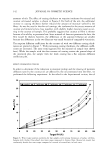
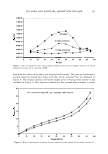
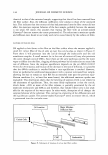
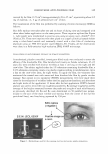
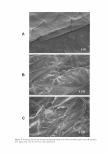
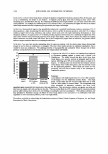
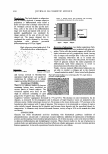
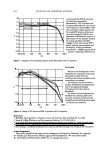
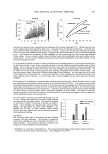
144 JOURNAL OF COSMETIC SCIENCE identical to that of the untreated sample, suggesting that the oil has been removed from the fiber surface. Also, the diffusion coefficients were similar to those of the untreated hair. This indicates that the coconut oil that had penetrated into the fiber cortex did not affect the moisture sorption behavior of the hair sample, probably because the amount is too small. Of course, this assumes that wiping the fiber with an acetone-soaked Kimwipe® does not remove the cortex-penetrated oil. The reductions in moisture uptake and diffusion rates found in our study seem to be caused mostly by the surface oil films. NATURE OF THE OIL FILM Oil applied to hair forms a thin film on the fiber surface where the amount applied is small (0.1 ml/g). Most of the oil ends up near the cuticle edge, as shown in Figure 9. From there it will penetrate into the cuticle through the endocuticle and the cell membrane complex. A small amount (as in the case of coconut oil) may also penetrate the cortex through cortical CMCs. Since these are the same pathways used by the water vapor to diffuse into the fiber, clogging of these pathways by oil molecules can retard the rate of diffusion. Since the sorption equilibrium depends on the set dM/dt (0.0015 %/min for 20 minutes), and because of the decrease in the rate of diffusion, it is possible that the dM/dt condition is satisfied before a true equilibrium is reached. However, when we performed an additional measurement with a coconut oil-treated hair sample, allowing the hair to remain at each RH for an extended time past the previous equi librium condition (i.e., at least five more hours), the additional moisture uptake was negligible. This observation shows that the lowering of sorption levels is not related to the attainment of equilibrium. Thus, the more likely explanation is that the cuticle, which forms ~20% or more of the fiber volume, is partially penetrated by the oil molecules (endocuticle and CMCs), and therefore, that volume (these sites) is not avail able for the sorption of the water vapor. In other words, absorption of oil changes the sorption behavior of the substrate. This can lead to a lowering of the diffusion rate and the equilibrium uptake. The acetone-soaked Kimwipe® seems to remove the oil, which is penetrated into the cuticular zone. Cuticle Cells Oil Location Major Moisture Diffusion Path Figure 9. Schematic of location of oil on hair fiber surface.

OIL FILMS AND MOISTURE ABSORPTION ON HAIR 145 CONCLUSIONS Treating hair fibers with various oils reduced the amount of moisture regain and the diffusion rates of moisture in the fibers. These reductions are caused solely by the layer of oil on the surface of the fiber acting as a barrier. We suggest that differences between various oil-treated samples result partly from the differences in the molecular structure of the oils and their penetration behavior into the hair. Increasing the thickness of the oil layer on the fiber surface increased moisture regain and decreased diffusion rates. However, removing coconut oil from the fiber surface reversed the changes caused by the thin oil films. Our results using the DVS method indicate that moisture sorption behavior is not influenced by the oil that has penetrated into the cortex. This might be due to the relatively small quantities of oil present in the fiber interior. Greater changes are observed with oil penetrated into the cuticle layers and retained on the surface. ACKNOWLEDGMENTS This study was carried out in conjunction with the TRI project "Analysis and Quanti fication of Hair Damage," supported by an international group of TRI corporate par ticipants. REFERENCES (1) A. S. Rele and R. B. Mohile, Effect of mineral oil, sunflower oil, and coconut oil on prevention of hair damage,]. Cosmet. Sci., 54, 175-192 (2003). (2) S. B. Ruetsch, Y. K. Karnath, A. S. Rele, and R. B. Mohile, Secondary ion mass spectrometric inves tigation of penetration of coconut and mineral oils into human hair fibers: Relevance to hair damage, ]. Cosmet. Sci., 52, 169-184 (2001). (3) S. B. Hornby, Y. Appa, S. Ruetsch, and Y. Karnath, IFSCC Magazine, 8, 99-104 (2005). (4) K. Keis, D. Persaud, Y. K. Karnath, and A. S. Rele, Investigation of penetration abilities of various oils into human hair fibers,]. Cosmet Sci., 56, 283-295 (2005). (5) S. P. Chahal, N. I. Challoner, and R. T. Jones, IFSCC Magazine, 3, 19-25 (2000). (6) Y. K. Karnath, A. J. Lyttle, S. B. Ruetsch, and C. Wilrich, "Moisturizing Effect of Haircare Products," Proceedings of XXIth IFSCC International Congress 2000, Berlin.
Purchased for the exclusive use of nofirst nolast (unknown)
From: SCC Media Library & Resource Center (library.scconline.org)