PRODUCTION AND PROPERTIES OF GLASS CONTAINERS 15 Tu• LECTURER: I presume you wish me to refer to Araldites and Epikotes in particular. There is a curing range below which a lacquer is under-cured and above which it is over-cured or burnt. The simplest way of testing this is by colour, and our Lacquering Section provides a series of "swatches" which show the limits of the colour of the final film. There is, however, another lengthy and time-consuming way. The film is sprayed with mixed solvents, left to absorb them, swell and then wiped off. The more a lacquer is cured the greater its resistance to mixed solvents, chloroform, methylated spirits, etc., depending on the type of resin used. The colour of the film is, however, a very good guide. MR. R. K. WALMSLE¾: With reference to plastic nozzles, do you not have a problem of protecting an uncut edge somewhere within the seal ? How do you protect the cut edge of the tube which is unlacquered, from the product ? T• L•CTURER: The raw edge of the metal does not come into contact with the product at all and fits into a flange device in the plastic nozzle. The product thus cannot come into contact with the cut edges. MR. R. K. WALMSLE¾: IS the nozzle applied after lacquering ? TUE LECXtJR•R: Yes, and internal waxing is applied after the plastic nozzle is fitted. For that reason we are experimenting with polypropylene because of the temperatures involved in the waxing operation. PRODUCTION AND PROPERTIES OF GLASS CONTAINERS C. TARRANT* Presented at the Symposium on "Packaging in the Cosmetic Industry", organised by the Society at Harrogate, Yorks., on $th July 1961. The historical origin, composition, chemical durability, surface treatment and flaking of glass are discussed. The protection of light sensitive products is also dealt with. •DEFINITION G•-Ass IS so commonplace a part of everyday experience that a definition is almost unnecessary, yet the term has been applied to such a variety of substances that some preliminary indication should be given as to the type of substance the properties of which are to be considered here. * Key Glass Works, Ltd, London S.E.14.

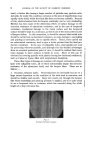
16 JOURNAL OF THE SOCIETY OF COSMETIC CHEMISTS One of the early definitions of glass was given by Christopher Merrett in 1662 in connection with his translation from the Italian of Antonio Neri's L'arte Fetraria ("The Art of Glass"). "Glass is one of the fruits of the fire, which is most true, for it is a thing wholly of art, not of nature, and not to be produced without strong fires. I have heard singular artists merrily to this purpose say, that their profession would be the last in the world, for when God should consume with fire the universe, that then all things would vitrifie and turn to glass." The definition continues to occupy a whole page of text, including twenty- six clauses, of which the twenty-fourth might be considered to be of special interest to chemists: "Brne, beer nor other liquors will (not) make them musty, nor change their colour, nor rust them." Glass does of course appear in nature, though not, as Merrett said, without the agency of "strong fires". It has been used by man from the earliest times of which we have archaeological record and objects shaped by hand from natural glasses by primitive people, have been found in widely separated localities. These natural glasses represent molten rock masses which were extruded and cooled so rapidly that they did not have time to become transformed into the usual aggregate of crystalline materials. The commonest of these glasses, obsidian, is usually translucent and blackish in colour, but is sometimes red, brown and greenish, and some varieties are transparent. It is easily broken into sharp, often elongated pieces, which lend themselves readily to the fashioning of spears, arrowheads and knives, and its use for such purposes by people of Stone Age culture was widespread. In more advanced cultures, obsidian was valued also for ceremonial purposes and for jewe!lery, some of the articles made from it showing a high quality of handicraft. Apart from the natural glasses of igneous origin, there is another group comprising mainly fulgurites and tektites. Fulgurites are formed by light- ning striking sand, or other loose porous materials. Until Franklin discovered the true explanation of lightning, a fulgurite was commonly supposed to be the remains of the lightning bolt. An example found in a sandpit, in the United States in 1925, consisted of 99% silica, the fragments recovered representing a total length of nine feet, with a maximum diameter of three inches tapering to three-sixteenths of an inch. Tektites is the name given to a group of glasses found in many parts of the world, usually considered to be of meteoric origin. An early hypothesis to explain their formation, discredited for some years but recently revived as the result of further investigations, was that they were volcanic bombs shot from the moon during the Pleistocene periods. Other workers have suggested that tektites may be aerial fulgurites, resulting from the fusion by lightning of dust in the
Purchased for the exclusive use of nofirst nolast (unknown)
From: SCC Media Library & Resource Center (library.scconline.org)