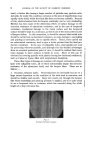
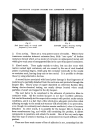
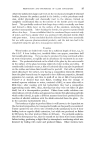
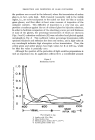
PROTECTIVE LACQUER SYSTEMS FOR ALUMINIUM CONTAINERS 7 ß !•' ' •'• r . •.. '"• ..... Fig. 3. Bad knurl mark in nozzle with fragment of loose metal. ? . . • : ., . .:. '5. '*: -•: ..... • i • ::. pig. 4. Extruded surface showing tearing and bad scoring 2. Cross scoring. These are a very potent source of trouble. Where these transverse scratches intersect extrusion lines, little "sore spots" of broken metal are formed which act as nuclei of corrosion on unlacquered metal, and which give weak areas of unsupported film in the case of lacquered containers. 3. Knurl rn. arks. These apply mainly to tubes, but can also occur with narrow necked rigid containers, and are caused by the use of steel knurled points or printing fingers, which grip the container internally in the nozzle or container neck, leaving deep cuts or torn metal. It is possible to obviate these by using alternative devices. A second factor associated with knurl point damage is that fragments of metal may be partially detached from the neck area and protrude through the lacquer film. Heavy areas of copper deposited on otherwise flawless films during electro-chemical testing, are nearly always located where small partides of swarf are trapped in the dry lacquer. The next factor to be considered is the adhesion of protective films to container walls. All the modern lacquers in use have excellent adhesion, but can fail drastically in this respect after contact with product under certain conditions, and it is a fact that a film which gives adequate protection when adhering strongly to the metal sub-stratum will afford little or no protection, even though its continuity and cohesion remain unaffected, when it becomes detached. In other words, it is possible for the lacquer film to become a loose membraneous bag, and whilst still containing the product, it allows components to penetrate and attack the metal. One of the very early signs that this type of attack is starting, is a pronounced increased stiffness of the product. There are three main causes of loss of adhesion in use, assuming that the

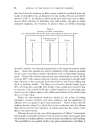
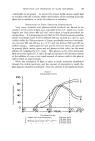
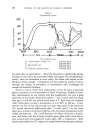
8 JOURNAL OF THE SOCIETY OF COSMETIC CHEMISTS coating material is not at fault in this respect, and that optimum stoving conditions have been observed: 1. L,•bricant Residues remaining under the dried lacquer .film. It is very easy to be misled, as tests on newly applied coatings which have not been in contact with product invariably give equal results to those obtained with specimens free from lubricant residues. It is only after ageing in contact with the product, that adhesion losses become apparent. Much controversy has raged about the part played by the lubricant itself, bearing in mind that the best lubricants for impact extrusion are, quite frequently, those which are the most difficnlt to remove, and in the case of collapsible tubes, no actual degreasing is used--the lubricant is intended to be removed by annealing. Further, that whatever lubricant is used is very strongly attached to the metal surface, and if any appreciable time elapses before annealing in the case of collapsible tubes, or degreasing in the case of rigid containers, it becomes almost impossible to guarantee complete lubricant removal. Many instances are known of adhesion failures in service of containers which have been subjected to, and passed, stringent coating tests when newly produced. There is little doubt that these are due to the fairly long term effects of lubricant residues. 2. Film •Penetrators in the product. Certain ingredients used in many pro- ducts packed in tubes and containers are known to rapidly penetrate the lacquer fihns, particularly epoxy based lacquers. These materials rapidly destroy the adhesive forces at the metal/lacquer interface. Chief among these are the following :-- Irish moss and associated gums. Sodium alginate under certain conditions. Menthol. Methyl salicylate and similar esters. Usually this particular difficulty can be overcome by slight reformulation of the product. With the gums, by substituting tragacanth, karaya, locust bean, sodium carboxymethyl cellulose or methyl cellulose, all of which are innocuous. 3. Oxide Films on the metal. The type of oxide film formed on aluminium containers is dependent on the annealing process in the case of collapsible tubes, the type of degreasing used, and on subsequent drying in the case of rigid containers, and in both cases on the length of time the containers are exposed to atmosphere before application of the lacquer. All these condi- tions should be controlled to give the optimum oxide film for maximum
Purchased for the exclusive use of nofirst nolast (unknown)
From: SCC Media Library & Resource Center (library.scconline.org)