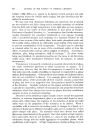
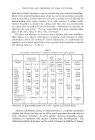
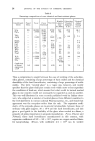
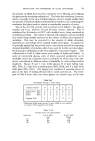
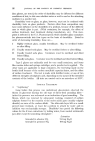
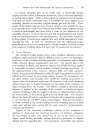
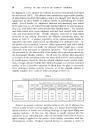
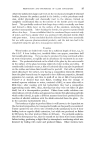
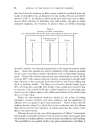
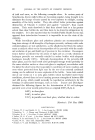
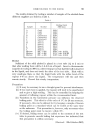
24 JOURNAL OF THE SOCIETY OF COSMETIC CHEMISTS Table 2 Percentage compositions of some chemical and heat resistant glasses Pyrex Kimble Colourless "NeutralAmber Constituent Fused Vycor Flamerex Labora- "Neutral" Oxide Silica Chemical tory Ampoule, Tubing No. N51A G.E.C. G.E.C. SiO2 100 96.300 80.70 57.52 74.7 67.0 64.1 ]3203 -- 2-900 12'00- 5-74 9.6 7'5 7.1 12.60 TiO• -- -- 0.05 -- • 3,. 8.5 } 7.1 AlcOa -- 0.400 2.20- 19.42 f 3-00 5.6 Fe2Oa -- -- 0.08 0.10 -- 4.1 MnO ...... 1.4 CoO -- -- -- 0.01 -- -- -- CaO -- -- 0.20 6.53 0-9 4.0 6.8 MgO -- -- -- 9.20 -- 0.3 0.1 BaO .... 2.2 -- -- ffnO .... 0.1 -- -- Na•O -- 0.020 3-90- 1.10 6.4 8.7 6.3 4.10 K20 I 0.020 I -- 0.5 4.0 3.0 A%O s -- 0.005 0.01 -- 0.03 I __ SO s SbaO a I I O'O09 Coefficient of linear 0-5 0-800 3.30 4.20 4.9 7.3 7.5 expansion x 106 Thus a compromise is sought between the ease of working of the soda-lime- silica glasses, containing a large percentage of basic oxides and the chemical durability of the hard borosilicates, containing a large percentage of acidic oxides. The term "neutral glass" is a vague one, however, and merely specifies that the glass shall pass certain tests which more or less reproduce the conditions of final use, which means that what would be termed neutral glass in one country would not necessarily be regarded as such in another. This was well illustrated in some recently published work by Italian obser- vers, who subjected a number of neutral glasses from different countries to the tests laid down in various national Pharmacopoeias, etc., and found that agreement was the exception rather than the rule. The expansion coeffi- cients of the ampoule glasses are in general intermediate between those of ordinary soda glass (approx. 10 x 10 -6) and the hard borosilicates, and this gives a good guide to the fusibility of the glass when worked in a flame, a property of prime importance in ampoule manufacture. Pyrex, Phoenix and Firrnasil, three hard borosilicates manufactured in this country, with expansion coefficients of 3.2 -- 3.3 x 10 -6, require an oxygen enriched flame for lampworking. Monax, with coefficient 4.4 x 10 -6 can be worked

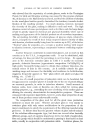
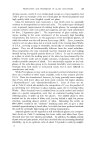
PRODUCTION AND PROPERTIES OF GLASS CONTAINERS 25 with a straight gas-air flame, and is thus suitable for ampoules, and in general glasses with coefficients greater than this can be similarly treated. This includes the well known Wembley M6 White Neutral glass and its related Amber Neutral, for use where protection against U.V. light is required. (At the other extreme, Vycor and fused silica can only be worked in an oxy- hydrogen or similar flame, and the difficulty is further increased by the fact that quartz appears to volatilise appreciably in this temperature range, so that heating cannot be too prolonged.) Finally, optical glasses may be mentioned briefly, these having the greatest diversity of composition because of the lens designers' need for the greatest range of optical properties. They are characterised by almost perfect freedom from physical defects and their quality represents the highest achievement of the glass maker. CHEMICAL DURABILITY The resistance which glass offers to the corroding action of water, of atmospheric agencies (mainly water and carbon dioxide), and of aqueous solutions of acids, bases and salts, is a property of great practical significance and is denoted by the term "chemical durability." In a large proportion of the uses to which glass is put, its power of resisting such attack is the chief reason for its preference over competing materials. An example is the use of glass containers in the distribution of commodities ranging from milk to medicine and acids. In this field the superiority of glass leaves it without. a competitor. Even in chemical manufacturing where the requirements are: more exacting, glass is being used to an increasing extent because of the resistance it offers to surface attack under extreme conditions. In other uses of glass, chemical durability is a secondary factor the requirement of a chemical durability sufficient for the service contemplated, however, places a limit on the composition which may be employed. Examples of such uses are those in •vhich glass is chosen for its optical properties, uses ranging from windows to lens systems. Although glass used for such purposes is not subjected to as drastic treatment as in the preceding cases, nevertheless it is essential that there be no appreciable amount of surface alteration. So important is this property of withstanding corroding agencies that many of the early workers in glass technology, from Merrett onwards, included such resistance in their definitions of glass. While such a definition seems too restrictive, it is well to remember that the earliest users of glass on any scale, peoples of the Mediterranean area replacing earthenware wine containers with those of glass, were much more concerned with the imper- viousness of the surface to attack by the contents than any consideration of transparency or other property.
Purchased for the exclusive use of nofirst nolast (unknown)
From: SCC Media Library & Resource Center (library.scconline.org)