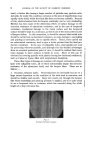
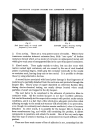
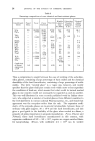
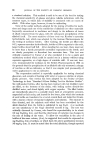
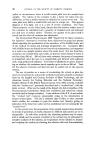
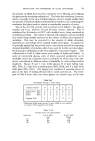
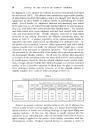
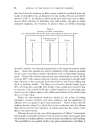
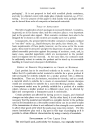
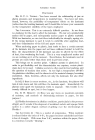
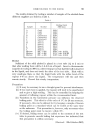
JOURNAL OF THE SOCIETY OF COSMETIC CHEMISTS also found that the tendency to flake cannot readily be predicted from the results of durability tests, as illustrated by the results of Bacon and Birch 5 shown in Table 5. In addition, l_•ister ø stated that while there was no differ- ence in alkali extracted in durability tests with bottles, the glass of which ,contained magnesia, the tendency to produce flakes in bottles containing Table 5 Tendency to Flake v Durability 5 oz. Bottles filled with distilled water and maintained at 95øC for 24 hrs. Titration in mg[x Bottle NaOH/litre Flakes -- B 15 -- D 19 F E 22 -- C 26 F G 28 F A 31 -- 1 38 F F 43 -- j 47 F H 50 F K 81 F alcoholic solutions was directly proportional to the magnesia content of the glass. Turner also pointed out, that the alkalinity of the solution produced by the water extraction tended to disturb the rate at which flakes accumu- lated• Flakes derived from water attack were maintained in contact for 24 hours at 100øC with sodium hydroxide solution, comparable in strength with that obtained at the maxin:um limit per•rissible in the 5 hour boiling test for 4 oz medicine bottles. ]'he flakes were found to dissolute slowly up to 50%, she, wing that, especially with bottles of less satisfactory character due to excessive soda content in the glass, flakes formed at an early stage may tend to go into solution again as the alkali concentration of the extract rises above a certain value. Flakes are also produced relatively quickly by the action of sodium phosphate, citrates, tartrates and saline solutions, and the application of silicones does not appear to give much protection. This is in line with the findings already referred to, which lead to the conclusion that the silicone fihns did not prevent the migration of sodium ions from the surface of the glass to any great extent. Although the most usual cause of the appearance of "flakes" is interaction between glass and bottle contents, there are other possible sources apart f•om the obvious one of glass splinters caused by faulty manufacture and handling. This possibility is one against which every glass manufacturer, and filler, is

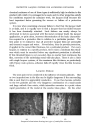
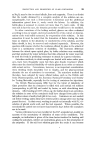
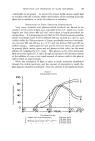
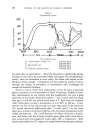
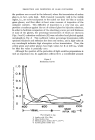
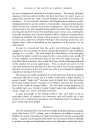
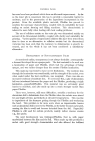
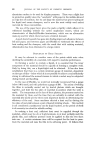
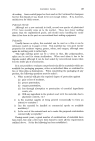
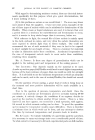
PRODUCTION AND PROPERTIES OF GLASS CONTAINERS 37 continually on his guard. An incorrectly chosen bottle closure might lead to reaction with the contents, whilst deterioration of the material may take place due to oxidation, or under the influence of radiation. PROTECTION OF LIGHT SENSITIVE PREPARATIONS Very many chemical and pharmaceutical products are known to be sensitive to the action of light rays, especially in the U.V. region (i.e., wave- lengths less than about 400 mt•) and amber glass is largely prescribed for storing them. It is interesting to note that the U.S. Pharmocopoeia considers all the wavelength band between 290 and 700 mt• harmful (i.e., all U.V. and visible) whilst the Pharmocopoeia of Japan specifically mentions two bands, one between 290 and 450 mt• (i.e., U.V.) and one between 590 and 610 (yellow-orange). Amber glass has not proved to be the best in all cases but in general, black, amber, green and red glasses in that order, are the most efficient in excluding the U.V. range. Blue glasses, on the other hand, give little protection against U.V. light, though an increase in the alumina content or the addition of even a very small amount of cerium oxide to the glass is said to effect an improvement. When the absorption of light in glass is fairly uniformly distributed through the visible spectrum, and the amount of absorption is small, the glass appears colourless and limpid when the amount of absorption increases lOO Figure 1 Transmission Curves 310 I I 3 Wavelength in 1. Amber vial (iron-manganese) 2. 3. Medium •'reen 'l•ottle (F•+*--Fe 0.94 mm thick 1-41 mm thick 2.16 mm thick 2.70 mm thick
Purchased for the exclusive use of nofirst nolast (unknown)
From: SCC Media Library & Resource Center (library.scconline.org)