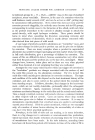
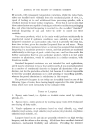
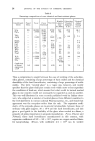
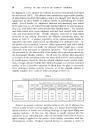
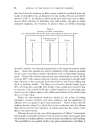
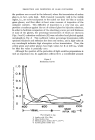
JOURNAL OF THE SOCIETY OF COSMETIC CHEMISTS by dipping in a 2% solution of a silicone in carbon tetrachloride and cured for one hour at 110øC. The silicone used contained an appreciable quantity •of unhydrolysed methyl chlorosilanes, and it was thought that the free acid might have an effect similar to sulphur dioxide in neutralising free surface alkali. Sets of bottles (i.e. sulphured, siliconed and untreated) were tested in the same way, i.e., by initial thorough washing followed by autoclaving at 15 p.s.i.g. while filled with carbon dioxide-free distilled water. The extracts were later boiled with excess sulphuric acid and back titrated with caustic soda and bromothymol blue. Results obtained, expressed as total alkali extracted in mg soda/sq. decimetre, for different autoclaving times, are shown in Table g. A marked superiority of the sulphur-treated bottles is indicated, with little improvement by siliconing over untreated ones. As the period of test increased, however, values approached each other and it appears possible that eventually the siliconed bottles might have a lower extraction than untreated or sulphured specimens. This could be due to the protection by the silicone film of the surface of the glass from attack by the increasingly alkaline solution. (In all tests, the silicone films appeared to be intact at the conclusion of the run, when dried at 110øC and examined.) It would appear, therefore, that for neutral solutions under normal condi- tions of usage, siliconed bottles have little advantage over normal untreated bottles, so far as possible extraction of alkali from the glass is concerned. Over prolonged storage periods, however, or if the original solution is slightly alkaline, there could be some advantage in their use. Table 4 Summary of results of autoclave tests on 8-oz. sauce bottles Total Alkali Extracted as mg NagO per sq. decimetre Type ot Set I: I hr. Set II: g hrs. Set II1: 3 hrs. Set IV: 4 hrs. Treatment Average Standard Average Standard Average Standard Average Standard Value Deviation Value Deviation Value Deviation Value Deviation Untreated 1.18 0.08 1.60 0.07 2.22 0.05 2.54 0.08 Silicane treated 1.11 0.07 1.43 0.02 2.00 0.08 2.53 0.03 Sulphur treated 0.49 0.07 0.67 0.08 1.68 0.05 2.08 0.06 Interest in general container manufacturing in the use of silicones has centred mainly in their external application, as a means of increasing mech- anical resistance of bottles and reducing breakage on high speed filling and capping machines. In this case, the silicone is usually sprayed into the containers in the annealing lehr, with the inevitable result that at least a light coating is applied to the insides of the bottles, sometimes with dis- .advantageous results. Hughes a reported having to abandon a series of

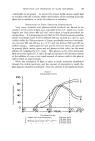
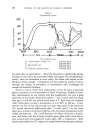
PRODUCTION AND PROPERTIES OF GLASS CONTAINERS otherwise satisfactory large scale tests on the mechanical strength of siliconed bottles, because the product packed in the bottles, a white petroleum emul- sion, whilst physically and chemically inert to the silicone, formed an unsightly condensation film on the interior of the bottles above the liquid level. This gradually coalesced into large drops which eventually ran down and formed a dilute layer on the surface of the emulsion, rendering the product unacceptable. After shaking the bottles, the process repeated itself after a few days. It was established that the condensed layer consisted only of water, and that a similar effect was produced with siliconed bottles filled with pure water. It was concluded that the sillconed bottles were unsuitable for use with aqueous pharmaceutical products, and the test run had to be completed using the jars for a non-aqueous ointment. FLAKING When bottles are boiled with water for a sufficient length of ti•ne, e.g., in the S.G.T. $ hour boiling test, insoluble flakes can appear, someti•nes dull but usually ghstening. They can also be produced by long continued action at room temperature, or rapidly and in abundance by treatment in an auto- clave. The preferential attack on the alkali of the glass by the water results. in the surface of the glass becoming relatively richer in lime and silica. If considerable hydrolysis occurs, a film of hydrated silica may also be produced on the surface and when dried would tend to peel off. But •vith or without much silica layer the surface, now having a composition distinctly different from the glass beneath may be expected to have different properties, thermal expansion for example, and thus to spall off on rise or fall of temperature. Turner 4 et al showed that such flakes, resulting from the storage of neutral aqueous solutions or water, consisted of 80ø,/0 or more silica with a little lime after washing with hot hydrochloric they had a composition approaching nearly 100% silica, showing that they were not flakes of glass itself, but of a decomposition product. Flakes from acidic solutions con- sisted almost entirely of silica and appeared as minute thin glistening particles which settled slowly, in quite a different manner from those produced by the reaction of alkaloid solutions with the alkali extracted from the glass. (As in the narcotine hydrochloride test.) The tendency of glass to produce flakes is well known to be dependent on the chemical composition, but unexpected results are frequently encountered. Turner quoted the use of two sets of bottles, both satisfactory in the 5 hour boiling tests as regards alkali extraction, but while one produced no flakes in 100 hours, the other produced flakes in 3« hours. The probable explana- tion of the discrepancy was, that the second set had been stored some months before testing, producing a slight filrn by atmospheric weathering which was loosened by boiling with water and produced flakes. Other workers have
Purchased for the exclusive use of nofirst nolast (unknown)
From: SCC Media Library & Resource Center (library.scconline.org)