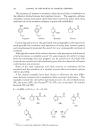
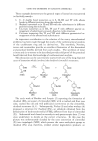
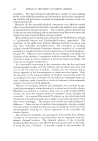
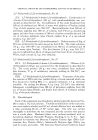
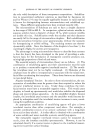
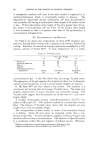
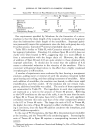
280 JOURNAL OF THE SOCIETY OF COSMETIC CHEMISTS A transparent emulsion will form if the oleyl alcohol is replaced by p- methylcyclohexanol, which is structurally similar to benzene. The alkanolamine oleate-oleyl alcohol combination will form microemulsions with nonpolar oils having a hydrocarbon chain length of 18 carbon atoms or less. If the hydrocarbon chain length of the oil is greater than 18 car- bon atoms, a microemulsion will not form. If the alcohol chain length is now increased so that it is greater than that of the hydrocarbon, a microemulsion will again form. II. EXPEP, IMENT^I• As• REsvLws In Table I are shown the compositions of three O/W emulsions pre- pared by heating while stirring with a spatula until uniform, followed by cooling. Emulsion 1A consists of isopropyl palmirate emulsified in a 45% aqueous solution of Tween 60. ©* At room temperature 1A is a white, TABLE I.--O/W EMULSIONS Parts By Weight • IB IC Tween 60 20 20 20 Isopropyl palmirate 20 20 20 Water 25 25 25 Span 80 6.5 6.5 2-Ethylhexanediol-l,3 6.5 Appearance opaque translucent transparent gel gel fluid semi-translucent gel. A thin film shows blue and orange Tyndall colors. The appearance of the gel suggests that droplets of about 1 or 2 • diameter, typical of macroemulsions, as well as much smaller droplets are present. In lB, Span 80 ©* has been added to the system. The emulsion is a translucent gel showing blue and orange Tyndall colors. The larger size droplets characteristic of macro emulsions are essentially missing. The Tyndall colors suggest that the particles are of the order of •/4 the wave- length of light. A medium chain-length alcohol, 2-ethylhexanediol-l,3 (6.12©)•, was added to lB to give 1C. This addition resulted in a crystal-clear viscous fluid. The absence of Tyndall colors shows that the droplets are now smaller than •/4 the wavelength of light. The interpretation of these results in terms of microemulsion theory is as follows. Tween 60 alone gives an expanded, rather than a con- densed, surface fihn. It cannot produce a negative interfacial tension, and therefore will not form a microemulsion. The addition of Span 80 results in a condensed surface fihn and negative interfacial tension. However, * Registered trade names of Atlas Chemical Industries, Wilmington, Del. t Registered trade name of Union Carbide Corp., New York, N.Y.

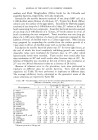
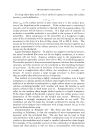
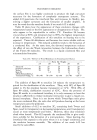
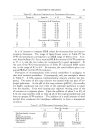
TRANSPARENT EMULSIONS 281 the surface film is too highly condensed to produce the high curvature necessary for the formation of completely transparent systems. The added 6.12 penetrates the interfacial film and increases its fluidity, per- mitting a higher curvature and the formation of smaller droplets. It may be noted that the emulsion breaks if too much 6.12 is added. Table II shows how the appearance of these emulsions changes with temperature based on the first appearance or disappearance of haze. Re- sults appear to be reproducible to within iøC. Emulsion 2A became crystal clear at 80øC and remained clear to 90øC, the highest temperature of the experiment. Clarification of this emulsion on heating was to be expected. Tween 60 dehydrates and becomes less water soluble with an increase in temperature. The reduced solubility tends to the formation of a condensed film. At the same time, the elevated temperature reduces the effect of van der Waals interaction between the hydrocarbon chains of the Tween 60 molecules. The result is a liquid condensed film and microemulsion formation. TABLE II.--EFFECT Or FILM MODIrlEP. S ON TP. ANSPAP. ENC¾ RANGE -Parts By Weight , 271 2B 2C 2D 2E Tween 60 20 20 20 20 20 Isopropyl palmirate 20 20 20 20 20 Water 25 25 25 25 25 Span 80 6.5 13 13 13 2-Ethylhexanediol-l,3 2 4 Transl•arent Range, øC 80-90 74-90 62-90 33-90 20-77 The addition of Span 80 to emulsion 2A reduces the temperature re- quired for the clarification of the emulsion. Thus, with 10% of Span 80 added to 2A the emulsion became transparent at 74øC. With 20% of Span 80 added, clarification occurred at 62øC. Since the presence of Span 80 results in a condensed interface, it is only necessary to heat the emulsion sufficiently to reduce molecular interaction to give a liquid con- densed interphase. Since it is not known which Tween-Span ratio gives the more condensed film, the ratio that will produce clearing at the lower temperature cannot be predicted. Small additions of 6.12 to emulsion 2C, containing both Tween and Span, result in transparency at decreasing temperatures, until transparency occurs at room temperature and below. However, these clear emulsions cloud when heated. The 6.12 expands the condensed film to give condi- tions suitable for the formation of a microemulsion. Upon heating, the interfacial film expands to the point where it is no longer condensed, and the emulsion becomes unstable. The addition of too much 6.12 has exactly the same effect.
Purchased for the exclusive use of nofirst nolast (unknown)
From: SCC Media Library & Resource Center (library.scconline.org)