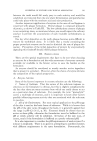
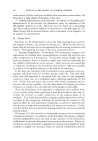
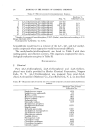
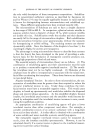
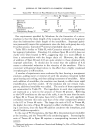
282 JOURNAL OF THE SOCIETY OF COSMETIC CHEMISTS TABLE Ill.--EFFECT OF FILM MODIFIERS 01•' TRANSPARENCY Ra•oz . Parts By Weight 3d 3B 3C Tween 60 20 20 20 Mineral oil 20 20 20 Water 25 25 25 Span 80 6.5 6.5 2-Ethylhexanediol-l,3 4 Appearance opaque gel opaque gel transparent fluid Transparency Range, øC none 74-90 20-90 One requirement specified by Schulman for the formation of a micro- emulsion is that the chain length of the nonpolar oil should not be greater than the hydrocarbon chain length of the emulsifiers. Isopropyl palmi, rate presumably meets this requirement since the fatty acid group has only 16 carbon atoms Carnation ©* mineral oil probably does not. Table III is similar to Table II, with Carnation mineral oil substituted for isopropyl palmirate. Emulsion 3A, without Span 80 or 6.12, does not clarify even when heated to 90øC, suggesting that it is more difficult to form a microemulsion with the longer chain oil. However, the effects of addition of Span 80 and 6.12 are quite similar to those obtained with isopropyl palmkate. It should also be noted that the addition of 6.12 causes a substantial reduction in the viscosity of the emulsion. This is consistent with general observations to the effect that a highly condensed in terphase gives a stiff emulsion. A number of experiments were conducted by first forming a transparent emulsion, adding water or mineral oil until the emulsion remained turbid upon heating and cooling, and then adding increments of emulsifier. After each addition of emulsifier, the emulsion was heated, to effect more rapid enqulsification, and then cooled. If the emulsion did not remain trans- parent, additional emulsifier was added. The results of these experiments are summarized in Table IV. The ingredients in each clear composition are expressed as a ratio to the amount of Tween 60 present. Referring to the O/W emulsions at the top of the table, it can be seen that the ratio of Span 80 to Tween 60 varies from 0.32 to 0.88. The only significant correlation between this ratio and that of the other components present is the 6.12 to Tween 60 ratio: The larger the ratio of 6.12 to Tween 60, the higher the ratio of Span 80 required to effect clarification. This find- ing is consistent, since the Span 80 addition condenses the interphase, and the 6.12 addition expands it. In the case of W/O emulsions, the Span 80 is the predominant emulsifier at the interface, and the Tween 60 is the condensing agent. Increasing the ratio of Tween 60 to Span 80 requires a corresponding increase in 6.12 con ten t. * Registered trade name of Sonneborn Chemical and Refining Co., Div. of Witco Chemical Co., New York, N.Y.

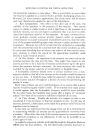
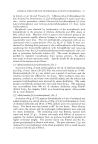
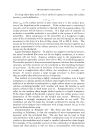
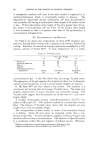
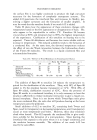
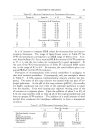
TRANSPARENT EMULSIONS 283 TABLE IV.--RATIO Or COMPONENTS IN TRANSPARENT EMULSIONS Tween 60 Span 80 6.12 Water Oil Transparent O/lff Emulsions A I 0.32 0.21 1.2 1.0 B 1 0.44 0.16 1.7 2.0 C 1 0.5l 0.21 1.2 2.5 D 1 0.53 0.24 1.3 2.9 E 1 0.53 0.24 1.8 2.9 F 1 0.65 0.32 1.2 1.0 G 1 0.65 0.32 1.9 1.0 H 1 0.65 0.32 1.2 2.6 I 1 0.88 0.32 3.2 1.0 Transparent lff /O Emulsions J 1 1.5 0.16 1.7 4.7 K 1 0.90 0.21 1.2 3.5 L 1 0.90 0.21 1.2 5.3 It is of interest to compare HLB values for microemulsion and macro- emulsion formation. The range of Span-Tween ratios in Table IV for O/W microemulsions correspond to an HLB range of 10.0 to 12.3. A re- cent Atlas bulletin (11) lists a required HLB for mineral oil O/W emulsions as 11 + 1, and the two values are consequently in good agreement. In the case of the W/O microemulsions of Table IV calculated HLB values are in the range of 8.5 to 9.9. In contrast, the same bulletin gives a re- quired HLB of 3 to 8 for W/O emulsions. Formation of microemulsions with anionic emulsifiers is analogous to that with nonionic emulsifiers. Consequently, only one example is shown in Table V. A 32% aqueous triethanolamine stearate solution was pre- pared. Two parts of this soap solution was heated with one part of iso- propyl palmirate. At the pH of this soap solution (pH 8.1), the micelles are highly condensed and very little of the isopropyl palmitate is taken into the micelies. Even with heating and vigorous stirring, most of the oil remains as a separate phase. Upon the addition of about 3 to 6% of 6.12, the soap micelles swell to take up all of the isopropyl palmirate and form an opaque O/W emulsion. The addition of a small amount of oleyl alcohol then condenses the interphase sufficiently to form a transparent emulsion. TABLE V.•/W EMULSIONS CONTAINING SOAP Parts By Weight-- 5d 5B 5C Triethanolamine stearate Water Isopropyl palmirate 2-Ethylhexanediol-l,3 Oleyl alcohol Appearance 9.5 9.5 20.5 20.5 15.0 15.0 3.0 2 separate Soap solution phases swells to take up oil, opaque 9.5 2O.5 15.0 6.0 0.5 Transparent above 25 øC
Purchased for the exclusive use of nofirst nolast (unknown)
From: SCC Media Library & Resource Center (library.scconline.org)