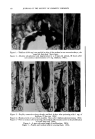
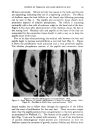
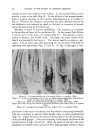
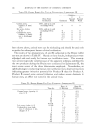
EFFECTS OF THALLIUM AND HAIR GROWTH IN RAT 135 below the base of the hair. It almost appears that there is a constriction of the basal part of the follicle, bringing the outer root sheath cells together and pinching the hair out of the follicle. In Fig. 14 this constriction process has progressed further, and the outer root sheath cells from a solid mass. There seems to be less glycogen in the cells. In all probability the glycogen is used in the final stages of the keratinization of the hair (9, I0). In the final stage (Fig. 15), the glycogen has disappeared, and the outer root sheath cells remain as an epitheloid mass below the hair (Fig. 4). It is this mass, referred to as the residual cells in the previous description on alkaline phosphatase, that will give rise to the new hair. As the new bud grows and differentiates, cells are pushed aside for the outer root sheath. They accumulate glycogen, remain inactive, and follow the hair outward when growth is completed. It thus appears that the hair bulb grows, ages and subsides, and that the cells of the outer root sheath are the main progenitors for successive hairs. While these cells of the outer root sheath possess the potentialities for the next hair just as do the cells of the flower and leaf buds of the plant, the time of their growth is controlled mainly by the metabolism of the skin and the animal. Three sources of evidence confirm this conclusion. In underfed animals (11) the hair fails to grow. The buds are present, and by raising the metabolism through irritation (12) or adrenalectomy (13) the hair grows at once. In the normal cycle, when the metabolism is low (14), plucking does not induce growth but with an increase in the metabolism of the skin, plucking induces growth immediately. The third confirmation comes from the present investigations. Depilation was induced by thal- lium administration in several rats. Four days after poisoning or just about the time the hair was to be lost, underfeeding was started, by giving the rats (age 35 days) 3 g. of Purina chow in the morning and three in the evening. As long as underfeeding was continued, the follicles remained inactive. SUMMARY AND CONCLUSION The specificity of thallium in terminating hair growth is unique. Some 80 substances (many of them toxic, respiratory inhibitors or enzyme binding) have been tested, yet none other possesses this property. It is remarkable that the hair is susceptible to its effects. The whiskers of the animal appear not to be affected, and the growing end of the rodent's incisor also is not affected by thallium. Since thallium will induce its effects so quickly, will cause a localized depilation and is so effective in such small quantities, there is every reason to believe that it interferes with an enzyme on which the life and mitotic activity of the cells of the bulb are dependent. This could be one of

136 JOURNAL OF THE SOCIETY OF COSMETIC CHEMISTS several hundred enzymes. While potassium cyanide and other substances are ineffective, this does not necessarily eliminate enzymes of a respiratory nature. Growth studies following thallium administration by histochemical methods show: that the papilla persists from generation to generation that the cells of the outer root sheath survive and become the progenitors of the new hair bud that the growth of the new hair bud is greatly dependent on the metabolism of the surrounding tissue. Whether the metabolism is by way of the papilla or how necessary the papilla is for the growth of the epithelioid mass has not been determined. (Received September 25, 1963) (1) A. Buschke, Dermatol. Z., 77, 186 (1938). (2) N. Thyresson,/icta Dermato-17enereol., 31, 3 (1951). (3) G. Truffi, Dermatol. 14/ochschr., 88,409 (1929). (4) E.O. Butcher,/Inn. N.Y./Icad. $ci., 83, 369 (1959). (5) M. Goffart,/Irch. intern. pharmaco. therap., 74, 9 (1947). (6) P. Gross, E. Runne and J. F. Wilson, 5 t. Invest. DermatoL, 10, 119 (1948). (7) B. Wolbach,/Inn. N.Y./Icad. Sci., 53, 517 (1951). (8) W. Montagna and H. B. Chase,/Inn. Winat., 99, 415 (1956). (9) J. R. G. Bradfield, Nature, 167, 40 (1951). (10) K. Adachi, D.C. Chow and S. Rothman, Science, 13S, 216 (1962). (11) E.O. Butcher and R. A. Richards, Endocrinology, 25, 787 (1939). •12) E.O. Butcher, rim. )t, PhysioL, 129, 553 (1940). (13) E.O. Butcher, Endocrinology, 32, 493 (1943). (14) E.O. Butcher, rim. )t. Physiol., 138,408 (1942).
Purchased for the exclusive use of nofirst nolast (unknown)
From: SCC Media Library & Resource Center (library.scconline.org)