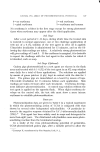
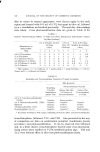
O8 JOURNAL OF THE SOCIETY OF COSMETIC CHEMISTS usually restricted to information which is in fact considered by the courts to constitute a trade secret. The ban, therefore, against dis- closure of trade secrets during employment is much stricter than is the ban against disclosure of trade secrets after employment has ceased. An accurate definition of what constitutes a trade secret is difficult to formulate, although the Restatement of Torts (6) seems to present as accurate a definition as is available. The Restatement describes a trade secret as follows: A trade secret may consist of any formula, pattern, device or com- pilation of information which is used in one's business, and which gives him an opportunity to obtain an advantage over competitors who do not know or use it. It may be a formula for a chemical com- pound, a process of manufacturing, treating or preserving matehals, a pattern for a machine or other device, or a list of customers. The more precise question of whether or not a trade secret exists and, if there is, whether the owner of the secret will be protected against its unlawful disclosure has been considered in numerous cases (7) and has also been greatly analyzed by text writers (8). The legal principles are not in great dispute either in the case law or that of the text writers, but it is the application of the legal principles to the particular set of facts on which the decision must turn which presents great difficulty. The Restatement (9) sets forth some elements useful for considera- tion in determining whether a trade secret, in fact, exists. These ele- ments include: (a) The extent to which the information is known outside of his business (b) The extent to which it is known by employees and others in- volved in his business (c) The extent of measures taken by him to guard the secrecy of the information (d) The value of the information to him and to his competitors (e) The amount of effort or money expended by him in developing the information (f) The ease or difficulty with which the information could be properly acquired or duplicated by others. Much of what has been stated so far has been concerned primarily with the employer-employee relationship during the period of employ- ment. Now we come to the time in an employee's life when, after at-

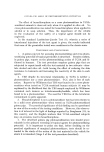
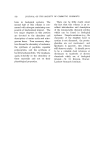
EMPLOYMENT CONTRACTS ,9,0 tending a professional or social meeting and seeing or hearing of all the available opportunities he may qualify for, he decides to leave for an- other position. Prior to departure, the technically sensitive employee should be reminded by the employer of his contractual obligations not to disclose confidential information or trade secrets to his new employer. Some corporations have even gone so far as to establish a standard exit inter- view with all employees to be certain that the departure procedure is properly and effectively handled. Depending on the circumstances or reasons of the employee's ter- mination which may vary within the spectrum from involuntary de- parture to voluntary termination, it is not surprising to visualize that the termination may cause the ex-employee to brood on real or fancied unfair treatment, to recall that he was paid less for creating some highly successful product than a salesman who sold the product, and to seek the seemingly easy road of using trade secrets of one employer as a basis for establishing his new position with a subsequent employer. Under such circumstances, what action can be taken by a former employer when the ex-employee loaded with trade secrets leaves to work for a competitor but is not officially hired ? Since it is apparent that no contract of em- ployment is valid which withdraws from an employee the right to earn a living, the employer's hands are usually tied in such situations. An ex- ception exists, however, when the employee is going from a position in which his complete time was spent in a highly confidential capacity to a precisely similar position with a competitor who desires the trade secrets to increase his competitive position in the industry. Probably the leading case in which the employer was successful in preventing an em- ployee from working with a competitor is that of Eastman Kodak Co. vs. Powers Film Products, Inc. (ll)). In this case, Powers Film Products located its plant in Rochester, N. Y., and sought to employ one of East- man's film processors. Eastman thereupon brought suit seeking an injunction against the employee from working with Powers Film Prod- ucts. The Court upheld the employment contract between Eastman and the employee and issued an injunction restraining him from dis- closing trade secrets and from entering into the employment of Powers. interesting enough, the Eastman contract contained a holdover clause which limited employment with a competitor for a period of two years after term ination of the employment in any part of the United States except the Territory of Alaska. The year of the decision was 1919 !
Purchased for the exclusive use of nofirst nolast (unknown)
From: SCC Media Library & Resource Center (library.scconline.org)