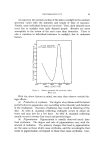
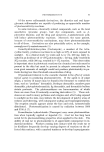
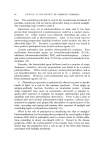
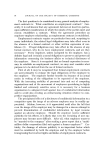
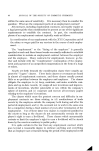
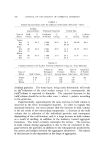
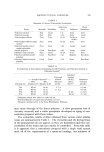
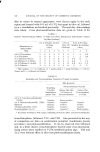
106 JOURNAL OF THE SOCIETV OF COSMETIC CHEMISTS TABLE I Particle Characteristics under the Influence of Humidity (95% R.H.--35øC) Packing Characteristics Frictional Properties Particle Size Type of Bulk % Coefficient % % % Water Starch Volume Change of Friction Change Dv Change Uptake Potato Dry 27 94.3 0. 800 66.6 59.2 124.09 38.2 Wet 41 1. 333 69.24 Corn Dry 39 84.6 0. 851 28.6 14.5 91.27 28.8 Wet 72 1. 094 18.0 Wheat Dry 38 87.3 1. 000 17.6 23.4 17.9 31.1 Wet 72 1.176 24.6 TABLE I[ Variables Related to the Suction Potential of Starches (Using 5 g. of the Material) Volume of Final Time of Expansion Type of Entrapped Pressure Water of Powder Starch Bulk Volume Air (cm. a) rncrease (min.) Rise (min.) Bed (ram.) Potato 5.25 2.15 132 90 29 Corn 7.5 4.45 134 120 1 Wheat 7 3.9 102 540 ... dividual particles. The water layer, being easily deformable, will result in the*reduction of the total surface energy (14) consequently, the bulk*volume is expected to diminish. The expected decrease in the bulk•volume should be in the order corn wheat potato, according to the grain size. Experimentally, approximately the same increase in bulk volume is observed in the three investigated starches. In order to explain this abnormal behavior, one must assume that the increase in bulk volume is the net result of two interacting components: i, decrease in the bulk volume due to adhesion of the individual particles and consequent diminishing of the void fraction, and ii, a large increase in bulk volume as a result of swelling, in addition to the tendency toward aggregate formation. The latter certainly outweighs the former. The increase in bulk volume during aggregation is due to the air contained in the gaps between the particles, in addition to the entrapped air produced by the arches and bridges between the aggregates themselves. The extent 9f this increase is also dependent on the shape of ag. greg•ates,

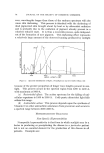
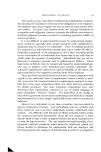
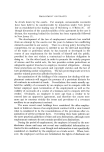
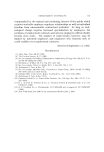
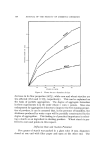
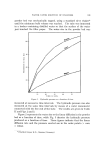
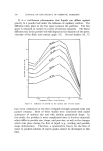
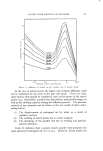
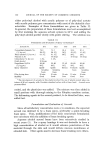
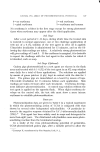
WATER VAPOR SORPTION OF STARCHES 107 Cumulative distribution curves shown in Fig. 1 (cf. also Table I) indicate that the swelling tendency of potato starch is much more pro- nounced than that of corn and wheat, the latter exhibiting the least swelling capacity. In potato starch, the apparent increase in volume is 94%, and the absolute increase in particle volume is 124% the dif- ference is due to particle adhesion. In the case of cornstarch, the absolute increase in particle volume by swelling is approximately equal to the apparent increase in bulk volume. Therefore, the effect of 1o 20 3o 40 •o •o •a • • PARTICLE SIZE IN • Figure 1. Particle size distribution of starches in the dry and wet condition adhesion is nullified by aggregate formation. The absolute increase in particle volume of wheat starch (17%) would not be the only explana- tion for the doubling of bulk volume. There should be another factor initiating the increase in bulk volume this factor is probably the forma- tion of aggregates with high apparent volume. Regarding the variation in frictional properties, it is known that the interparticle friction depends on the particle shape, size, size distribu- tion, and surface roughness. At high humidity, a condensed water film deposits on the individual particles and causes the following changes: i, adhesion and decreased surface energy of the system, and ii, resistance to flow and sliding induced by higher interparticle friction. A comparison of the relative changes produced by humidity in the investigated starches indicates that potato starch suffers a significant
Purchased for the exclusive use of nofirst nolast (unknown)
From: SCC Media Library & Resource Center (library.scconline.org)