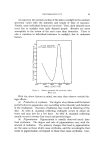
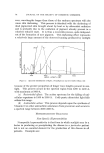
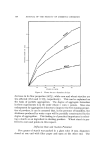
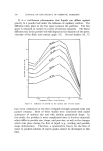
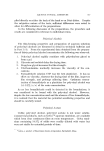
110 JOURNAL OF THE SOCIETY OF COSMETIC CHEMISTS It is a well-known phenomenon that liquids can diffuse against gravity in a powder bed under the influence of capillary suction. The diffusion takes place in the free space between the particles. The free space is assumed to consist of a series of tortuous channels. The linear diffusion rate in the powder bed will depend on the diameter of the pores, viscosity of the fluid, and contact angle (15). Several studies (16, 17) Figure 4. 0.01 0.1 1 10 100% AER. OSIL CONC. (LOG SCALE). Influence of Aerosil on the suction rate of corn starch have been conducted on the flow of liquids through granular beds and packed columns. Most of these studies were concerned with model substances of uniform size and with definite geometrical shape. In this study, the problem is more complicated since it involves materials which differ in particle size, shape, and pore size, as well as the changes which take place during the flow of liquid (e.g., swelling and possible shape deformation). Therefore, a quantitative theory for the flow of water in packed columns of starch grains cannot be developed at this time.

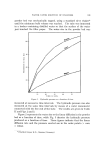
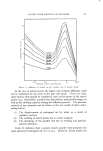
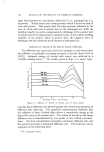
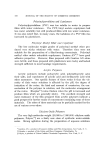
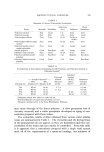
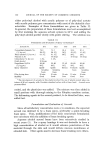
WATER VAPOR SORPTION OF STARCHES 111 ! 0.01 0.1 1 10 100% AEROSIL CONC. (LOG SCALE) Figure 5. Influence of Aerosil on the suction rate of potato starch In the case of potato starch the higher rate of linear diffusion could not be explained on the basis of the pore size alone. There are some other factors that should be considered, such as the nature of the starch grains (e.g., wettability), particle size distribution, and particle shape, as well as the swelling capacity during the diffusion process. The pressure exerted at any moment can be taken as the net result of three inter- acting forces: (1) The displacement of entrapped air by water as a result of capillary suction. (2) The swelling of starch grains due to water sorption. (3) The shrinkage of the powder bed due to wetting and particle- particle adhesion. Table II indicates that a potato starch powder bed possesses the least amount of entrapped air (2.5 cc./g.). However, it has nearly the
Purchased for the exclusive use of nofirst nolast (unknown)
From: SCC Media Library & Resource Center (library.scconline.org)