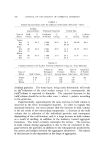
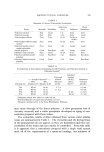
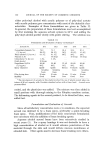
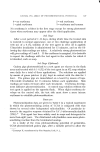
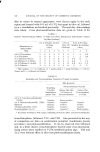
128 JOURNAL OF THE SOCIETY OF COSMETIC CHEMISTS skin to return to normal appearance, were shaven again in the neck region and treated with 0.05 ml. of 0.1% test agent in olive oil, followed by u.v.-irradiation, as described previously. The next day, skin readings were taken. Cross photosensitization data are given in Table II for TABLE I Relative Photosensitizing Effects of TCSA and Other Halogenated Salicylanides (Guinea Pig Skin Readings) • Substituents on Salicylanilide Ring 2% in Absolute Alcohol, 0.2% in 0.5% in 8% Soap 1st Stage Olive Oil Solution Re-challenge (days) Challenge (days) 1 2 3 4 5 1 2 1 2 3 3,3'4',5-Tetrachloro 0 0 0 2 2 2 3 1 2 2-3 3 ',4•,5-Trichloro 0 0 0 1 1 2 2 1 2 2-3 3',4'-Diehloro-5-bromo 0 0 0 0 sl. 1 1 0-sl. sl. 1 3,5-Dibromo-3',4'-diehlor 0 0 0 0 sl. 0 0 0-sl. 1 1-2 3,4',5-Tribromo-3 '-methyl 0 0 0 0 0 0 sl. 0-sl. sl.-1 1-2 3,4',5-Tribromo 0 0 0 0 0 0 sl. 0 0 0 Skin readings: 0 = no erythema, sl. = patchy pink, 1 = pink erythema, 2 = red ery- thema, and 3 = erythema and trauma. TABLE II Sensitizing and Photosensitizing Potential of Topical Germicides Skin Response Photosensitizing Potential Sensitizing Potential Guinea Pigs with Guinea Pigs (Landsteiner- No History of Photosensitized Jacobs Test) Photosensitization to TCSA ',4',5-Tetraehlorosalieylanilide (TCSA) Negative Strong positive ... 8,4',5-Tribromosalicylanilide (TBS) Negative Negative Negative Bithionol Negative Positive Positive Trichlorocarbanilide (TCC) Negative Negative Negative Hexachlorophene (G-11) Negative Negative* Weak positive * Erythema develops in both stages, indicating phototoxic effect, not photosensitization. hexachlorophene, bithionol, TCC, and TBS. Also presented in the way of comparison are data on sensitization potential (Landsteiner-Jacobs procedure) and photosensitization. It can be observed that bithionol and, to a lesser degree, hexachlorophene showed some cross photosensi- tizing action when studied on TCSA-sensitized guinea pigs. TBS and TCC were without effect in this cross photosensitization study.

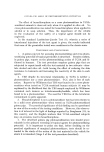
GUINEA PIG ASSAY OF PHOTOSENSITIZING POTENTIAL 12,0 The effect of hexachlorophene as a cross photosensitizer to TCSA- sensitized animals is observed only when it is applied in olive oil. No cross photosensitization was noted for hexachlorophene when applied in alcohol or in soap solution. Thus, the importance of the vehicle in the evaluation of the safety of a topical agent should not be neglected. In the standard Landsteiner-Jacobs Test (8), wherein a series of intradermal injections of the test agent is given, the results indicated that none of the germicides tested were sensitizers in the classic sense. DISCUSSION AND CONCLUSIONS 1. A guinea pig test for assessing photosensitizing and cross photo- sensitizing potential of topical germicides is described. Results confirm, in guinea pigs, reports on the photosensitizing action of TCSA and bi- thionol in humans. The test procedure employs guinea pigs that are subjected to repeat insult with the test material in two solvents--abso- lute alcohol and olive oil--both having the effect of reducing the skin resistance to toxicants and increasing the reactivity of the skin to such agents. 2. TBS despite its structural relationship to TCSA is neither a photosensitizer nor a cross photosensitizer. TCC also is free of such action. Reports by Wilkinson that TBS was found to be a cross photo- sensitizer when tested on TCSA-sensitized human subjects (4) may be explained by the likelihood that the TBS sample employed by Wilkinson contained such isomers as tetrabromosalicylanilide, which has been found to be a photosensitizer. The need for TBS free of the tetrabrom contaminant is quite apparent. 3. Hexachlorophene is not a photosensitizer but has been shown to be a mild cross photosensitizer when tested on TCSA-photosensitized guinea pigs. The practical significance of this finding can be questioned in view of the severity of the testing conditions. However, this observa- tion is of interest in the light of findings reported by Baughman (10), in this country, and the English workers that TCSA-sensitized subjects may, on occasion, react to hexachlorophene. 4. The described guinea pig photosensitization test should prove valuable in the primary screening of topical agents for photosensitizing potential. It is important to point out that, before deciding on the practical significance of marginal photosensitizers, tests should be ex- tended to the study of the action of the test material in the vehicle for which it is intended (Stage 3 of the test procedure described).
Purchased for the exclusive use of nofirst nolast (unknown)
From: SCC Media Library & Resource Center (library.scconline.org)