126 JOURNAL OF THE SOCIETY OF COSMETIC CHEMISTS In view of these unexpected incidents of photosensitization by some germicides, it has become very evident that an animal assay procedure to screen out weak photosensitizers would be a valuable aid in the con- tinuing search for safe and effective topical agents for use in soaps and cosmetics. Such a procedure has been developed. The guinea pig is the animal of choice for studying sensitization phenomena, and it has proved to be useful for checking out potential photosensitizers. The key to this procedure is to apply the test agent under "abuse" conditions. Solvents are used that have the effect of altering the skin defenses, thus making the guinea pig more vulnerable to the action of irritants. Three major skin defenses that provide pro- tection against environmental stress, both physical and chemical, are (a) the skin barrier in the stratum corneum (b) the water binding capacity of the stratum corneum and (c) the buffering capacity of the skin. It is believed that the normal subject is capable of effectively combating weak irritants that come in contact with the skin, but the hypersensitive person is prone to react to low-order irritants because of poor skin defenses. The test procedure to be described is, therefore, based on the concept that the test animal should be exposed to the topical agent under conditions of stress that undermine the skin defenses. This is accomplished by administering the test material in organic sol- vents known to reduce barrier efficiency, water binding capacity, and buffering capacity. PROCEDURE EMPLOYED FOR DETERMINING PHOTOSENSITIZATION POTENTIAL OF TOPICAL AGENTS ON CxUINEA PIG SKIN This test is comprised of two stages with an optional third stage. 1st Stage Young adult guinea pigs, usually six to a group, are shaven with electric clippers on the upper dorsal area (cervical region). To this site is applied 0.05 ml. of a 2% solution of the test agent in absolute alcohol. This is repeated daily for a total of five applications. After each applicaq tion the guinea pigs are ultraviolet-irradiated for 15 minutes, employing a Sun Lamp (GE or Westinghouse) from a distance of 18 in. The animals for this exposure are contained in a box with dimensions 15•/• X 13•/• and 8 in. high. Skin readings for evidence of erythema are made 24 hours after each application as follows:

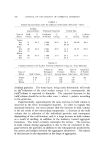
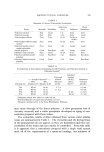
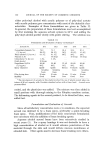
GUINEA PIG ASSAY OF PHOTOSENSITIZING POTENTIAL 127 0 = no erythema 2 = red erythema 1 = pink erythema 3 = erythema and trauma No erythema is evident in the first stage except for strong photosensi- tizers when erythema may appear after the third application. 2nd Stage After a rest period of 7-10 days, during which time the treated skin is restored to normal appearance, one or two challenge applications of 0.05 mi. of a 0.1% solution of the test agent in olive oil is applied. Ultraviolet irradiation is administered for 15 minutes, and on the fol- lowing day skin readings are taken. A relatively strong photosensitizer will give readings of 2 and 3. If the erythema is marginal, it is desirable to repeat the challenge with the test agent in the vehicle for which it is intended, such as soap. $rd Stage (Optional) Guinea pigs photosensitized to a test agent are shaven in the flank areas and treated with 0.1-0.2% of the test agent in an 8% soap solution once daily for a total of three applications. The solutions are applied by means of gauze patches (6 ply) kept in contact with the skin for 1 hour. The guinea pigs are immobilized on a board by means of tape. Ultraviolet irradiation for 15 minutes follows each application. Skin readings are taken 24 hours after each treatment. Erythema develop- ment indicates photosensitization. A control soap solution without the test agent is applied on the opposite flank. When slight erythema de- velops on the control side, the test side must show a more intense erythema to establish photosensitization. RESULTS Photosensitization data are given in Table I in a typical experiment in which the photosensitizing action of TCSA is compared with that shown by several other halogenated salicylanilides. Of particular in- terest is the negative response obtained for 3,4',5-tribromosalicylanilide (TBS).* This agent has been widely used in soaps and detergents for more than eight years. The chlorinated salicylanilides cause more photo- sensitizing reaction than the brominated analogs. In a study of the cross photosensitizing potential of germicides, TCSA-photosensitized guinea pigs, after a suitable period to allow the * Tcmi•sept II, manufactured b 7 Fine Or•ganics! Lodi• N, J,
Purchased for the exclusive use of nofirst nolast (unknown)
From: SCC Media Library & Resource Center (library.scconline.org)