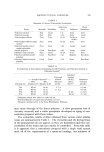
WATER VAPOR SORPTION OF STARCHES 105 was filled carefully in a fine stream into a tOO mi. glass measuring cylin- der, avoiding any movement which could promote close packing. After observing the initial volume, the cylinder was mechanically tapped, using the standard sieve shaker,* until no change in volume was observed. The final volume represents the volume at the close packing arrange- ment (bulk volume in cc./25 g. of starch). Angle of repose: The method was mentioned by Neumann (1), Train (t0), Grosby (tl) and Tawashi (12) and consists of pouring the powder through a funnel onto a horizontal sheet of graph paper until the top of the heap so formed reached the tip of the funnel. The diameter of the base of the heap was read and the angle of repose calculated from: H tan 0 - R where: tan 0 = coefficient of interparticle friction H = height of the funnel tip from the graph paper (20 min.) R = radius of the circular base in mm. 0 = angle of repose Each experiment was repeated three times, and the average was calcu- lated. Microscopical counting technique: The method was described in de- tail by Tawashi (13). A projection microscope was used for these de- terminations. The particle size range was divided into intervals. The number of particles in each size interval was counted in ten microscopical fields. The average number was calculated, and from the number frequency the volume distribution was determined. The mean volume diameter was computed on the basis of the volume distribution. The experimental results are shown in Table I and Fig. 1. Table I summarizes the changes which occur when dry starch is kept at 35øC and 95% relative humidity until the equilibrium moisture content is reached. These changes are increase in bulk volume and variable in- creases in frictional and swelling properties. Although the increase in bulk volume in the three different starches is nearly equal (almost 100%), there is a remarkable difference in the relative changes in the frictional and swelling properties. Generally speaking, a thin layer of water condenses on the outside of the particle in a moist atmosphere. This layer favors adhesion between the in- * Friedrich Greyer K.G., Ilmenau (Germany),

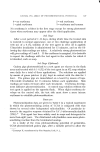
106 JOURNAL OF THE SOCIETV OF COSMETIC CHEMISTS TABLE I Particle Characteristics under the Influence of Humidity (95% R.H.--35øC) Packing Characteristics Frictional Properties Particle Size Type of Bulk % Coefficient % % % Water Starch Volume Change of Friction Change Dv Change Uptake Potato Dry 27 94.3 0. 800 66.6 59.2 124.09 38.2 Wet 41 1. 333 69.24 Corn Dry 39 84.6 0. 851 28.6 14.5 91.27 28.8 Wet 72 1. 094 18.0 Wheat Dry 38 87.3 1. 000 17.6 23.4 17.9 31.1 Wet 72 1.176 24.6 TABLE I[ Variables Related to the Suction Potential of Starches (Using 5 g. of the Material) Volume of Final Time of Expansion Type of Entrapped Pressure Water of Powder Starch Bulk Volume Air (cm. a) rncrease (min.) Rise (min.) Bed (ram.) Potato 5.25 2.15 132 90 29 Corn 7.5 4.45 134 120 1 Wheat 7 3.9 102 540 ... dividual particles. The water layer, being easily deformable, will result in the*reduction of the total surface energy (14) consequently, the bulk*volume is expected to diminish. The expected decrease in the bulk•volume should be in the order corn wheat potato, according to the grain size. Experimentally, approximately the same increase in bulk volume is observed in the three investigated starches. In order to explain this abnormal behavior, one must assume that the increase in bulk volume is the net result of two interacting components: i, decrease in the bulk volume due to adhesion of the individual particles and consequent diminishing of the void fraction, and ii, a large increase in bulk volume as a result of swelling, in addition to the tendency toward aggregate formation. The latter certainly outweighs the former. The increase in bulk volume during aggregation is due to the air contained in the gaps between the particles, in addition to the entrapped air produced by the arches and bridges between the aggregates themselves. The extent 9f this increase is also dependent on the shape of ag. greg•ates,
Purchased for the exclusive use of nofirst nolast (unknown)
From: SCC Media Library & Resource Center (library.scconline.org)