770 JOURNAL OF THE SOCIETY OF COSMETIC CHEMISTS because of the greater uniformity of cross-sectional area of the fiber along its length." The practice came to be used as the realization grew that the various animal fibers differ significantly from each other in some important respects and that consequently caution needs to be exercised in applying results obtained on one fiber type to other keratin fibers. In Section II of this paper, differences between wool and hair are discussed published data are the main source of the survey. A narrower fiber comparison of interest to the cosmetic chemist is that between human scalp hair of different races. In this field, literature information is scanty except for data on fiber diameter and cross-sec- tional shape gathered in anthropological studies (2-5). A comparison of some chemical, physical, and mechanical properties of Caucasian and American Negro hair was therefore undertaken a standard wool (Lincoln) was examined at the same time. The results are reported in Section III. II. WOOL AND HAm In evaluating published comparisons of wool and hair, the problem of intraspecies differences comes into play. Most of the literature data are based on Caucasian hair, but in the case of wool many breeds and crossbreeds have been employed. The interbreed differences in most properties are probably minor, but in the review which follows the breed is specified wherever known. 1. Morphological Both wool and hair fibers have the same main morphological com- ponents-cuticle, cortex, and medulla. The cuticle, which consists of overlapping flat scale cells about 0.5/• in diameter, surrounds the fiber. In wool, the cuticle layer is 1-2 scale-cells thick in hair, 5-6 cells (6). The cuticle is more resistant to diffusion of reagents than the cortex (7) and more resistant to attack by chemical reagents, such as sodium sul- fide (8). It thus acts as a protective barrier to the body of the fiber against chemical as well as mechanical degradation. The greater resistance of human hair to chemical attack by many reagents (see below) is at least partly due to the thickness of the cuticular layer. The cortex of keratin fibers consists of spindle-shaped cells, oriented along the axis of the fibers. In wool, the cortex is divided into two com- ponents, differing from each other in their structure and reactivity:* * They are named (9) ortho- (the more reactive component) and para-cortex (the less reactive one).

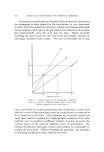
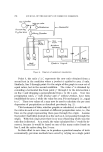
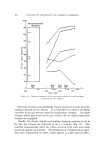
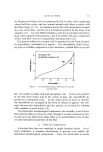
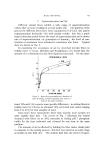
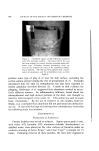
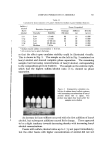
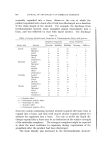
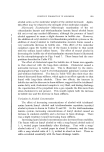
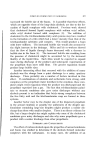
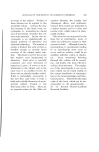
HAIR AND WOOL in Merino wool fibers, the two portions lie side by side, each comprising about half the cortex, and are wound around each other in phase with the fiber crimp (10, 11) in crimpless wools, the ortho component occupies the core of the fiber, and the para is located around it in the form of an annulus (12). No such differentiation is noted in Caucasian hair fibers their cortex appears homogeneous, and it resembles the para component of the wool fiber cortex in composition and properties (113). The protein within the cortical cells is organized in the form of paral- lel micro fibrils, embedded in a matrix. The microfibrils, which repre- sent the crystalline component of the structure, contain little or no sul- i i i i WooI-Speakman, 1929 Hair-ChamberlainAWOOL1931Speakman,and I I i I 20 40 60 80 RELATIVE HUMIDITY, % 100 Figure 1. The adsorption regain isotherms of wool (19) and hair (20) fur the matrix is sulfur-rich and amorphous (14). In the para-portion of the fine wool cortex and in the cortex of hair, the micro fibrils are packed in a hexagonal array. In the ortho-cortex of wool or mohair, the micro fibrils are arranged in the form of whorls or spirals the con- trast between the microfibrils and the matrix, as revealed by staining with osmium, is much lower (14). The innermost morphological component, the medulla, is not invari- ably present either in wool or in hair, though it is more common in hair. In any case, it is believed to make little or no contribution to the chemi- cal and mechanical properties of the fiber. 2. Chemical Composztion A keratin fiber does not constitute a single chemical entity. As al- ready indicated, a complex substructure is present even within the individual morphological components. Thus, the whole fiber is clearly
Purchased for the exclusive use of nofirst nolast (unknown)
From: SCC Media Library & Resource Center (library.scconline.org)