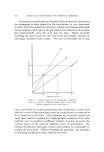
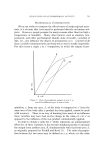
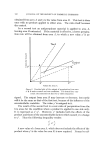
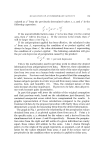
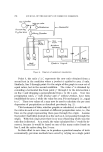
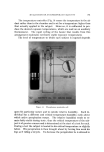
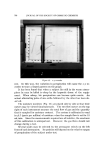
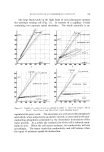
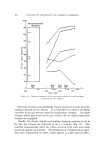
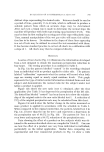
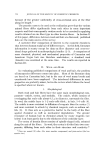
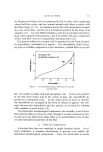
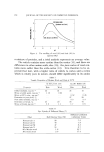
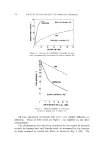
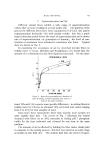
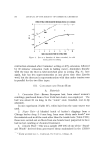
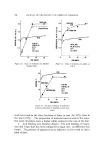
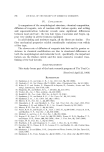
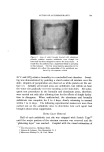
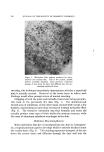
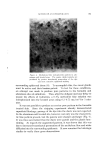
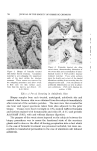
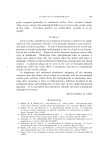
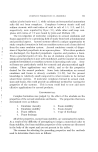
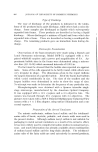
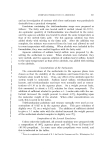
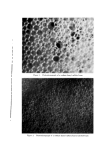
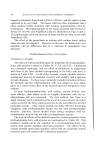
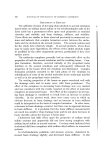
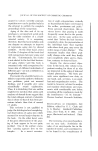
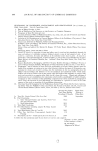
784 JOURNAL OF THE SOCIETY OF COSMETIC CHEMISTS 0.8 •,. 0.6 - z 0.4 0.2 NEGRO HAIR q,. ........... © .... o-8 ,C::)__ 0 f CAUCASIAN HAIR := / • 0'6 / +_,. p,a•-'--' "' WOOL •_ • 0'4 0 '"' 0'3M TGA • 0'6M NH,• OH • / pH 9'3 • 0'2 // 36øC 125:1 BATH / i I i 20 40 60 TIME, MINUTES Figure 10. Rate of reduction in alkaline thioglycolate CAUCASIAN HAIR ....0"'" • NEGRO HAIR • &,,-,-,,, WOOL I M NH,• HS03 NH,• OH to pH 6.0 36øC 125:1 BATH __ L I I 0 20 40 60 TIME MINUTES Figure 11. Rate of reduction in sulfite at pH 6 WOOL /8 -'- o • 40 / •- NEGRO HAIR / = '•e / 0'3M TGA lad = 0'6M NHa OH 2O - /0•,,,, pH 9'3 ! CAUCASIAN HAIR 36oc /•/ 125:1 BATH t / ! I , I 0 20 40 60 TIME, MINUTES Figure 1•. The data of Figure 10 replotted in terms of fraction of disulfide bonds rup- tured wool recovered in the three fractions is lower in hair (68-70%) than in the wool (78%). The proportion of material unrecovered is the same this must, therefore, have a higher sulfur content in the case of the hair. 3. Acid Binding and Moisture RegainsThe acid binding of Cauca- sian and Negro hair has been compared by Sagal (45) no difference was found. The,absence of pigment has no influence on the result in either kind of hair.

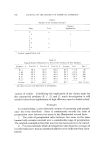
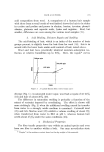
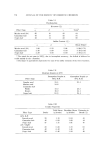
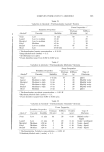
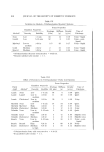
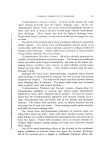
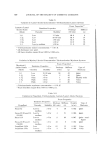
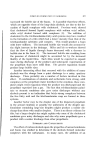
HAIR AND WOOL 78,5 Data for the moisture regain, determined under desorption conditions at 65% R.H. and under absorption conditions at 87% R.H., are given in Table VII. Only slight differences among the various fibers are seen. 4. Mechanical Properties--The data of Table VIII were obtained in single cycle force-extension tests to break on an Instron tensile tester, 2.54 cm fiber specimens being extended at 2.54 cm/min, the broken fibers being subsequently weighed on a torsion microbalance to establish their linear density. (As noted in Section III, A, 2, the Negro hair fibers are a different material from that used in the rest of the study.) The two hair samples behave very similarly the wool is stronger and more extensible--a finding in direct contrast to that in Table I. This strikingly illustrates the variability resulting from differences between samples and test procedures. 5. Diffusion of Reagents--Diffusion appears to be the rate-deter- mining step in the reduction of keratin by mercaptans (46) and by sul- rites (47). Thus, the rate of reduction may be used to compare the diffusion of the reagents in different fibers. The results of such measurements at 36 øC, using ammonium thio- glycolate at pH 9.3 and ammonium sulfite at pH 6.0, are given in Figs. 10 and 11. The two types of hair give practically identical curves, except for the slightly lower reduction level of Caucasian hair in the later stages of the reaction with thioglycolate the wool is reduced much more rapidly. When the data are considered in terms of the fraction of the disulfide bonds ruptured, the equilibrium is found to be somewhat higher for wool in the case of thioglycolate (Fig. 12) and identical for all three fibers in the sulfite experiment. 6. Rates of Reaction--The solubilities of the three fibers in the urea- bisulfite and the alkali tests are recorded in Table IX. As expected, the hair is more resistant to attack than wool in both media. In the UB test, a difference between the two hair types appears, the reasons for which are not clear. When the cystinc and cysteine contents of the residues from the tests were determined by the Zahn-Traumann method (45), the two hairs again behaved very similarly to each other and differently from the wool (Table X). The response to boiling dilute acid was measured by determining the weight change (a) in the acid exposure itself and (b) in subsequent alkali solubility test. The results, which are summarized in Table XI, again show a large difference between the hair and wool, with the two hair samples quite closely matched.
Purchased for the exclusive use of nofirst nolast (unknown)
From: SCC Media Library & Resource Center (library.scconline.org)