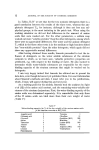
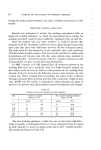
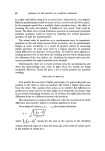
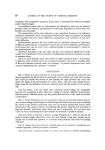
18 JOURNAL OF THE SOCIETY OF COSMETIC CHEMISTS Table XI Rank orders of the detergents in the various tests a b c d e __ Immersion Extraction of test Freeing of Permeation Patch (surface SH-groups test F.C.- test involved) amino positive acids material __ T• 3 5 3 3 3 2 T3 1.5 1 I I 1 1 T• 4 3 2 2 2 3 T 6 1.5 2 5 5 5 5 T o 5 4 4 4 4 4 From Tables X and XI it is apparent that none of the other tests give results that agree completely with those of the immersion test. Without any doubt there are two detergents that are least irritating in the immersion tests: T3, a nonionic condensate of isooctylphenol with 8-9 moles ethylene oxide, and T6, a pure fatty acid soap. Their agreement in the immersion test is as marked as their divergence in all the other tests. T 3 is not reactive in any of the other tests. T6, on the contrary, was between the two worst offenders in the patch test, it was top scorer in the permeation test, it hardly freed any sulphyhydryl groups, and ranked highest in extracting F.C.-positive material and amino acids. DISCUSSION After having stated so l nany hard facts, I cannot resist the temptation to speculate on their meaning. Since many subjects showed a true in- flammation in the immersion test, it is obvious that the toxic properties of the detergent for the living epidermis are important in determining the final effect of detergents under our experimental conditions. I agree com- pletely with Bettley (3) that the effect of a detergent on skin is caused by two important parameters: penetration through the barrier and toxicity for the living epidermis and cutis. When a detergent penetrates only a little, but is very toxic to living cells, the final effect surpasses that of a non-toxic detergent that penetrates easily. The discrepancies between the various tests might be attributed to the following fact s:

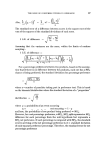
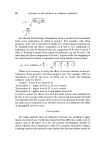
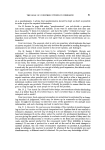
THE INTERACTION OF DETERGENTS AND THE HUMAN SKIN 19 1. Different classes of detergents damage the skin in different ways. 2. The final effect of a detergent on the skin is the product of penetration and toxicity. In our in vitro tests we measured only one parameter at a time. 3. The differences for the soap (T6) between the results of the patch tests (strong irritation) and the immersion tests (no irritation) might be explained in the following way: Blank and Gould (16) found that the sodium laurate soap irritates at pH 7.5, but not at pH 9.5. They state that at pH 7.5 free fatty acids are split off that penetrate more easily through the stratum corneum than soaps, because of their favourable water/ether partition coefficient. These readily-penetrating fatty acids are irritating to the living skin. This has also been shown during investigations on acne vulgaris. Smeenk was able to establish that in patch testing, a soap solution is neutralized, which may result in the splitting-off of fatty acids. In the im- mersion test on the other hand, the pH of the soap solution remains alka- line, with the result that no fatty acids are formed. 4. The in vitro tests are carried out under circumstances differing so greatly from what actually happens when living skin is exposed to deter- gents, that comparison is impossible. CONCLUSIONS Two questions posed at the beginning of my talk can now be answered. Detergents can irritate a normal skin. Obviously, Suskind's results are only valid for the detergents which he used and for his experimental conditions their application to all detergents under all conditions is not warranted. Furthermore, he studied the hands primarily. In our experiments the skin of the arms proved to be mure sensitive. The question of whether detergents may cause a chapped skin was also answered in the affirmative. It has been proved that under the same atmos- pheric conditions some detergents may cause a chapped skin, while others do not cause this condition. Summarizing our other results we can state that various tests considered for the evaluation of a detergent do not give results that concur with those obtained with the immersion test, which is the best simulation of-actual use. Finally, I have had an opportunity to tell you about effects we observed with respect to the washing out of water- soluble substances by various detergents from the skin, and the implications of this for the condition of the stratum corneum. I am not yet able to develop a comprehensive theory covering everything that happens in human skin exposed to washing procedure. Our next step in the study of
Purchased for the exclusive use of nofirst nolast (unknown)
From: SCC Media Library & Resource Center (library.scconline.org)