THE INTERACTION OF DETERGENTS AND THE HUMAN SKIN 9 against the loss of water from inside, and against the penetration of water from outside, was drawn from the observations that when one strips a skin of its horny layer by repeated applications of adhesive tape, the water loss does not vary greatly after a number of strippings but there is an abrupt increase in the loss of water through the epidermis the moment a con- spicuously glistening layer is reached. Szakall (11) postulated that only one particular layer in the stratum corneum acts as a barrier, but this con- ception has been criticized by Kligman and others. Concurring with Klig- man, we may safely state, that there is probably a barrier gradient of in- creasing resistance from above to below, corresponding to the increasing cohesiveness of the cells. It is another of Kligman's objections to much of the earlier experimental work on the stratum corneum, that there is a marked difference between the stratum corneum of the palms and soles, and that of the rest of the body. The horny layer of the palms and soles is much thicker, but, per unit of thickness, it is 100 to 200 times as porous as the stratum corneum of the abdomen. Unfortunately, much experimental work is done with the callus of the soles and then erroneously considered to apply to the rest of the stratum corneum. It has been known for some time that detergents may act in various ways on the skin. They may remove the lipid film from the surface of the stratum corneum, they may remove water-soluble substances, and they may react with the scleroproteins of the horny layer, causing an increase of the amount of free sulphydryl radicals. It is conceivable that detergents, by one or more of these mechanisms, could enhance the penetration of water and other substances, amongst them soaps, through the barrier zone. To test the effect of detergents on the skin, Bettley (3) tried to measure the penetration of potassium ions under the influence of soaps through the whole epidermis. He used two opposing Perspex chambers separated by cadaver epidermis. In one chamber the detergent under study is present with the addition of potassium chloride, in the other distilled water. The migration of potassium ions is measured. In doing so he made two assump- tions: 1. Once a substance has penetrated the barrier zone of the stratum corneum, the epidermis is no longer a serious obstacle. 2. The penetration of the K or Na ion (KC1 or NaC1 added to a soap solution) is a good parameter for the enhanced permeability of the stratum corneum. His experiments led to several interesting conclusions, e.g. sodium

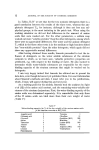
10 JOURNAL OF THE SOCIETY OF COSMETIC CHEMISTS laurate soaps enhance the penetration more than sodium lauryl sulphate and much more than Tweens. A second way to assess the action of detergents on skin is to determine the degree to which sulphydryl groups are liberated in keratin, a method proposed by van Scott and Lyon (13). A third is Vermeer's washing-simulation method. Vermeer et al (14) designed an apparatus by which a clearly defined area of skin can be washed under standard conditions of temperature, time, and washing strength, after which the washing solution is analysed with the Folin- Ciocalteu reagent. The same test is repeated after removing the non-soluble substances from the washing water by boiling with sodium hydroxide. As a rough measure of the action of detergents on skin, patch tests can be made. These certainly show whether there is a reaction in the form of irritation but, as in the other three methods, the results must be interpreted with great caution. The most reliable method of detecting the action of detergents without doubt is to give a detergent to panels of housewives for a certain length of time, with evaluation of the condition of their skin before and after this period. This method also offers difficulties, the greatest being that there are so many variables in the conditions under which the detergents are used that very large numbers of participants must be used. In another acceptable method volunteers immerse their arms daily for a given time in a solution of the detergent under investigation, the period of immersion and the concentration of the detergent being comparable to the average exposure of a housewife during the day. A similar method was used by Suskind (8). Many tests on experimental animals have also been proposed. These are discussed at length by Draize (14). He maintains that these animal tests are useful within certain limits. Skins of laboratory animals are, how- ever, dissimilar to human skin, e.g. because of the absence of a well- developed stratum corneum and the presence of many hair follicles, and such tests give only very rough information, in my opinion. In my department, my colleague Smeenk has made a comparison of the results obtained with a number of tests for nine detergents. At the same time, his aim was to assemble physiological data on the interaction of detergents and skin. The results have already been reported (15). At that time they could be summarized as shown in Tables H-IV.
Purchased for the exclusive use of nofirst nolast (unknown)
From: SCC Media Library & Resource Center (library.scconline.org)