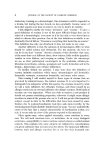
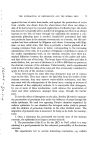
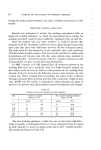
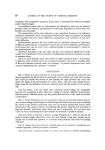
THE INTERACTION OF DETERGENTS AND THE HUMAN SKIN 11 Table II Products employed in tests T1. A sodium salt of alkyl benzene sulphonate with 12 C-atoms. Highly branched T2. A similar salt, unbranched, containing 10-13 C-atoms T 3. isoOctyl phenol condensed with 8-9 moles ethylene oxide T4. isoOctyl phenol condensed with 15 moles ethylene oxide T s. Sodium secondary alkyl sulphate with 8-18 carbon atoms in alkyl chain T 6. A pure fatty acid soap (Lux flakes) T 7. Sodium salt of sulphated ethoxylate of broad cut lauryl alcohol T 8. Coconut dimethyl amine oxide T 9. Sodium salt of sulphated broad cut lauryl alcohol anionic anionic nonionic nonionic anionic anionic anionic amphoteric anionic Table III Comparison of the results of three tests Low Intermediate Patch test T3 T4 T7 0.02 0.06 0.10 T2 T1 Ts 0.24 0.38 0.56 Permeation test T4 2.13 3.66 . Ts __ . 5.58 T• T2 T7 T9 7.15 7.28 8.06 8.09 Freeing of sulphydryl-groups High T 9 T 6 T s T 8 16.23 1.00 1.30 1.52 T6 34.95 T3 T s T 4 T 7 T s 0 0 0 0 Ts To 9 17 T• T2 26 22 Table IV Median values for amino nitrogen, "soluble proteins" and insoluble proteins in wash water (y/rail) Amino nitrogen Soluble proteins Insoluble proteins Dist. water 4.6 30.0 20.5 T• T 3 5.2 4.7 38.0 33.5 11.0 31.0 T5 T6 5.1 34.5 37.0 5.0 35.5 31.0 To each of the 3 sets of 6 x 24 determinations, the method of m-rankings of Friedman was applied. Amino acids: X2 (d.f. =5)= 3 (0.75 P 0.50) not significant "Soluble proteins": X2(d.f.=5)=30.4 (P•0.001) highly significant Insoluble proteins: XZ(d.f.=5)=24.1 (P0.01) highly significant.

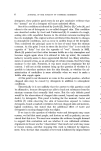
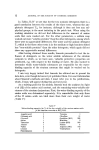
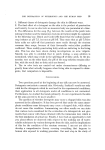
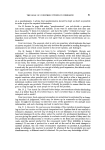
12 JOURNAL OF THE SOCIETY OF COSMETIC CHEMISTS In Tables II-IV we see that for the two nonionic detergents there is a good correlation between the results of the three tests, whereas the am- photeric detergent T 8, for instance, although it does not free any sul- phydryl groups, is the most irritating in the patch test. When using the washing simulator we did not find differences in the amount of amino acids that were washed out. For the other parameters, a sodium soap washed out more "soluble proteins" than the other detergents, among which there were no appreciable differences. The water and the anionic detergent T 1 which in the three other tests is in the medium or high brackets eluted less "non-soluble proteins" than the other detergents, which again did not show any appreciable mutual differences. After having obtained these results, Smeenk proceeded to test the in- fluence of detergents on the water soluble substances of the stratum corneum to which, as we have seen, valuable protective properties are attributed, e.g. with respect to the binding of water. He also wanted to determine which water-soluble substances are responsible for the water- binding capacity of the stratum corneum that might be washed out by detergents. I am very happy indeed that Smeenk has allowed me to present his data here, even though he has not yet published them. For exact information about Smeenk's methods and data I must refer you to his publications, which, I hope, will appear during this and next year. As a starting point for his models, Smeenk took the analyses by Spier et al (12) of the amino acid content, and the remaining water-soluble sub- stances of the stratum dysjunctum. First, the water-binding capacity of the amino acids was determined separately. It is remarkable that only three of the 17 amino acids can bind more than their own weight of water (Table V): Table V Water-binding capacity (in •o of the dry weight) of the various amino acids •of the stratum corneum at 95 •o R.H. Aspaffcic acid 1 Tyrosine 1 Glutamic acid 0 Citrulline 11 Glycocoll 7 Ornithine (HC1) 225 Serine 1 Histidine 2 Threonine 2 Lysine (HC1) 243 Alanine 1 Proline 2 Valine 2 Arginine (HCI) 142 Leucine 1 Tryptophane 2 Phenylalanine 0
Purchased for the exclusive use of nofirst nolast (unknown)
From: SCC Media Library & Resource Center (library.scconline.org)